


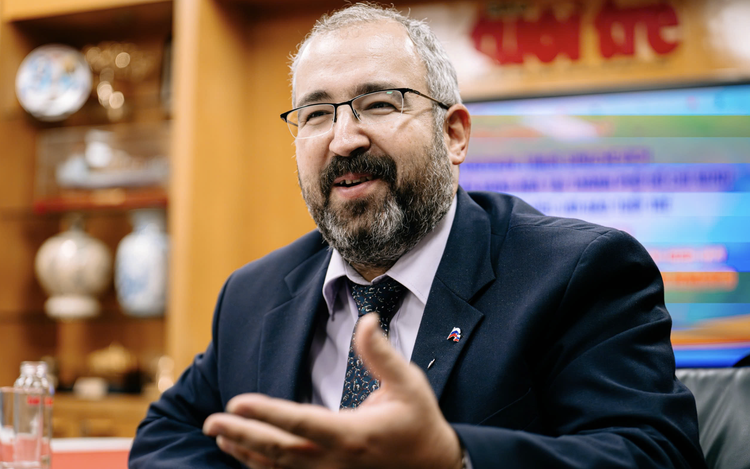
Russian Consul General in Ho Chi Minh City Sadykov Timur Sirozhevich during an interview while visiting the headquarters of Tuoi Tre (Youth) newspaper. Photo: Thanh Hiep / Tuoi Tre
In spite of profound geopolitical shifts around the world, Vietnam-Russia ties have continued to demonstrate remarkable resilience, supported by a foundation of friendship built over generations.
Russian Consul General in Ho Chi Minh City Sadykov Timur Sirozhevich strongly believes that the enduring strength of bilateral ties stems not only from a shared past but also from emerging areas of partnership that promise to shape the future.
Historical legacy seen as lasting foundation
Vietnam and Russia marked the 75th anniversary of diplomatic relations in 2025.
Yet, Sadykov said that the connection between the two sides dates back more than a century, when late-President Ho Chi Minh traveled to Saint Petersburg and drew inspiration from revolutionary ideas and lessons in independent nation-building.
During the war years, Russia provided military equipment and dispatched experts and advisers to support Vietnam's struggle for national independence.
Following national reunification, thousands of Russian specialists, engineers, construction workers, doctors, teachers were sent to Vietnam, making a significant contribution to the post-war reconstruction.
Hundreds of factories, roads, bridges, schools, hospitals and research centers were built with Russian assistance.
In the 1980s, Russian specialists first discovered oil in Vietnam, and a joint venture Vietsovpetro was established in Vung Tau, laying the foundation for Vietnam's oil and gas industry.
Besides, tens of thousands of Vietnamese students received higher education at universities in Russia, creating a generation of professionals who became an integral part of the shared heritage between the two nations.
New opportunities for cooperation
While history remains the cornerstone of bilateral relations, people-to-people exchanges are increasingly emerging as a powerful growth driver.
Following the removal of COVID-19-related restrictions, relations between the two countries rebounded rapidly and surpassed pre-pandemic levels.
Vietnam welcomed some 280,000 Russian visitors in 2024.
Just one year later, the figure rose to 600,000, including more than 500,000 arrivals in Khanh Hoa Province alone.
Sadykov expects the number of Russian tourists visiting Vietnam to reach at least one million this year.
Meanwhile, the number of Vietnamese travelling to Russia is also growing proportionately.
Cultural ties are also gaining momentum.
As part of the cultural cooperation program for the 2025-27 period, the Vietnam Festival was held in Moscow last summer, while the Days of Moscow took place in Ho Chi Minh City in December last year.
The educational sphere is very promissing, with 2026 declared the Year of Russian-Vietnamese cooperation in science and education.
Accordingly, student exchanges and direct links between leading Russian and Vietnamese universities are currently intensifying.
Economic cooperation spans various fields such as manufacturing, logistics, agriculture, telecommunications, finance, and banking.
According to Sadykov, Russia is particularly interested in Vietnam’s economic development experience, especially its efforts to build a modern socialist-oriented economy that combines planned economy with market mechanisms.
“During my time in Vietnam as consul general, I have witnessed the rapid transformation of the Vietnamese economy, the emergence of entirely new industries and innovative approaches to developing the traditional ones,” Sadykov told Tuoi Tre (Youth) newspaper.
Such an experience attracts Russia’s interest, particularly as the global economic system, logistics networks, and patterns of production redistribution continue to evolve.
Energy has emerged as one of the most important pillars of cooperation.
Aside from traditional collaboration in the oil and gas sector, both sides are placing special emphasis on nuclear power.
Preparations are underway for the construction of Vietnam's first nuclear power plant which will help ensure the country's complete energy independence.
The two nations also attach great significance to science and technology.
Joint research programs are being carried out in such fields as physics, materials science, biology, ecology, chemistry, and medicine.
The Joint Vietnam - Russia Tropical Science and Technology Research Center continues to serve as a key platform for scientific collaboration, while researchers from both countries regularly conduct joint studies on marine ecosystems and biological resources.
Cooperation in digital technologies and cybersecurity is also opening new prospects in healthcare and education.
“Despite the constant fluctuations in the global political situation, I am confident in the unwavering commitment of our countries' leadership to maintaining not just a strategic partnership, but fraternal relations.
“I would like to quote Russian President Vladimir Putin: Our countries, relying on the best traditions of friendship, mutual trust and mutual assistance, will achieve all of our large-scale goals,” he said.
Ho Chi Minh City in Russia cooperation vision
The Russian consul general described Ho Chi Minh City as Vietnam’s leading industrial and financial hub and a key engine of national growth.
Russia welcomes the city’s ambition to become a global center for innovation, high technology, and finance.
A number of Russian regions and cities, including Moscow, Saint Petersburg, Vladivostok, Buryatia, Yakutia, Kaluga, Novosibirsk, and Sverdlovsk, Yekaterinburg, and Nizhny Novgorod have already maintained relations with Ho Chi Minh City.
Meanwhile, other regions have also expressed interest in establishing closer ties.








Max: 1500 characters
There are no comments yet. Be the first to comment.