


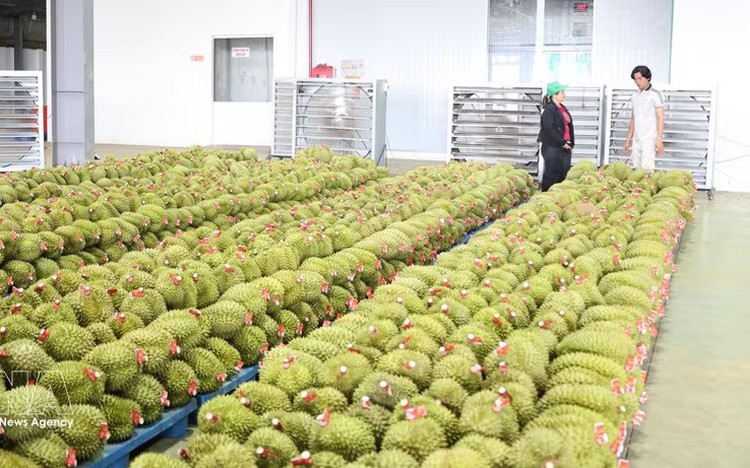
Dong Nai city plans to achieve a durian production target of 360,000 tonnes by 2030. Photo: VNA
Expanding the billion-dollar product portfolio
According to Dinh Cao Khue, Vice Chairman of the Vietnam Fruit and Vegetable Association (Vinafruit), Chairman and General Director of Dong Giao Export Food Joint Stock Company (Doveco), beyond key export products, several other fruits are showing strong potential to become high-value commodities.
Passion fruit, pineapple and banana are notable examples of how the application of science and technology, proactive seed supply and market-oriented production organisation can deliver results.
He said that around five years ago, domestic passion fruit production remained fragmented and struggled to compete with South American producers such as Peru and Ecuador. However, with support from the Fruit and Vegetable Research Institute and universities, Vietnam has developed its own supply of disease-free planting materials, replacing imported varieties from Taiwan (China).
This has improved productivity and expanded exports to various markets, including the US and South America, particularly Brazil, the world's third-largest passion fruit producer.
For pineapple, the shift from the Queen variety, with yields of around 50 tonnes per hectare, to Cayenne at 70 tonnes per hectare, and now MD2 at 100 tonnes per hectare, has enhanced competitiveness and enabled producers to meet demand for both fresh fruit and industrial processing.
According to Khue, revenue from one hectare of MD2 pineapple can reach 900 million VND to 1 billion VND (38,757 USD), while passion fruit generates at least around 500 million VND, highlighting their potential to develop into high-value export commodities.
The development of the banana industry also demonstrates considerable room for value growth.
Pham Quoc Liem, Vice Chairman of Vinafruit and General Director of U&I Agriculture Corporation (Unifarm), said the banana sector should focus not simply on expanding cultivation areas but on standardising growing areas, improving marketable yields and product quality, and developing higher-value markets.
According to the company's estimates, Vietnam will need to standardise around 24,000 hectares of export-compliant banana growing areas, while improving productivity and selling prices, to raise the banana export turnover to 1 billion USD.
Further ahead, if 30% of the country's existing banana-growing area were brought up to standard, export revenue from the fruit could exceed 2 billion USD, he said.
Restructuring production chains to increase export value
To achieve the 20 billion USD fruit and vegetable export target, a key priority is to develop concentrated raw-material growing areas of sufficient scale, with consistent quality and stable supplies for processing and exports.
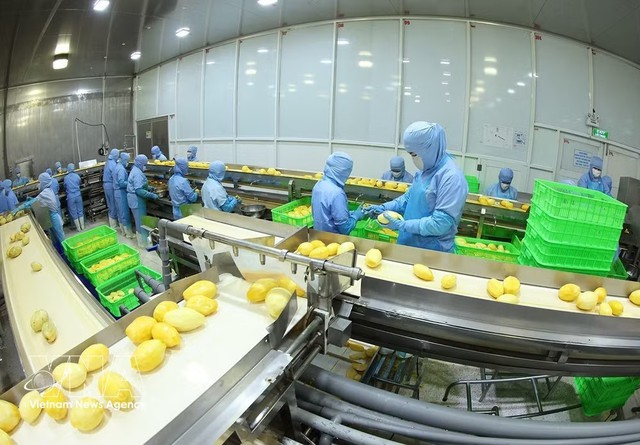
A processing line for frozen mango products for export at the factory of An Giang Fruit and Vegetable Foodstuff Joint Stock Company in Chau Phu commune, An Giang province. Photo: VNA
In the Mekong Delta, Westfood Hau Giang Joint Stock Company has partnered with local producers to develop more than 300 hectares of MD2 pineapple plantations on acid-sulphate and grey soil areas in Can Tho, An Giang and Dong Thap.
Tran Ba Son, Director of the company's raw-material growing area division, said demand for processing materials was substantial. The company aims to expand its MD2 pineapple growing areas to around 1,000 hectares by 2030 to ensure supplies for long-term export orders.
To develop large-scale raw-material areas, Khue called on the Ministry of Agriculture and Environment and local authorities to pay greater attention to planning, infrastructure investment and production organisation.
His company plans to break ground on a major processing plant in the central province of Nghe An, with a capacity of 30 tonnes of products per hour, equivalent to around 60,000 tonnes annually. The plant is expected to purchase pineapples from growers across the area stretching from Nghe An to Quang Tri.
The region has harsh climatic conditions and is frequently affected by storms and heavy rains, but its natural conditions are suitable for pineapple cultivation.
According to Liem, each promising fruit and vegetable product should have at least one enterprise-led partnership model linking businesses with cooperatives and farmers to develop standardised raw-material growing areas.
The State should play an enabling role through policy development, coordination and support, including preferential credit policies tied to production partnership contracts.
Alongside production organisation, science and technology should be applied comprehensively, from plant varieties and cultivation to processing and post-harvest preservation.
Research institutes and universities need to work more closely with businesses in research and technology transfer, Khue said, adding post-harvest technology and processing are other areas requiring commensurate investment.
According to Liem, agricultural pre-processing, packaging and storage facilities are increasingly required to meet stringent standards for food safety, quality control and traceability, including Good Manufacturing Practice (GMP), Hazard Analysis and Critical Control Points (HACCP), and ISO 22000.
If infrastructure is not suited to production technology and the scale of raw-material growing areas, post-harvest operations could become a bottleneck, driving up costs and reducing the ability to fulfil export orders, he stated.
It is therefore necessary to improve regulations to allow the construction of agricultural pre-processing, packaging and storage facilities directly serving production on agricultural land, at scales appropriate to technological requirements, while ensuring environmental standards and compliance with land-use purposes, he noted.
In addition, investment in irrigation systems for fruit-growing areas needs greater attention.
Khue noted that current irrigation investment programmes primarily focus on rice cultivation, while fruit trees also require support to secure water supplies and stabilise production, particularly in areas frequently affected by climate change.


Max: 1500 characters
There are no comments yet. Be the first to comment.