



Within 24 hours of its online release in 2021, drama 'Bo Gia' (Dad, I’m Sorry) by Tran Thanh was illegally streamed on 10 piracy websites. Photo: Production team
Official Dispatch No. 38 directs intensified nationwide efforts to prevent and strictly handle violations, particularly during a peak enforcement period from May 7 to 30.
At a roundtable organized by Tuoi Tre (Youth) newspaper, experts from multiple fields contributed proposals aimed at building a more transparent, fair, and competitive creative and digital economy, while also enhancing Vietnam’s international reputation.
Film piracy cannot be handled in isolation
Dang Tran Cuong, director of the Cinema Department, said combating film piracy cannot rely on isolated takedowns of individual websites.
He stressed the need for synchronized legal, technical, and inter-agency measures, along with stronger public awareness of lawful content consumption.
He also called for the development of high-quality, affordable, and convenient legal streaming platforms to encourage users to shift away from piracy.

Hoang Cong Cuong argues that copyright theft should not be called 'reference' or 'inspiration.' Photo: Facebook
The Department of Cinema plans to continue coordinating with relevant agencies to update lists of infringing websites, while also working with advertising companies and digital intermediaries to reduce ad placements on piracy platforms.
In response to the growing influence of artificial intelligence, the department will cooperate with technology firms to improve automated detection of copyright violations online.
It will also work with film distributors, cinemas, and legitimate streaming platforms to detect and prevent illegal recording and distribution of films.
Nguyen Hai Binh, vice-chairman of the Vietnam Copyright and Creativity Association, proposed three core solutions for copyright protection.
First, promoting legal cultural consumption through incentive mechanisms, such as digital identity–based cultural credit systems and programs encouraging the purchase of books, tickets, music, and film services.
Second, transforming copyright into investable assets by standardizing data on ownership, licensing rights, territorial scope, revenue history, and other legal attributes.
This would allow creative works to be valued, transferred, used as capital contributions, or integrated into investment structures.
Third, ensuring fair competition between domestic companies and cross-border platforms operating in Vietnam, requiring foreign platforms to meet equivalent standards when exploiting the Vietnamese market.
Digitizing copyright protection
Stage director Hoang Cong Cuong underlined the need to digitize copyright protection procedures to replace slow and paperwork-heavy processes.
He proposed developing a dedicated app allowing creators and organizations to register copyright online, receive digital certification, and store creative process data as evidence in case of disputes.
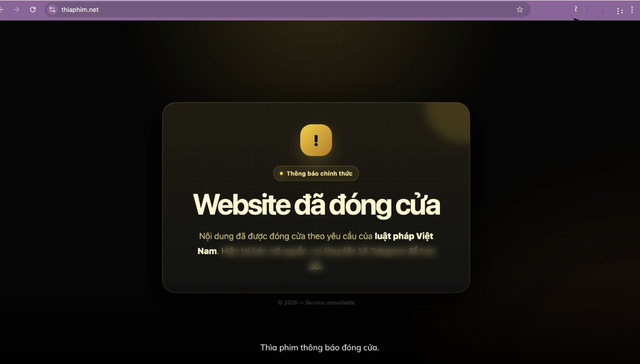
A screenshot shows an illegal streaming website shutting down after Prime Minister’s Official Dispatch No. 38.
The system would allow authorities to digitally verify and certify creative works, including scripts, visuals, music, choreography, and costumes, while also maintaining secure records of creative development materials.
He also suggested strengthening automated detection systems similar to those used by major digital platforms such as YouTube and Facebook, as well as enhancing censorship and inspection roles before granting performance approvals.
In serious cases, he proposed temporary or permanent bans from professional activity for repeat offenders.
Lawyer Hoang Ha proposed that authorities should target financial flows behind piracy networks, including advertising revenue, payment accounts, affiliate marketing systems, intermediaries, and ultimate beneficiaries, rather than only removing links or websites.
He also suggested improving evidence collection procedures to address challenges such as deleted content, anonymous accounts, and overseas server storage.
He called for increasing the responsibility of intermediary platforms by requiring rapid takedown mechanisms, account suspension for repeat offenders, and data sharing with authorities.
Ha proposed clearly differentiating levels of violations, with administrative penalties for minor cases and criminal prosecution for organized, large-scale, or profit-driven infringement.
Stronger tools for rights holders are needed, including fast-response reporting channels, standardized documentation, and defined handling timelines.
He also called for a national interlinked database of repeat offenders, domains, accounts, warehouses, and entities involved in intellectual property violations to improve enforcement efficiency.
Participants agreed that stronger intellectual property protection is essential to improving Vietnam’s investment environment, supporting cultural industries, and developing the digital economy.








Max: 1500 characters
There are no comments yet. Be the first to comment.