


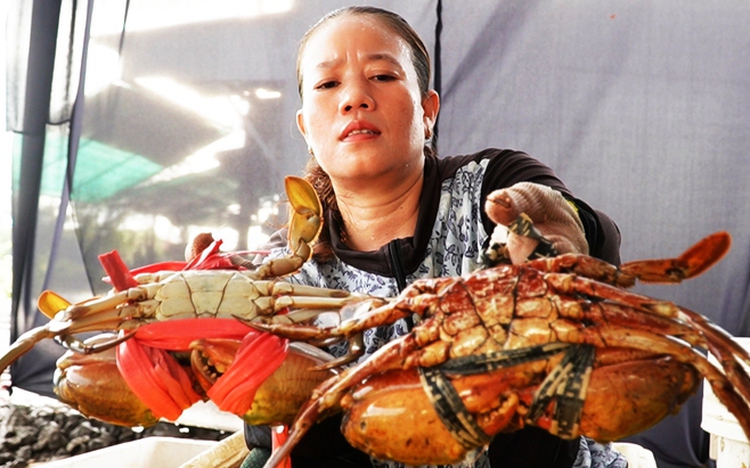
A woman holds two oversized ‘sumo’ crabs farmed in Ca Mau Province, the southernmost locality in Vietnam. Photo: Thanh Huyen
Nguyen Viet Bac, a lecturer at Ca Mau Community College, presented his ‘sumo’ crabs project in the final round of the contest on Sunday.
The annual event, organized by the provincial Startup Support Steering Committee in collaboration with the local Department of Science and Technology, was held under the theme ‘Innovative Startup – Green Aquaculture – Sustainable Development.’
Bac’s initiative features an integrated model linking broodstock production, technology transfer, and product distribution to strengthen the local crab-farming sector.
The project’s core strategy is to select superior genetic sources from large marine crabs weighing about 500bgrams each and to cross-breed square-flap female crabs over 300 grams with males of 500-600 grams to produce roe-bearing females of more than 500 grams for breeding.
The broodstock development process follows biological standards and incorporates ozone and microbial technologies during the nursery stage to improve growth rates and survival among juvenile crabs.
This initiative not only aims to sustainably increase the size of Ca Mau’s farmed crabs but also helps reverse broodstock decline.
A key innovation is the use of colored LED lighting during the larval phase to control the sex ratio and promote optimal growth and weight gain in the crabs.
According to the project team, the technology allows farmers to adjust the gender mix to optimize seasonal profits, such as increasing the proportion of females harvested during Lunar New Year for higher returns.
The team also noted strong demand in Ho Chi Minh City for oversized crabs and added that crabs weighing 600 grams or more are ideal for export to Singapore.
In addition to providing high-quality broodstock, the project offers technical consulting and feed solutions to help farmers achieve their target weights.
After nearly a year of implementation, the ‘sumo’ crabs model has delivered encouraging results and is moving toward registration for geographical indication and One Commune One Product (OCOP) certification.
Alongside Bac’s initiative were nine other notable projects selected for the final round of the fourth edition of the competition.
These included ‘Hat vang,’ a vegetable oil produced through a green-cycle model and linked to e-commerce; ‘Bana.T,’ which repurposes banana-based products; and ‘BeTram,’ a line of fermented honey.
The five projects in the final round are scheduled to be announced at the closing and awards ceremony of the contest on Monday.








Max: 1500 characters
There are no comments yet. Be the first to comment.