


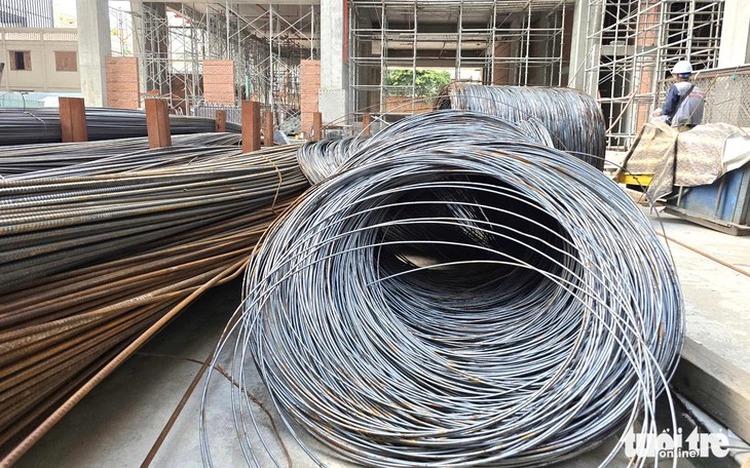
Vietnam’s steel market maintained positive growth momentum in the first half of 2026, reflecting a strong recovery in domestic demand fueled by public investment, infrastructure development and a gradual revival in the real estate sector. Photo: Cong Trieu / Tuoi Tre
The expansion far outpaced growth of 11.4 percent in manufacturing and 9.51 percent in construction, according to the Vietnam Steel Association, or VSA.
Vietnam also strengthened its position in the global steel industry, remaining among the world’s 10 largest crude steel producers.
Domestic crude steel consumption climbed 25.5 percent to 14.81 million metric tons as demand strengthened for products used in construction and industrial manufacturing, particularly construction steel and hot-rolled coil.
However, the industry’s performance was mixed across product segments.
Steel exports rose about 17 percent in June, improving the sector’s second-quarter performance following a weaker start to the year.
By contrast, coated steel and cold-rolled steel recorded declines in both production and sales. Coated steel output fell 14.4 percent, while cold-rolled steel production declined 6.2 percent.
The downturn reflected weaker global demand and growing pressure from trade-remedy measures imposed on Vietnamese steel products.
Trade deficit, green barriers remain key challenges
Although exports have remained strong in markets including ASEAN, the European Union, the U.S. and India, the VSA said the industry continues to run a trade deficit.
Vietnam currently imports 7.8 million metric tons of iron and steel worth US$5.6 billion, while exporting 5.5 million metric tons of finished steel valued at $3.7 billion.
The resulting trade deficit stands at about 2.3 million metric tons, equivalent to $1.9 billion.
The year 2026 is also expected to see a surge in increasingly complex trade-remedy measures worldwide.
Vietnam’s steel industry is facing stricter requirements on sustainable development, carbon emissions reductions and, in particular, the Carbon Border Adjustment Mechanism, or CBAM, in major markets.
To sustain growth and improve competitiveness, experts said the industry needs to make effective use of the 19 free trade agreements (FTAs) Vietnam has signed.
Investment in modern technology, a shift toward green steel and a higher localization rate for raw materials will also be critical for Vietnamese companies to overcome technical barriers and strengthen their position in international markets.








Max: 1500 characters
There are no comments yet. Be the first to comment.