


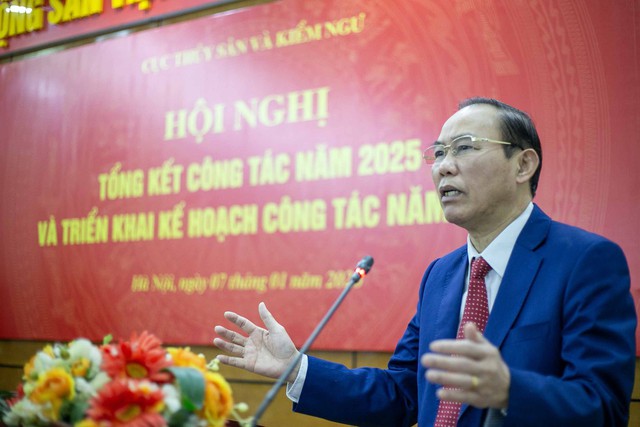
Vietnamese Deputy Minister of Agriculture and Environment Phung Duc Tien speaks at a conference held in Hanoi on January 7, 2026 to review the fisheries sector’s performance in 2025 and discuss targets for 2026. Photo: Chi Tue / Tuoi Tre
The targets were unveiled at a conference held in Hanoi on Wednesday to review the fisheries sector’s performance in 2025 and discuss targets for 2026.
Tran Dinh Luan, director general of the directorate, said effective production management was a highlight of 2025, helping the sector reach a total output of 9.95 million metric tons — two percent above the year’s target and three percent higher than in 2024.
Of this total, aquaculture accounted for 6.1 million metric tons and capture fisheries made up the remainder.
Key aquaculture species, such as Vietnamese tra fish (pangasius) and shrimp, recorded strong growth in both output and exports in 2025, boosting their export value compared with the previous year.
Marine species and tilapia also began finding new market opportunities, alongside other notable developments in the sector.
Thanks to these results, fisheries exports in 2025 reached $11.32 billion, up 7.8 percent from the year’s target and 12.7 percent from 2024, Luan said.
“The sector is clearly moving in the right direction, focusing on efficient production, deep processing, value-added products, and circular economy practices that have strengthened supply chains for both production and export,” he added.
Looking ahead, the industry targets a fisheries output of more than 10 million metric tons in 2026, up 0.5 percent from 2025, with capture fisheries expected at 3.75 million metric tons, down 2.1 percent, and aquaculture projected at 6.25 million metric tons, up 2.2 percent.
This plan continues to reflect the sector’s strategy of reducing capture fisheries while expanding aquaculture.
Export earnings are set to reach around $11.5 billion this year, up about 1.6 percent from 2025.
Luan noted that the sector will continue to face challenges, including the EU’s ‘yellow card’ warning on illegal, unreported and unregulated (IUU) fishing, increasingly severe storms and floods, and signs of pollution in some farming areas.
“These challenges require flexible management. Early in 2026, we will hold conferences on key species, such as shrimp and pangasius, with local authorities to ensure sustainable growth and a steady supply of raw materials for processing and export,” he said.
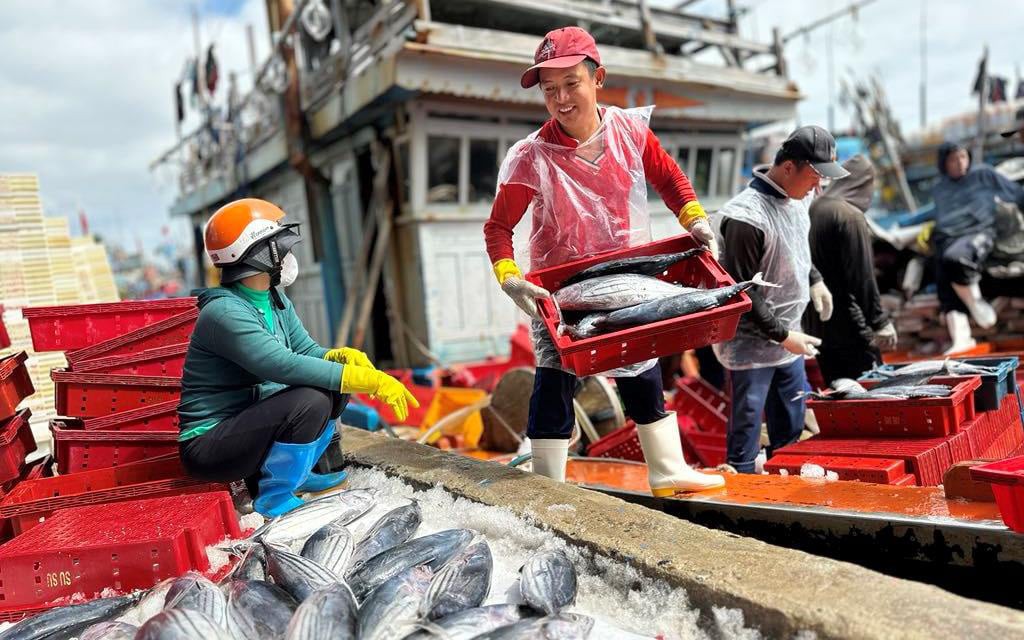
Nguyen Hoai Nam, general secretary of the Vietnam Association of Seafood Exporters and Producers, said global markets are demanding higher standards, with capture fisheries products required to be legally sourced and farmed products to carry certified farming area codes.
He underscored that issuing such codes is still affected by planning and administrative procedures.
Nam recommended that the directorate continue supporting businesses to remove bottlenecks, accelerate implementation, and promote digital certification and verification for seafood products.
Concluding the conference, Deputy Minister of Agriculture and Environment Phung Duc Tien highlighted that despite domestic and global challenges, the fisheries sector achieved comprehensive successes last year in production, exports, technology, and processing.
Looking to 2026, he said the industry must pursue breakthrough solutions in aquaculture, focusing on breeding, marine and reservoir farming, and wider adoption of technology and digital transformation.
For exports, he insisted on addressing barriers arising from the U.S. Marine Mammal Protection Act, promoting key products including tilapia, and expanding access to European and UK markets.








Max: 1500 characters
There are no comments yet. Be the first to comment.