


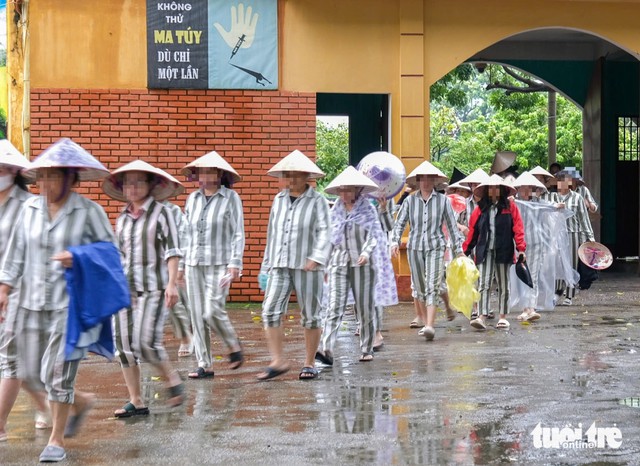
Prisoners at a detention facility in Vietnam. Photo: Ha Quan / Tuoi Tre
The new law is seen as a humanitarian measure balanced with strict discipline.
It expands communication rights by adding video calls alongside traditional phone calls.
Prison wardens will decide whether to allow calls and supervise them.
The law retains the existing provision allowing prisoners to send two letters per month.
Prison wardens are required to inspect and censor all incoming and outgoing correspondence.
All communication costs must be paid by the prisoners.
The Ministry of Public Security and the Ministry of National Defense will issue detailed regulations.
A related Defense Ministry circular, also effective July 1, 2026, outlines communication rules for prisoners in military detention facilities.
These facilities will be equipped with secure Internet-based systems to enable video calls.
Prisoners must register their relatives’ contact information, while family members participating in a video or phone call must also provide sufficient personal information to verify their identity, confirm their relationship with the prisoner, and declare the expected duration of the communication
Prisoners are limited to one phone or video call per month, with each lasting no more than 10 minutes.
Inmates who receive official commendations for good behavior may be rewarded with one additional phone or video call each month, also limited to 10 minutes.
The law also introduces a new provision permitting prisoners to donate organs or tissue to relatives under strict conditions.
Donations must be voluntary, medically safe, and permitted only for inmates convicted of less serious or first-time serious crimes with less than three years remaining on their sentence.
Prisoners must cover all medical and health care costs related to the donation.








Max: 1500 characters
There are no comments yet. Be the first to comment.