


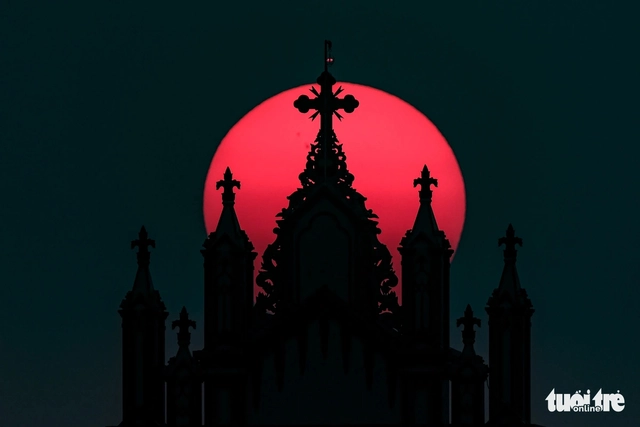
The ‘blood moon’ at Xuong Dien Beach in the former Nam Dinh Province, now part of Ninh Binh Province in northern Vietnam. Photo: Nam Tran / Tuoi Tre
During the eclipse, the moon will turn a striking copper-red instead of its usual yellow glow.
The entire event lasts five hours and 42 minutes, with the total phase when the moon is fully immersed in the earth’s shadow lasting 82 minutes.
The timeline of the eclipse is as follows:
- 3:43 pm: Penumbral eclipse begins (not visible in Vietnam)
- 4:50 pm: Partial eclipse begins (not visible in Vietnam)
- 6:03 pm: Total eclipse begins
- 6:34 pm: Maximum eclipse
- 7:03 pm: Total eclipse ends
- 8:18 pm: Partial eclipse ends
- 9:25 pm: Penumbral eclipse ends
In Hanoi, the moon will rise at 5:57 pm, just minutes before the total eclipse begins.
Most provinces in the country will see the moon rise before the total phase starts, except for Dien Bien, Lai Chau, western Son La, Ca Mau, and An Giang, where the moon will rise 3-6 minutes after the eclipse has already begun.
The phenomenon can be observed directly with the naked eye, without telescopes or binoculars.
However, clear skies are essential.
Rain, thunderstorms, or heavy clouds will block visibility.
Observers are advised to choose wide-open areas with minimal artificial light interference.
The Hanoi Astronomical Society said that this is the only total lunar eclipse of 2026, and the only one in nearly three years.
Those who miss it will have to wait until the night of December 31, 2028, stretching into January 1, 2029, for the next chance to see the moon bathed in red.








Max: 1500 characters
There are no comments yet. Be the first to comment.