


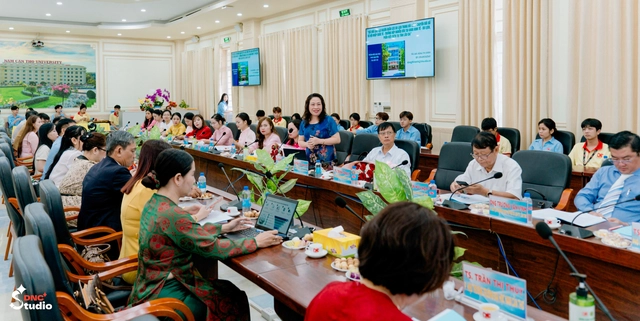
A view of the 'Tourism Human Resource Training in the Digital Era' conference in Can Tho City, southern Vietnam. Photo: Pham Diem / Tuoi Tre
The conference was held at Nam Can Tho University, with experts, academics, tourism businesses, and management agencies discussing ways to improve tourism training as artificial intelligence (AI) and digital technologies rapidly reshape the industry.
Tourism sector faces annual shortage
Vietnam welcomed nearly 21.2 million international visitors and about 135.5 million domestic tourists in 2025, generating more than VND1 quadrillion (US$38.41 billion) in tourism revenue.
The Mekong Delta received more than 63.3 million tourists last year, including 3.6 million international visitors, generating more than VND80 trillion ($3.07 billion) in tourism revenue.
However, the sector's rapid growth is also creating pressure on its workforce, with demand for new workers roughly twice the current supply.
Workers with university or postgraduate qualifications account for only about 10 percent of the tourism workforce, while most others have elementary, intermediate or college-level qualifications or lack formal professional training.
At the same time, employers are increasingly seeking skills beyond traditional tourism operations, including customer data analysis, hotel management systems, online distribution channels, digital marketing, and AI applications.
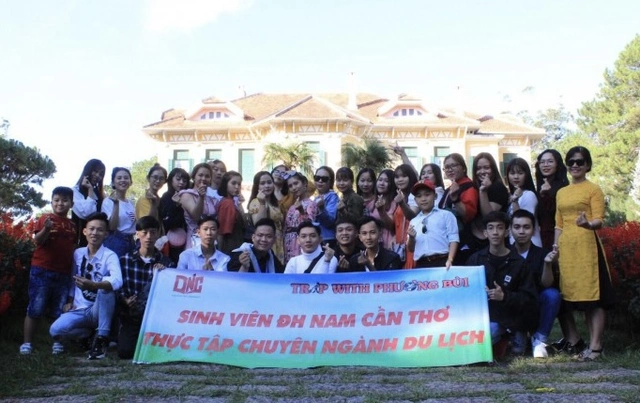
Tourism and hotel and restaurant management students at Nam Can Tho University during an internship. Photo: Archives
Experts propose 'five-integration' model
Dr. Dang Thi Oanh of Thai Nguyen University in Lao Cai Province, northern Vietnam argued that digital transformation and international integration require tourism workers to develop professional expertise, digital skills, foreign-language proficiency, and creative thinking.
To address these changing requirements, she proposed a 'five-integration' model combining professional expertise with digital technology, universities with businesses, training with local practices, domestic knowledge with international standards, and vocational training with innovation.
The model would help students use AI and digital tools responsibly while preserving local cultural values, Oanh said.
She also called for changes in tourism training programs, saying the reform should begin with lecturers.
Some programs remain focused on traditional professional theory and have not kept pace with changing market requirements, She added.
Dr. Tran Huu Hiep, vice-chairman of the Mekong Delta Tourism Association, proposed a broader 'digital-era tourism human resource management ecosystem' involving management agencies, universities, businesses, tourism associations, and students.
Students should develop digital and foreign-language skills and maintain a lifelong-learning mindset to adapt to the labor market during 2025-30, Hiep said.
Businesses seek greater role in training
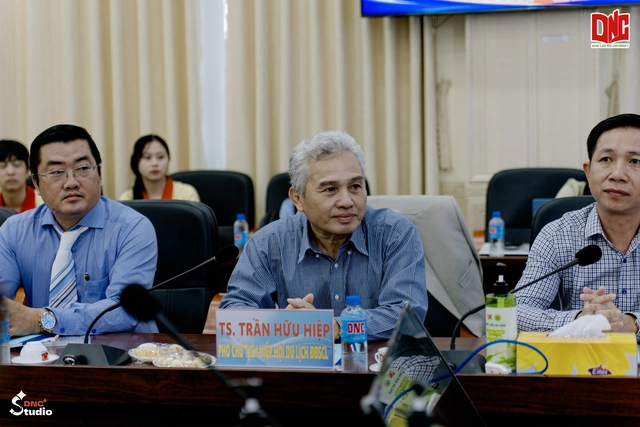
Dr. Tran Huu Hiep, chairman of the Mekong Delta Tourism Association, speaks at the conference. Photo: Pham Diem / Tuoi Tre
Ngo Van Lieu, general manager of Tru by Hilton Can Tho, said businesses have to retrain about 50 percent of the skills required by new employees, with technology adaptation one of the main areas requiring additional training.
They need workers who understand tourism operations while also being able to use digital tools and AI, including for digital marketing, online sales management, demand analysis, and customer service.
According to Lieu, closer cooperation with universities could help narrow the gap.
"Businesses are ready to work with universities to co-create training programs, receive students for business semesters, and bring practical experience into teaching," he said.
Such cooperation would help students meet graduation requirements and enter the workforce with practical skills, Lieu added.








Max: 1500 characters
There are no comments yet. Be the first to comment.