


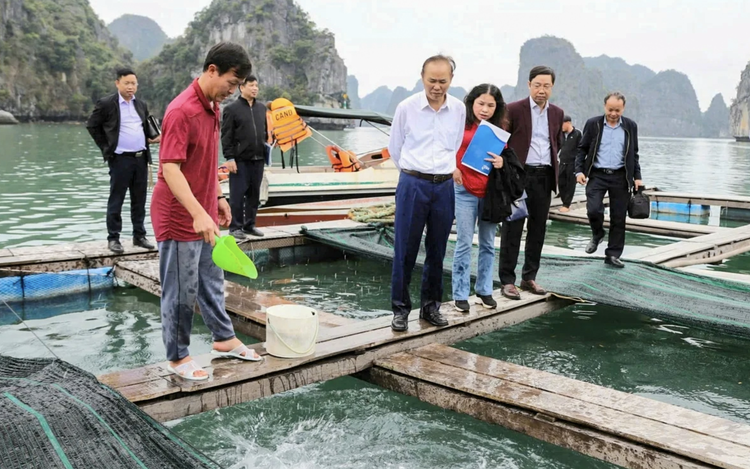
Deputy Minister of Agriculture and Environment Phung Duc Tien (in white shirt) inspects amberjack and croaker farming operations in Vietnam. Photo: Dinh Muoi
Tran The Muu, deputy head of the academy, told a press briefing held by the Ministry of Agriculture and Environment on Monday that identifying suitable, high-value marine species is critical for the sector’s next phase of development.
“Traditional farmed species for domestic consumption already have stable supply chains,” he said.
The nation now needs to shift toward species with strong export potential, he underlined.
In recent years, the academy has focused research efforts on species such as pompano, croaker, and amberjack.
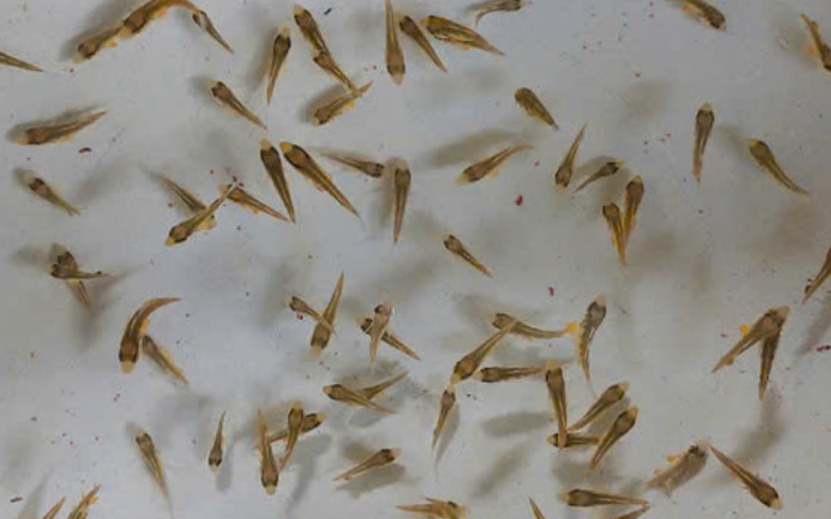
While breeding and farming technologies for pompano are largely complete, work on croaker and amberjack has reached the stage of hatchery production and pilot farming models.
“We conducted a pilot by farming a cage of amberjack on Cat Ba Island, Hai Phong City, northern Vietnam," Muu said.
“After about eight months, the fish grew very well, reaching nearly one kilogram.
“However, the survival rate has not met expectations. We are continuing to study the farming environment and refine husbandry processes to improve survival rates."
Amberjack and croaker are considered premium species with strong demand in markets such as China, Taiwan, Japan, and Singapore.
In the coming period, the academy will focus on perfecting farming techniques for the two species in order to scale up production and generate sufficient output for export.
Exploring tuna farming as long-term goal
Nguyen Quang Hung, deputy head of the Directorate of Fisheries, said Vietnam will continue to prioritize traditional species such as grouper, seabass, pomfret, and lobster, given their proven farming technologies and reliable seed supply.
Besides, the nation is exploring the introduction and domestication of new high-value species popular in major seafood markets.
Hung highlighted oceanic tuna as a potential candidate.
Previous research involved capturing juvenile tuna weighing 3-4 kilograms in offshore fishing grounds near Vietnam's Hoang Sa (Paracel) and Truong Sa (Spratly) archipelagos, then transferring them to Nha Trang Bay for grow-out to commercial sizes of 50-60 kilograms.
“If we can successfully produce tuna juveniles and farm them at scale, it would significantly reduce pressure on wild fisheries,” Hung said, noting that the technical challenges remain substantial.
The press briefing was held to introduce the upcoming National Conference on Fisheries Science, Technology and Surveillance 2026, scheduled to take place from April 27 to 28 at the Saigon Exhibition and Convention Center in Ho Chi Minh City.
The conference is expected to gather together around 300 policymakers, scientists, and representatives from firms, international organizations, and fishing communities.
It will feature plenary sessions, specialized panels, and an exhibition showcasing technological advancements in the fisheries sector.
Organizers hope the conference will help identify promising new species and foster collaboration between researchers and industry players to drive sustainable growth in Vietnam’s aquaculture sector.








Max: 1500 characters
There are no comments yet. Be the first to comment.