


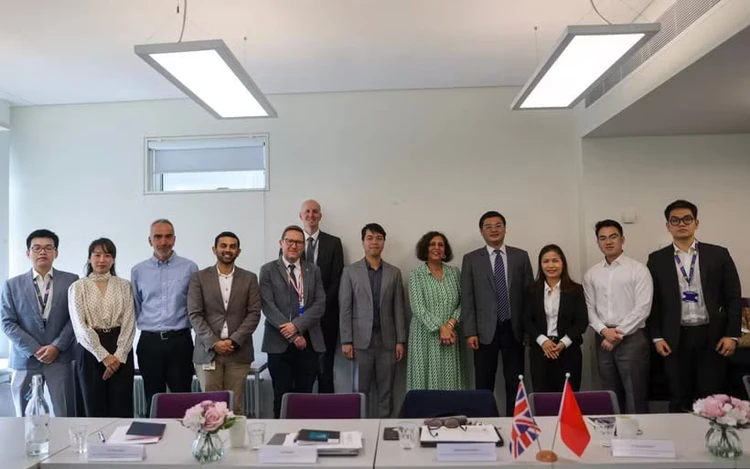
The Vietnamese Embassy in London's Education Section and representatives from the Department of Higher Education (Ministry of Education and Training) visit and hold a working session at Queen Mary University of London. Photo: VNA
The change is rooted in what may appear to be an administrative detail: for the first time, the UK Foreign, Commonwealth and Development Office is a co-owner of the International Education Strategy alongside the Department for Education and the Department for Business and Trade.
The involvement of all three ministries shows that education is being elevated to the level of foreign policy. Dr. Dao Thi Hong, First Secretary in charge of education and Vietnamese students at the Vietnamese Embassy in the UK, described this as a “three-legged stool”: the Department for Education sets training standards, the Department for Business and Trade focuses on growth, while the Foreign Office turns education into a foreign policy tool. Education, she said, is no longer solely an education-sector issue but has become central to the UK’s global engagement policy.
Against this backdrop, Hong said six months are not enough for UK universities to fundamentally change their operating models, but sufficient to reveal a shift in thinking – from “Market Opportunity” to “Partnership Opportunity”. Education is no longer simply about exporting services but has become a bridge for building sustainable international relations.
The shift is evident in several areas. UK universities are now approaching Vietnam with government support, with ambassadors serving as focal points for promoting cooperation rather than leaving individual universities to find their own way. The focus is also moving beyond self-funded international students towards deeper forms of engagement, including branch campuses, dual-degree programmes, vocational skills development and joint research in priority areas such as artificial intelligence (AI), green energy and biomedicine.
In the 2024/25 academic year, about 3,725 Vietnamese students studied in the UK, while 13,285 enrolled in UK programmes delivered in Vietnam. Both flows are growing, but the balance is increasingly shifting towards UK education being delivered to learners in Vietnam. If managed strategically, this could enable Vietnam to expand access to international education at home while improving the quality of its workforce.
Vietnam’s continued inclusion among the UK’s priority markets, she said, is only a “necessary condition”. The “sufficient condition” lies with Vietnam itself – its ability to formulate strategic priorities, choose partners and design mutually beneficial cooperation models.
The door is open, but whether Vietnam enters it as a “chosen” partner or as a country that proactively “chooses” its partners is a question only Vietnam’s education sector can answer for itself, according to the expert.








Max: 1500 characters
There are no comments yet. Be the first to comment.