


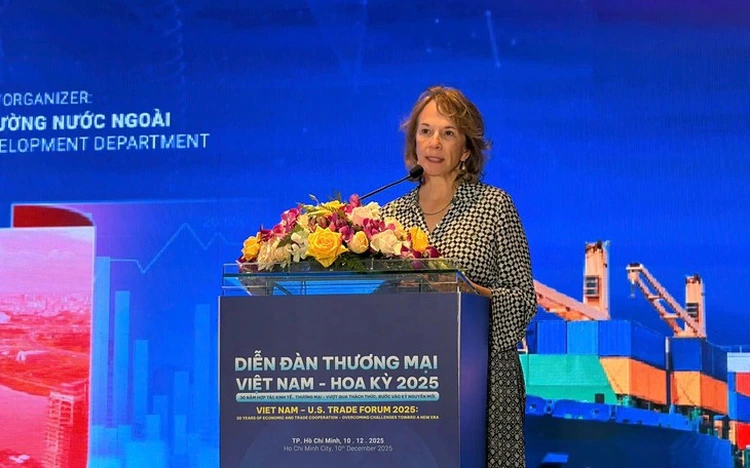
AmCham Vietnam vice-chair Virginia Foote speaks at the Vietnam–U.S. Trade Forum 2025 in Ho Chi Minh City, December 10, 2025. Photo: Nghi Vu / Tuoi Tre
The Vietnam-U.S. Trade Forum 2025 was held by the Ministry of Industry and Trade’s International Market Development Department and AmCham Vietnam in Ho Chi Minh City, marking 30 years of diplomatic ties and 25 years since the bilateral trade agreement.
Vigorous trade performance over 3 decades
According to the ministry, milestones such as the 2000 bilateral trade agreement, Vietnam’s 2007 WTO accession, and the elevation to a comprehensive strategic partnership in 2023 have propelled bilateral trade to US$149.5 billion in 2024, more than 330 times higher than in 1994.
This underscores the U.S.’s central role in Vietnam’s export structure and the growing interdependence between the two economies.
Trade momentum continued this year.
In the first eleven months, turnover reached $155.6 billion, with Vietnam’s exports to the U.S. rising 27.2 percent to $138.6 billion and imports increasing 25.2 percent to $17 billion.
AmCham Vietnam vice-chair Virginia Foote said Vietnam has become an essential export base for U.S. firms, noting that many American companies entering the market bring their supply chains with them.
The Southeast Asian country is now the U.S.’s eighth-largest trading partner and its fourth-largest in ASEAN, while the U.S. remains Vietnam’s second-largest trading partner and top export destination.
On October 26, both countries issued a joint statement outlining the framework for a reciprocal, fair, and balanced trade agreement to expand market access.
Vietnam will widen preferences for most U.S. industrial and agricultural goods, while the U.S. will maintain a 20-percent reciprocal tariff on Vietnamese-origin products and consider zero-tariff treatment for selected items.
Experts said 2026 is poised to be a defining year for restructuring bilateral trade ties and shaping long-term cooperation.
Challenges to be addressed
Forum speakers said Vietnam’s next economic phase will be shaped by fast-changing U.S. trade policy, which is restructuring global supply chains and increasing pressure on partners like Vietnam.
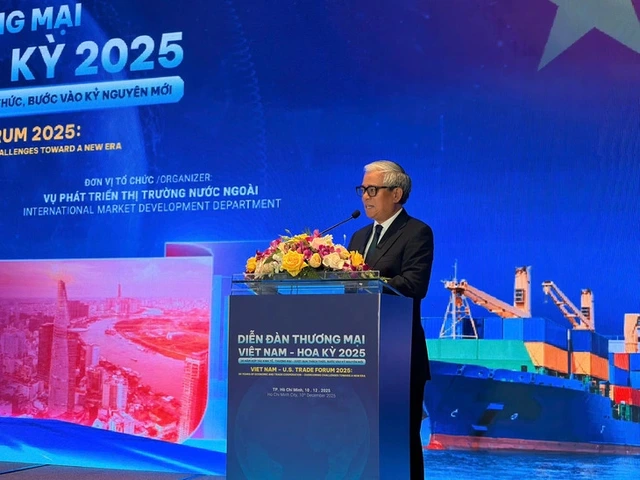
Vietnam’s former Ambassador to the U.S. Pham Quang Vinh speaks at the Vietnam–U.S. Trade Forum 2025 in Ho Chi Minh City, December 10, 2025. Photo: Nghi Vu / Tuoi Tre
Challenges range from tariff adjustments and trade defense measures to stricter technical standards, sustainability requirements, and supply chain transparency.
Nguyen Hong Duong, deputy director of the International Market Development Department, said sensitive issues between the two countries, especially reciprocal tariffs, will require sustained dialogue between businesses and policymakers.
Early risk detection is crucial for coordinated solutions.
According to Nong Nghiep & Moi Truong (Agriculture & Environment) newspaper, Tran Toan Thang, head of the Division of International Studies and Integration Policy at the National Institute for Economics and Finance, told the forum that U.S. tariff shifts affect trade, investment, capital flows, and broader strategic priorities.
He added that Vietnam must diversify markets, strengthen value chains, and invest in technology and innovation to build resilience.
AmCham Vietnam vice-chair Foote also noted that Vietnamese businesses must pay closer attention to rules of origin, as the U.S. has raised concerns that some exports have not yet met these requirements.
Despite the challenges ahead, Vietnam’s former ambassador to the U.S. Pham Quang Vinh said bilateral trade remains well positioned for further growth thanks to shared interests and the strong foundation built over the past three decades.








Max: 1500 characters
There are no comments yet. Be the first to comment.