


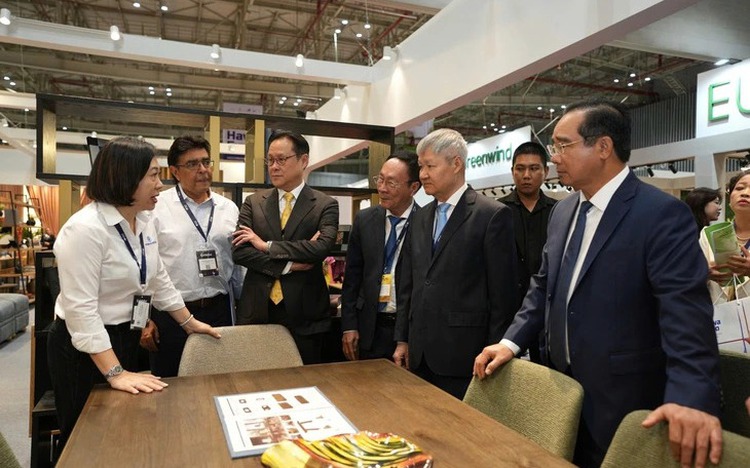
Visitors listen as a furniture company representative introduces products at a booth during Hawa Expo 2026 in Ho Chi Minh City, Vietnam, March 4, 2026. Photo: HAWA
Industry representatives discussed strategies to expand direct-to-consumer exports at a seminar on Vietnam’s furniture export strategy held on Wednesday within the framework of Hawa Expo 2026 in Ho Chi Minh City.
The expo, an international exhibition on wood and furniture products organized by the Handicraft and Wood Industry Association of Ho Chi Minh City (HAWA), is taking place from March 4 to 7 at the Saigon Exhibition and Convention Center.
Phung Quoc Man, chairman of HAWA, said Vietnam’s wood furniture sector has grown alongside stronger trade connections and the rapid expansion of e-commerce.
He noted that companies need to adapt to evolving market conditions and keep pace with emerging trends, particularly cross-border online retail.
Through global e-commerce platforms, Vietnamese firms can reach end consumers directly, especially in the U.S., where demand for furniture remains strong.
Data from Amazon show that the U.S. is the world’s largest furniture market, with total spending reaching US$253.8 billion in 2023, while e-commerce accounted for 29.4 percent of sales.
To compete effectively in online marketplaces, manufacturers need to invest more in product design and develop their own brands instead of relying mainly on contract manufacturing, a move that could help raise the value and identity of Vietnamese furniture.
“The future of Vietnam’s wood industry is not only about exporting more, but also about helping the world better recognize its identity and value,” Man said.
Huynh Le Dai Thang, director of Nghia Son Wood Co. Ltd., said his company began shifting from business-to-business (B2B) to B2C sales during the COVID-19 pandemic.
The company now sells furniture directly to overseas customers through platforms such as Amazon, Wayfair, and Walmart, as well as through its own website under the brand Victory Relax.
Thang said Vietnamese furniture producers have long been strong in B2B manufacturing, but entering the B2C segment through e-commerce remains challenging in the early stages and requires training and support from online platforms.
“Technology changes constantly, so we need to stay continuously updated,” he said, adding that the company has set up a dedicated team to manage its e-commerce operations.
Pham Thi Trang Dai, senior account manager at Amazon Global Selling Vietnam, said Vietnam’s wood furniture sector still has significant growth potential in cross-border e-commerce, which is expanding by around 30 percent each year.
Vietnamese furniture has already gained international visibility, with the home and kitchen category ranking among the top five best-selling product groups from Vietnam on Amazon.
According to Dai, Vietnamese manufacturers are well positioned to compete in the 'affordable luxury' segment, offering wood furniture that is not the cheapest but still reasonably priced for consumers.
Items such as bedside tables, wardrobes, and other household furniture can generate monthly sales ranging from several million to hundreds of millions of U.S. dollars, categories that align with Vietnam’s manufacturing strengths.
She added that companies should invest more in research and development to design furniture that can be easily assembled and disassembled, making it more suitable for B2C online sales.








Max: 1500 characters
There are no comments yet. Be the first to comment.