


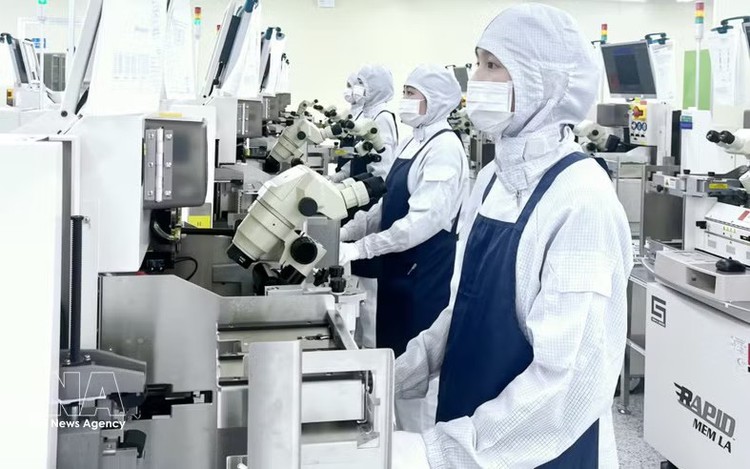
Production line at Hana Micron Vina Co., Ltd in Bac Ninh city. Photo: VNA
Focusing on specialized chip development
According to the Ministry of Science and Technology, Vietnam's semiconductor industry has made notable progress. In 2025, it generated more than $21 billion in revenue and attracted over $14 billion in foreign investment through more than 240 projects. The country is now home to around 60 chip design companies and over 7,000 semiconductor design engineers.
The country is gradually participating in key stages of the global value chain, from chip design, packaging, and testing to R&D and specialized chip production. Specialized chips are particularly important as they address specific requirements of end products and industries. For example, AI chips used in edge cameras must process images quickly, consume little power, protect data, and operate reliably despite unstable connectivity. Chips for UAVs and robots require real-time processing and high reliability, while security chips must establish hardware-based roots of trust.
However, each stage faces challenges related to technology, markets, investment, and ecosystem development.
Nguyen Anh Tuan, Director of the national center for pilot semiconductor chip manufacturing support under the Ministry of Science and Technology, said high R&D costs and an incomplete domestic production chain remained major obstacles. Small-order firms also struggle to access affordable international packaging and testing services. Moreover, turning chip prototypes into commercial products requires further investment in software, circuit boards, reliability testing, and product integration, increasing costs and development time.
A mismatch between technological development and market demand further complicates the process. Businesses hesitate to invest without initial customers, while customers are reluctant to order products that have not been tested in practice. Without support for trials, procurement, and initial applications, many chip products risk remaining at the research stage, Tuan said.
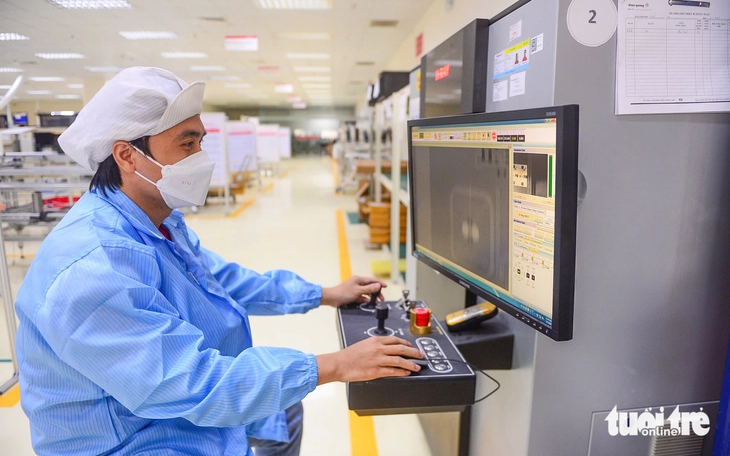
Experts therefore call for an integrated specialized-chip ecosystem, rather than fragmented support for individual businesses. The Ministry of Science and Technology said it is finalizing a proposal to submit to the Prime Minister on specialized chips to be prioritized for State procurement in selected sectors.
The draft list comprises 20 chip groups, identified based on demand from ministries, agencies, businesses, research institutes, universities, and experts. They cover AI and edge computing; next-generation telecommunications and wireless technologies; sensors, autonomous systems, and the Internet of Things; energy and power electronics; and hardware security and encryption. The list is expected to orient research, signal market demand, and focus resources on products with development potential.
The national center for pilot semiconductor chip manufacturing support will provide shared infrastructure, including design tools, laboratories, prototyping, testing, and measurement services. It will connect chip designers with end-product manufacturers to reduce costs, risks, and time to market.
Expanding international cooperation
Vietnam also needs to deepen international cooperation by tapping the capabilities of global technology corporations in specialized-chip research and practical applications. R&D centers in Vietnam and Qualcomm are expanding cooperation in four areas: AI, semiconductors, software, and systems engineering. Besides, developing markets for domestically designed chips is equally important.
Domestic firms are also advancing production plans. Geleximco Group is completing investment procedures for a chip manufacturing plant in Hung Yen province, with construction scheduled to start in November 2026 and commercial production expected in early 2028. The group plans to prioritize testing and integrating Vietnamese-designed control chips, sensors, and power chips into its electric vehicles and industrial ecosystem, helping create initial demand for locally designed products.
Stronger policy coordination and international cooperation are also helping universities and research institutes access advanced technologies and build research capacity. In 2026, the National Foundation for Science and Technology Development selected five Vietnam-Japan joint semiconductor research projects for funding.
Assoc. Prof. Dr. Nguyen Thi Thuy of Hanoi National University of Education, one of the participating institutions, said high-level diplomatic engagement through State management agencies had created opportunities for Vietnamese scientists to work with leading global technology partners, including Japanese institutions.
Building on this mission, the research team at Hanoi National University of Education aims to train and develop a pool of elite semiconductor talent through annual Vietnam-Japan cooperation programs, reputable scientific forums, and international seminars in the semiconductor field, Thuy said.



Max: 1500 characters
There are no comments yet. Be the first to comment.