


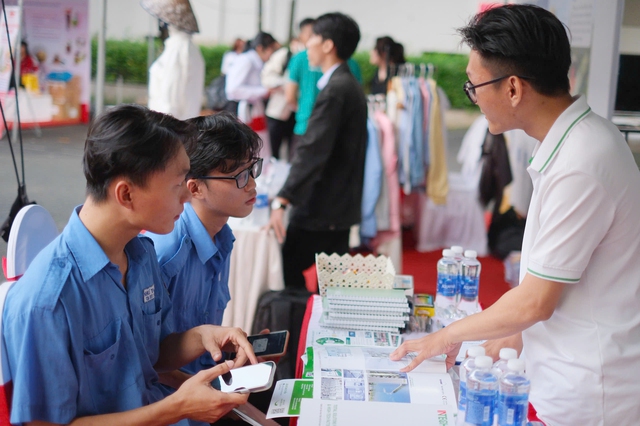
Young jobseekers attend a job fair in Ho Chi Minh City, Vietnam. Photo: Vu Thuy / Tuoi Tre
Nearly 80 percent of companies in Asia-Pacific report difficulty finding workers with suitable skills, ManpowerGroup said in its 2025 Talent Shortage Report, almost double the level recorded in 2014.
The shortage spans sectors including information technology, engineering, healthcare, finance, energy, and sustainability-related industries.
Employers struggle to hire
In Vietnam, the mismatch has become more visible as Generation Z, born between 1997 and 2012, enters the workforce in larger numbers.
Despite strong demand for labor, many young jobseekers face prolonged job searches or leave roles within their first year of employment, according to recruitment firms.
"The market has jobs, but employers and jobseekers are not meeting," said Cao Le Thanh Loan, senior operations manager of Manpower Vietnam.
ManpowerGroup data show Generation Z accounts for about 17 percent of the current workforce, smaller than Generation Y, born between 1981 and 1996, and Generation X, born between 1965 and 1980, but increasingly influential in shaping recruitment and workplace expectations.
Unlike earlier generations, Gen Z workers are less focused on working strictly within their trained profession, Loan said.
Instead, they place greater emphasis on corporate values, workplace culture, and whether an organization aligns with their personal priorities.
A Manpower survey found that about 41 percent of Gen Z respondents would reject a job offer, even if it was well paid and matched their qualifications, if the employer's vision did not align with their views, particularly on sustainability and social responsibility.
Employers say the shift in worker preferences has not been matched by a corresponding improvement in job readiness.

While Gen Z is generally strong in digital skills and foreign languages, many lack practical workplace skills such as communication, problem-solving, and handling pressure, Loan said.
Vietnamese companies report that young employees often leave after only a few months, citing stress or a poor cultural fit.
Early departures limit skills development for workers while increasing recruitment and training costs for employers.
Mismatch persists despite adjustments
As a result, many businesses have tightened hiring criteria, prioritizing candidates who can perform immediately over those requiring longer training.
Recruiters say this has narrowed entry-level opportunities, particularly for young workers without hands-on experience.
Employers are also adapting by expanding hybrid and remote work, improving welfare benefits, and linking pay more closely to performance.
However, labor specialists warn that these measures will have limited impact unless workers invest in developing long-term skills.
"Technical knowledge can be updated quickly, but skills such as communication, resilience, and problem-solving take time and experience to build," Loan said.
Analysts say without closer alignment between education providers, employers, and workers, Vietnam risks a prolonged imbalance in which companies struggle to find talent while young people find it harder to secure stable employment.








Max: 1500 characters
There are no comments yet. Be the first to comment.