


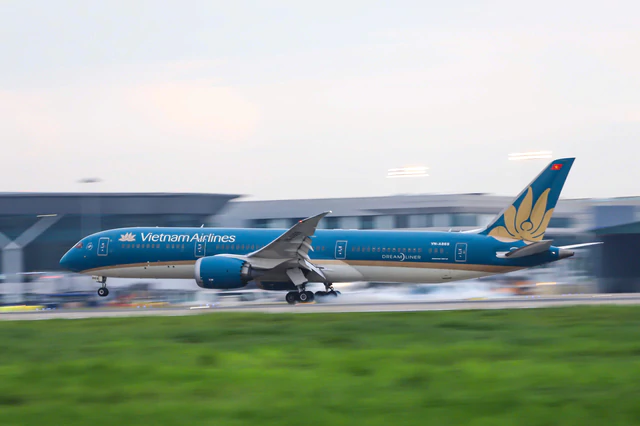
Vietnamese airlines are racing to expand their international route networks. Photo: C. Trung / Tuoi Tre
New international routes take off
Vietnamese carriers rolled out a series of international routes in October 2026, targeting new passenger markets and expanding connections between Vietnam and destinations across Asia and Europe.
Vietnam Airlines on Monday announced plans to launch direct flights between Hanoi and Hangzhou, China, starting November 15, with four round trips per week.
Promotional round-trip fares start at VND7.25 million (US$279.8), including taxes and fees.
The announcement came just days after Vietjet launched services connecting Hanoi with Almaty in Kazakhstan and Prague in the Czech Republic, while Sun PhuQuoc Airways introduced flights between Ho Chi Minh City and Shanghai.
Vietjet began operating its Hanoi-Almaty and Hanoi-Prague services on October 10 using Airbus A330 aircraft.
The Prague service, which includes a stopover in Kazakhstan, operates two round trips per week, allowing the carrier to tap both Central Asian and Central European markets.
Sun PhuQuoc Airways, meanwhile, is focusing on connecting international markets with Vietnam's tourist destinations.
Following the launch of its Ho Chi Minh City-Shanghai route on October 15, the airline plans to introduce Phu Quoc-Moscow flights on November 13 using Airbus A330 aircraft, targeting Russian tourists seeking beach holidays.
The flurry of new services reflects a broader shift among Vietnamese airlines toward international expansion as growth opportunities in the domestic market become increasingly limited.
An airline representative said that carriers are engaged in a quiet race to expand their international networks and fleets, driven partly by mounting competition at home.
Major domestic routes such as Hanoi-Ho Chi Minh City and Ho Chi Minh City-Da Nang are already served by multiple airlines, with intense fare competition squeezing profit margins amid high fuel, aircraft leasing, and operating costs.
International markets, by contrast, offer greater room for growth, allowing carriers to attract foreign visitors to Vietnam and make more efficient use of their aircraft.

Russian tourists enjoy the beach in Nha Trang, Khanh Hoa Province, Vietnam. Photo: Quang Dinh / Tuoi Tre
New routes offer opportunities but profitability remains uncertain
An airline executive overseeing commercial operations described the international expansion as a search for "new frontiers," warning that opening a route does not necessarily guarantee passengers or profits.
Even fully booked flights may be unprofitable if operating costs are too high.
Some routes have been launched with considerable publicity, only to see flight frequencies reduced or services suspended when demand failed to meet expectations.
Maintaining balanced passenger traffic in both directions remains particularly challenging on routes heavily dependent on seasonal tourism.
For travelers, however, the growing international network offers more destinations and potentially lower fares.

Growing numbers of international tourists visiting Vietnam for beach holidays are prompting airlines to launch more direct flights to destinations such as Phu Quoc and Nha Trang. Photo: Quang Dinh / Tuoi Tre
Passengers departing from Hanoi can now reach Hangzhou in about three hours by direct flight before continuing to Shanghai by high-speed train.
Almaty and Prague are also becoming more accessible, reducing the need for multiple connecting flights.
Meanwhile, direct international services are expected to bring more foreign tourists to Vietnam's resort destinations.
A representative of Anex Vietnam said the company expects to bring approximately 15,000 Russian tourists to Phu Quoc each month during the 2026-27 winter season.
For travel companies, the new connections create opportunities to develop tour packages, reduce transfer costs, and attract more international visitors.
According to the Civil Aviation Authority of Vietnam, the country's aviation market handled approximately 70.5 million passengers in the first nine months of 2026, up 12.6 percent year on year.
Passenger traffic is projected to reach 94 million for the full year, indicating substantial room for further growth.
Vietnamese carriers accelerate fleet expansion
The international route expansion is accompanied by an aggressive push to increase fleet capacity.
As of September 2026, Vietjet operated 107 aircraft, accounting for approximately 41.6 percent of all aircraft registered in Vietnam.
Vietnam Airlines had 94 aircraft, while the combined fleet of Vietnam Airlines Group, including Pacific Airlines and Vasco, stood at 103.
Sun PhuQuoc Airways has expanded its fleet from five to 21 aircraft in less than a year and aims to reach 100 by 2030.
The airline has signed an agreement to purchase 40 Boeing aircraft and plans to lease Boeing 787 jets from 2028 to support long-haul operations.
Vietravel Airlines has also increased its fleet to six aircraft and reached an agreement to purchase 50 Airbus aircraft, with deliveries scheduled to begin in 2029.


Max: 1500 characters
There are no comments yet. Be the first to comment.