


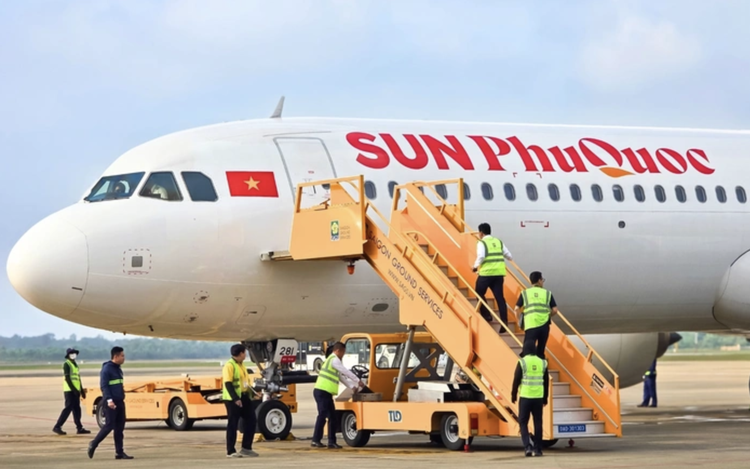
Saigon Ground Services Joint Stock Company (SAGS) handles ground operations for a Sun PhuQuoc Airways flight at Da Nang International Airport in central Vietnam. Photo: SAGS
In aviation, ground handling refers to a wide range of services that support aircraft operations, including flight service planning, passenger check-in, baggage handling, cabin cleaning, weight and balance control, ramp operations, aircraft towing and pushback, as well as other activities required before and after a flight.
A delayed departure is not always caused by bad weather or technical problems.
An aircraft may already have closed its doors or arrived at the stand, yet still be forced to wait because a pushback vehicle has not arrived.
Baggage loading may not be complete, preventing the cargo hold from being closed.
Even a delay of a few minutes in cabin cleaning can push back the scheduled departure time.
With packed flight schedules, a 15- to 20-minute delay on an early flight can disrupt an entire day of operations.
A single slow step can trigger a chain reaction across the entire flight network.
This is why airlines are increasingly looking to take greater control of ground handling operations instead of depending entirely on external service providers.
Accordingly, Sun Group put Phu Quoc Airport Ground Services Company into operation in early August.
The group added another link to its ecosystem on the island alongside its airline, airport, hotels, entertainment complexes, and transportation services.
Previously, Sun PhuQuoc Airways outsourced ground handling at Noi Bai International Airport in Hanoi to Hanoi Ground Services Joint Stock Company, and at airports in Ho Chi Minh City, Da Nang City and Khanh Hoa Province to Saigon Ground Services Joint Stock Company (SAGS).
Cargo operations have also involved specialized providers, including Air Cargo Services of Vietnam Joint Stock Company at Noi Bai and Saigon Cargo Service Corporation at Tan Son Nhat International Airport.
However, establishing its own ground handling company does not necessarily mean an airline will completely replace existing partners.
A more practical approach is for the carrier to handle its own operations at Phu Quoc, where it has concentrated flights and an existing ecosystem to support the business.
At other airports, outsourcing may remain more efficient than building a separate operating structure.
According to statistics compiled by Tuoi Tre (Youth) online newspaper by early August, at least seven companies were providing ground handling services at airports across the market.
National flag carrier Vietnam Airlines operates Vietnam Airport Ground Services Company, which provides its services at Noi Bai, Da Nang, and Tan Son Nhat International Airports.
Meanwhile, Vietjet also runs a ground services company.
Since April 2025, the airline has handled its own flights at Tan Son Nhat instead of continuing a full-service contract with SAGS.
Going independent is not an easy game
Airlines said that the biggest advantage of self-operated ground services is greater control.
Carriers can arrange staff, passenger stairs, baggage belts, and pushback vehicles according to their own flight schedules.
Processes can also be customized around fleet characteristics, flight frequency, and operational needs instead of sharing resources with multiple airlines.
This advantage becomes particularly important during peak hours.
When one service provider handles several airlines at the same time, staff and equipment can come under pressure.
A late-arriving flight can quickly disrupt the preparation schedule for following departures.
For airlines, shorter turnaround times mean higher aircraft utilization.
Aircraft only generate revenue while they are flying.
Every minute spent waiting on the ground creates additional costs.
The revenue potential of the ground handling market is significant.
In 2024, Vietjet contributed about VND591 billion (US$22.5 million) to SAGS’ revenue, accounting for nearly 39 percent of the company’s total income.
When its largest customer shifted toward self-handling, SAGS had to seek additional international airline customers to replace the lost volume.
Associate Professor Dr. Nguyen Thien Tong, an aviation expert, said that the entry of more players into the market would increase competitive pressure, forcing existing providers to invest in equipment, improve productivity and enhance service quality.
However, operating in-house does not automatically mean lower costs.
Airlines must invest in pushback tractors, passenger stairs, baggage conveyor systems, specialized equipment, and a workforce capable of meeting flight schedules.
The model only becomes economically effective when a carrier has sufficient flight volume at a particular airport.
If the number of flights is limited, equipment may remain idle and employees may not be fully utilized, turning what was intended as a strategic advantage into a costly burden.








Max: 1500 characters
There are no comments yet. Be the first to comment.