


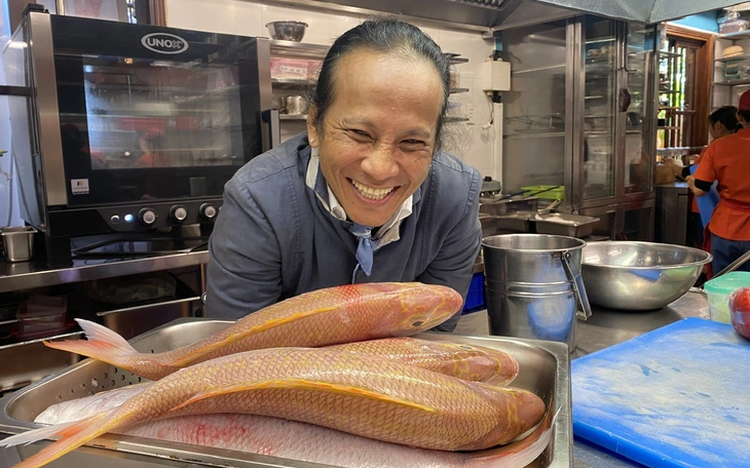
Tran Thanh Duc draws international visitors to Hoi An through Vietnamese cuisine.
Behind it is Tran Thanh Duc, 57, a Vietnamese American whose life has stretched across continents before finding its way back to where it began.
Learning to be Vietnamese again
If one watches Duc in his kitchen, there is little to suggest the distance he has traveled.
He stands among his staff, talking, adjusting things here and there, moving with a calm certainty that makes it hard to imagine he once moved from country to country, and taking on whatever work he could find just to get by.
Born in Ho Chi Minh City, Duc had his life shift in 1985 when he moved to the United States with a Mexican-American family.
In those early years, the kitchen became something familiar to hold on to.
His adopted mother taught him not only how to cook, but also how to sit down at the table, how to share a meal, and how to belong, even if only for a moment, in a place that was not originally his.
As he grew older, Duc's life revolved around studying while working continuously, taking on almost any job he could find over six years.
He mowed lawns, worked as a pool lifeguard, farmed, repaired machinery, drove tractors, washed dishes, and cared for the elderly, all while carrying the weight of a US$120,000 education cost in the back of his mind.
There were times, as he recalled, "that I took three jobs at once to earn enough money to sustain life and study."
He chose environmental engineering at university, a path that offered some sense of stability.
After graduating, he worked briefly as an engineer, but the direction did not hold.
When Vietnam reconnected its international phone lines, Duc made a call home after ten years without contact.
Not long after, he made a trip back to Vietnam, a place that felt both familiar and distant, where his parents were facing a son they could barely recognize, someone they had once believed was gone.
Yet even that return did not settle things, and Duc went back to the United States, leaving engineering behind to join a Vietnamese restaurant in southern Texas.
Starting again from the beginning, he washed dishes and waited tables, working through the night to pay off tuition debt while carrying a larger aspiration of "learning how to be Vietnamese again."
In that kitchen, he picked up more than just cooking techniques. He began to understand how a Vietnamese kitchen runs, how flavors come together, and how everything is organized behind the scenes, though he did not stay in one place for long.
He left again, carrying his backpack with a small knife and a few bottles of fish sauce and chilli sauce, traveling through Mexico and Central America.
"Market is always the first place I visit wherever I go," he said, as if it was his way of understanding a place without needing much explanation.
The ocean and cooking became part of his life.
He surfed, then cooked, combining local ingredients with familiar seasoning and sharing food with friends from many countries.
By the end of the 1990s, his journey had taken him even further, to New Zealand, Thailand, and Australia.
When he returned to the United States around 2000, he and his friends hosted small gatherings, putting together menus that moved between Western, Asian, and Latin American influences.
For Duc, food was never the same twice.
"I don't follow any specific recipes," he said. "Everything was cooked based on what I understand."
Finding himself back in Vietnam
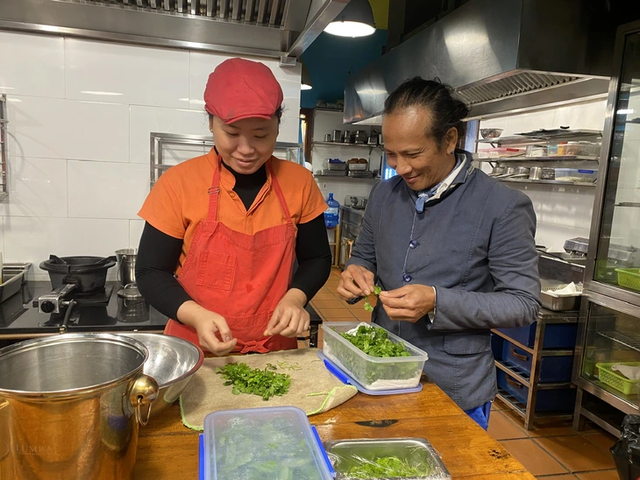
Tran Thanh Duc works alongside his staff in the kitchen of his restaurant in Hoi An, Vietnam.
In 2001, he left again for Europe, traveling through Denmark, Sweden, and the Netherlands, moving forward without really looking back. But by the end of 2003, he returned to Vietnam.
Hoi An was different, not just another stop along the way. Taken by the town's beauty and gentle pace, he decided to stay and open the first Mango restaurant on Nguyen Thai Hoc Street.
The name came from something simple but constant in his life.
"When opening the restaurant, I thought of mango," he said.
"As a young guy wandering around in the U.S. and Europe, I always carried a small knife, a mango or a pineapple, something I could prepare anywhere, sometimes with sea fish I caught.
"That food became part of my youth, part of who I am, so now I cook for others with my whole heart.
"I was fortunate that guests enjoyed it, and I chose Mango for the restaurant."
From that small beginning, the restaurants grew, with new locations opening in the central areas of Hoi An as customers continued to return.
Duc built his business around local people, creating jobs while giving workers the chance to learn and build something for themselves.
Today, his restaurant chain employs around 100 people. In his conversations with locals, Duc often shares the journey he has taken, one shaped by survival, contribution, and a deep love for his hometown.
At the same time, he began putting his earlier studies into practice.
In Hoi An, his restaurants and home became models of green living, as he experimented with composting organic waste from the restaurants and turning it into fertilizers.
He bought land and worked with local farmers to grow organic vegetables, which were then supplied back to his kitchens.
When Duc speaks about his life in Hoi An, he often returns to the people around him: the workers, the farmers, and those who have been part of the journey.
"Throughout my life, I've come to value three things the most: first is to remain honest whenever you are, second is to give all in whatever you do, and third is to see things through to the end and never quit halfway," he said.
"All the assets I have today are not tangible, material ones, but the people in Hoi An who have lived and worked with me over the past 20 years.
"I offered jobs so they could earn money and build their lives, but they gave me something much bigger in return: a sense of belonging in the country I now call home."
This place is where life and happiness come together
After years of moving through different countries and different versions of himself, Duc arrived at a place where he no longer felt the need to keep going.
He found a life in Vietnam that felt both grounded and purposeful.
Beyond running a restaurant, he also finds ways to support the community through volunteering.
"After almost two decades of exploring the unknown, I decided to stay in Hoi An, Vietnam, where I was born, to have my own family and develop my passion," he stated.
"This place is my life, the happiness of me and my wife with our three daughters."
And when he meets others who share a similar background, growing up away from Vietnam, he often returns to the same thought.
"Nowadays, wherever I meet someone with Vietnamese roots, I always try to tell them, if possible, to return to their homeland to help develop the country and live there.
"Open up and look at the country through a new lens.
"As a Vietnamese, your experience can help develop the country in so many ways."








Max: 1500 characters
There are no comments yet. Be the first to comment.