


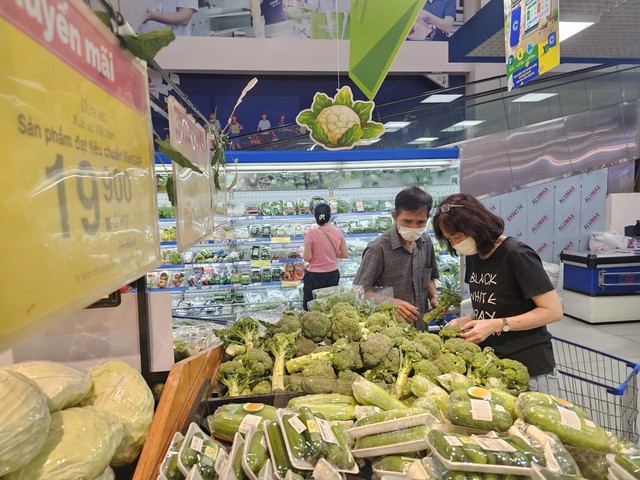
Shoppers carefully consider every expense amid rising costs. Photo: Nhat Xuan / Tuoi Tre
Vietnam's retail market continued to grow in the first eight months of 2026, with goods retail sales estimated at VND3,947.6 trillion (US$150.7 billion), up 12.8 percent year on year, according to the National Statistics Office (NSO).
The growth rate was higher than the 9.1 percent recorded during the same period last year.
A survey by Vietnam Report found that 72.1 percent of consumers considered their personal finances better than 12 months earlier.
Of them, 46.2 percent reported a slight improvement, while 25.9 percent said their financial situation had improved significantly.
Consumers remain cautious
Improved finances have not prompted consumers to spend more freely.
Some 89.5 percent of respondents said they usually compare prices among sellers before making a purchase, while 39.5 percent said they often delay purchases to wait for promotions, according to the survey.
Vietnam Report experts said consumers have retained cautious spending habits after a period of tighter budgets.
They continue to compare prices across sales channels and look for promotions before deciding whether to buy, spending only when they believe a product offers sufficient value for its price.
Meanwhile, retailers are under growing cost pressure.
Nearly three-quarters of businesses surveyed by Vietnam Report identified rising inflation as their biggest challenge in 2026.
The consumer price index rose 4.45 percent in the first eight months of the year from a year earlier, according to the NSO, nearing the full-year inflation control target of around 4.5 percent.
Rents, labor, energy and transportation costs, along with supply fluctuations and geopolitical developments, are also putting pressure on retailers.
In the digital-device sector, shortages of some memory chips and RAM could further increase input costs.
Retailers are consequently reassessing their expansion plans.
Grocery retailers still have room to expand in provinces and cities outside major urban centers and in rural areas, where modern retail penetration remains relatively low.
These areas accounted for about 64.1 percent of Vietnam's population in 2025.
However, expanding into more dispersed areas also means higher logistics and operating costs.
Electronics and digital-device retailers are shifting their focus from opening more stores to improving the efficiency of existing outlets, as coverage in many major cities has become relatively high.
They are paying greater attention to revenue per store, space utilization and product mix.
Underperforming outlets may be downsized, relocated or restructured.
Artificial Intelligence (AI) reshapes shopping habits
AI is also changing how consumers begin their shopping journeys.
A Vietnam Report survey of Gen Y and Gen Z consumers found that 78.4 percent had used AI tools for shopping.
However, frequent use remains limited, with 19.9 percent using AI frequently, 39.4 percent occasionally and 19.1 percent rarely.
Consumers mainly use AI to research and filter information before making purchases.
Some 44.4 percent use AI to learn about products, 23.5 percent to search for or receive recommendations for suitable products, and 19.8 percent to compare products and brands.
According to experts, consumers may increasingly use AI to gather information and narrow down their choices before checking prices, promotions, reviews or actual shopping experiences through sales channels.
This creates new requirements for retailers, particularly regarding product information.
Details on prices, ingredients, functions, specifications, warranties and product differences need to be complete, clear and consistent so consumers can verify them and AI systems can retrieve and process the information.








Max: 1500 characters
There are no comments yet. Be the first to comment.