


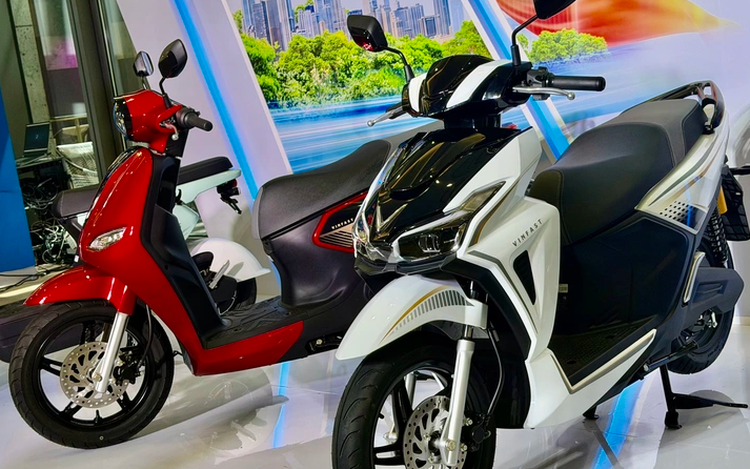
Vietnamese EV maker VinFast debuts two new electric motorcycle models. Photo: Cong Trung / Tuoi Tre
Vietnamese manufacturers are accelerating investment in an effort to regain the share of the market estimated at 3.36 million new motorcycles annually.
The competition is intensifying as nearly 60 million gasoline-powered motorcycles remain in circulation, representing a vast replacement market as consumers gradually shift to electric vehicles.
VinFast, the electric vehicle manufacturer founded by billionaire Pham Nhat Vuong, has set a target of selling 1.5 million electric motorcycles in 2026, equivalent to roughly half the current size of Vietnam’s annual motorcycle market.
The company has expanded its product line-up with the launch of two new models, including the Kyo, priced at VND30-35.3 million (US$1,140-1,330), and the Kinet, fetching VND40-49.9 million ($1,520-1,895).
The users of both models can swap batteries at public battery stations or recharge them at home.
Another domestic EV maker Pega said its factory has a designed production capacity of 40,000 motorcycles per month, with some models achieving a localization rate of up to 85 percent.
Meanwhile, Dat Bike has also expanded its manufacturing facility in Ho Chi Minh City and aims to increase production capacity 10-fold over the next two years.
An industry expert told Tuoi Tre (Youth) online newspaper at the launch event for VinFast’s Kinet and Kyo models on Monday that the market has moved beyond the early-adopter phase, when customers purchased electric motorcycles primarily to experience new technology.
Manufacturers should compete not only on design and price but also on battery technology, warranty coverage, and resale value.
Citing figures from the Vietnam Association of Motorcycle Manufacturers (VAMM), he said annual motorcycle demand in Vietnam is estimated at about 3.36 million units, or more than 280,000 motorcycles per month.
The five members of VAMM sold over 638,430 motorcycles in the second quarter of 2026, up 4.4 percent year on year.
The figures excluded the number of motorcycles sold by VinFast and other electric motorcycle producers.
Supply has also expanded rapidly.
Domestic manufacturers produced about 1.73 million motorcycles during the first five months of the year, a year-on-year increase of 36 percent.
Production in May alone reached nearly 379,000 units, up 40.1 percent year on year.
The expert said the country’s fleet of nearly 60 million gasoline-powered motorcycles represents an enormous replacement opportunity.
If only five percent of those vehicles are replaced each year, annual demand would amount to around three million units.
As more consumers switch to electric motorcycles, the replacement cycle could significantly reshape market share across the industry.
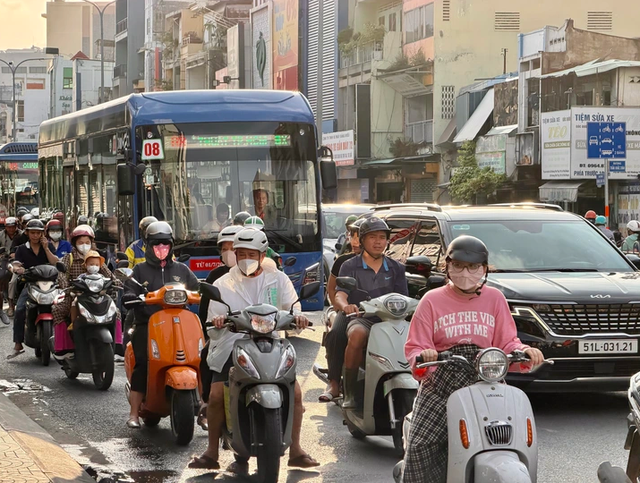
Nearly 60 million motorcycles currently in circulation in Vietnam will gradually enter the replacement cycle, creating a significant opportunity for EV makers. Photo: Cong Trung / Tuoi Tre
Foreign producers expand operation in Vietnam
Japanese manufacturer Honda plans to move production of its UC3 electric motorcycle from Thailand to its factory in Phu Tho Province, northern Vietnam, beginning in September.
Chinese electric two-wheeler manufacturer Yadea inaugurated a smart electric vehicle factory at Tan Hung Industrial Park in Bac Ninh Province in the northern region of Vietnam in March.
The manufacturer has poured over $100 million into the first phase of its facility.
Supporting industries play key role
Another industry expert said the long-term development of Vietnam’s electric motorcycle sector depends on integrating domestic supporting industries into the supply chain.
Only when suppliers receive sufficient order volumes will they invest in new equipment, improve technical capabilities, and move into higher value-added manufacturing, the expert said.
While Vietnam’s billion-dollar motorcycle market is large enough to support multiple players, it is also expected to become increasingly competitive.
Foreign-invested companies and businesses that rely primarily on imported motorcycles may enjoy short-term advantages in pricing and speed to market, the expert said.
However, such business models are unlikely to remain competitive over the long term unless companies gradually develop domestic manufacturing capabilities, localized components, and comprehensive after-sales services.








Max: 1500 characters
There are no comments yet. Be the first to comment.