


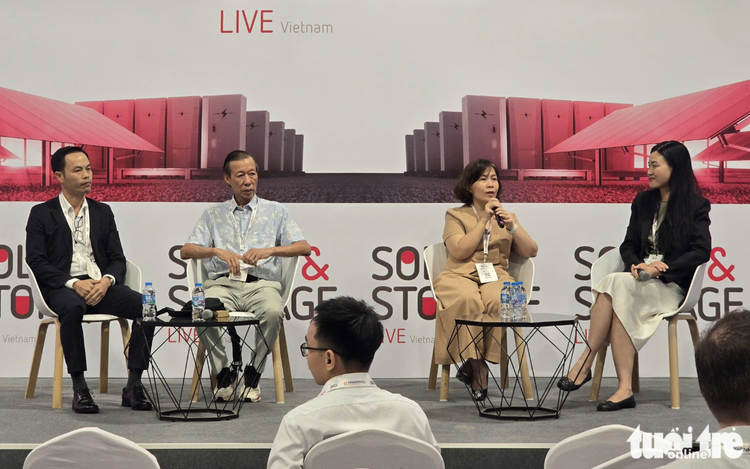
Panelists discuss clean energy and corporate value within the framework of the Solar & Storage Live Vietnam 2026, which took place in Ho Chi Minh City, July 8 and 9, 2026. Photo: Cong Trieu / Tuoi Tre
The panel discussion, titled ‘When Clean Electricity Determines Corporate Value: Solving the Challenge of Competitiveness and Sustainable Development,’ was part of Solar & Storage Live Vietnam 2026, the country’s largest clean energy exhibition, which took place at the Sky Expo Center on Wednesday and Thursday.
Chu Thi Linh Chi, director of advisory services at KPMG Vietnam, said mergers and acquisitions (M&A) increasingly reflect the growing importance of environmental, social, and governance (ESG) performance.
She noted that investors are willing to pay higher valuations for companies that demonstrate greater ESG maturity.
Echoing the view, Nguyen Thi Xuan Thuy, Mekong sustainability development director at Maersk, said that market priorities are shifting from minimizing logistics costs to minimizing carbon emissions in logistics operations.
Global brands such as Adidas and Nike have introduced increasingly stringent emissions standards for suppliers, effectively making access to clean electricity a prerequisite for participation in global supply chains, she said.
As such, clean energy has become a core competitive advantage, particularly for hi-tech industries including semiconductors and artificial intelligence, she underlined.
Several experts noted that businesses are redefining how they evaluate energy costs.
Rather than focusing solely on price, companies, especially foreign-invested enterprises integrated into global supply chains, are placing greater emphasis on whether energy supplies are reliable, renewable, readily available, and produced from clean sources.
They also stressed that sustainability extends beyond environmental protection.
Long-term success depends on building business models that remain commercially resilient while meeting evolving sustainability expectations.
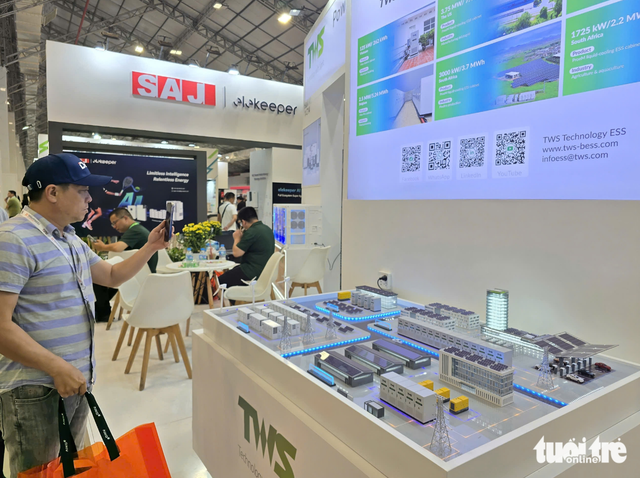
The Solar & Storage Live Vietnam, Vietnam’s largest clean energy exhibition, attracts over 250 exhibitors and 5,500 visitors in 2026. Photo: Cong Trieu / Tuoi Tre
Financing, technology remain major obstacles
For efforts to adopt clean energy, several companies continue to face significant barriers.
Le Duc Trong, director of Bat Trang Design And Product Ceramic Joint Stock Company, said financing remains the biggest challenge for manufacturers.
Technology selection is another concern, as companies must invest in solutions that will remain competitive and relevant over the next five to ten years.
Even large multinational corporations face similar constraints, experts said.
Maersk, for example, cannot decarbonize its operations independently if smaller transportation partners lack the financial resources and technical infrastructure needed to make the transition.
It took Maersk three years to build the supporting ecosystem required to deploy electric trucks transporting containers between Vietnamese ports and logistics hubs.
For small and medium-sized enterprises (SMEs) and traditional craft villages, economic benefits are often the strongest incentive for change, Trong said.
Adopting clean energy has enabled ceramics-making households to reduce electricity costs by 40-50 percent and increase the proportion of products meeting quality standards to up to 98 percent.
However, experts acknowledged that achieving low-carbon operations remains particularly difficult for SMEs because of limited financial capacity and technical expertise.
To accelerate the transition, they urged smaller businesses to proactively engage with clean energy solution providers that can offer financing packages, operational support, and technical assistance to reduce upfront investment costs.
They also called for technology providers to develop simpler systems that are easier to operate and maintain at smaller scales.
Before investing in new energy technologies, businesses should first improve energy efficiency by optimizing existing energy consumption practices, they added.








Max: 1500 characters
There are no comments yet. Be the first to comment.