



Tran Dinh Hoang Phuc scores 8.0 on the IELTS test on his first attempt at the age of 11.
The 11-year-old fifth grader sat the International English Language Testing System exam for the first time on January 3 and earned an overall band score of 8.0.
"I felt very happy and excited when I knew the result," Phuc said. His father learned the score first, then asked Phuc to share the news with his mother, before the family told grandparents and relatives.
Phuc studied from grade 1 through grade 4 at An Binh Elementary School in what was formerly Thu Duc City, now An Khanh Ward in Ho Chi Minh City.
At the start of grade 5, he received a scholarship and transferred to Sedbergh Vietnam, a private international school in the city's Tan My Ward.
English has been part of Phuc's life almost as long as he can remember. He began learning the language at about 2.5 years old and says he has always found it "easy and fun."
"I like watching movies and learning new words," the fifth grader said. "I read books, stories, and science books in English, and I watch foreign programs. I don't really like reading or watching things in Vietnamese."
Before enrolling at DOL English, Phuc mostly studied at home with a tutor and later with a teacher named Phuong for more than a year, following the Cambridge curriculum.
His father discovered DOL English through Facebook and enrolled him after learning about its Linearthinking method.
"At DOL English, learning feels fun and new," Phuc said. "I didn't feel pressured or stressed."
Among the four IELTS skills, he said he enjoys and feels most confident in listening and reading. Writing, he added, remains the most challenging.
"I'm still young, so my social knowledge and life experience are limited," he admitted. "That's why I need to keep learning."
IELTS writing and speaking tasks often deal with topics such as society, economics, culture, and technology, areas far removed from a elementary school syllabus.
Phuc acknowledged that many of the themes were unfamiliar at first.
"But with Linearthinking, I can still answer writing and speaking questions," he said. "It helps me generate ideas and express them in my own language, in a clear and logical way that can convince the examiner."
He said the method was especially helpful in writing, widely considered the hardest skill to score above band 7.
"In reading, the passages are very long and the vocabulary can be strange," Phuc said. "Before, that was a problem. After learning Linearthinking, I can understand the text without knowing every word. I can find the main ideas and answer faster."
Linearthinking is a thinking-based English learning methodology designed specifically for Vietnamese learners.
Developed since 2008 by alumni of the High School for the Gifted under the Vietnam National University-Ho Chi Minh City, it combines mathematical thinking, advanced memory techniques, and research on how a learner's mother tongue affects English acquisition.
Beyond improving the four language skills, the method trains logical thinking, helps learners systematize knowledge, and use English more naturally and effectively.
At DOL English, Linearthinking also provides teachers with a clear logical framework to design lessons, enabling them to teach students how to think rather than what to memorize, leading to more confident teaching and sustainable learning outcomes.
For Phuc, speaking also became less intimidating. He said he used to give short, undeveloped answers and felt nervous about Part 3, which often involves abstract social questions.
"Now I know how to expand my ideas and speak more persuasively, with correct grammar and better vocabulary," he said. "Sometimes my classmates even say 'wow' when I explain something new I've learned."
Despite the stakes, Phuc said he felt calm on the test day.
"I wasn't nervous," he said, attributing that to his experience with Cambridge English exams such as Flyers, KET, PET, and FCE.
He scored full marks in Flyers at the end of grade 3 and achieved grade A results in KET, PET, and FCE between late grade 3 and grade 4.
"The test felt suitable for me," he said. "If I try harder, I think I can raise my score."
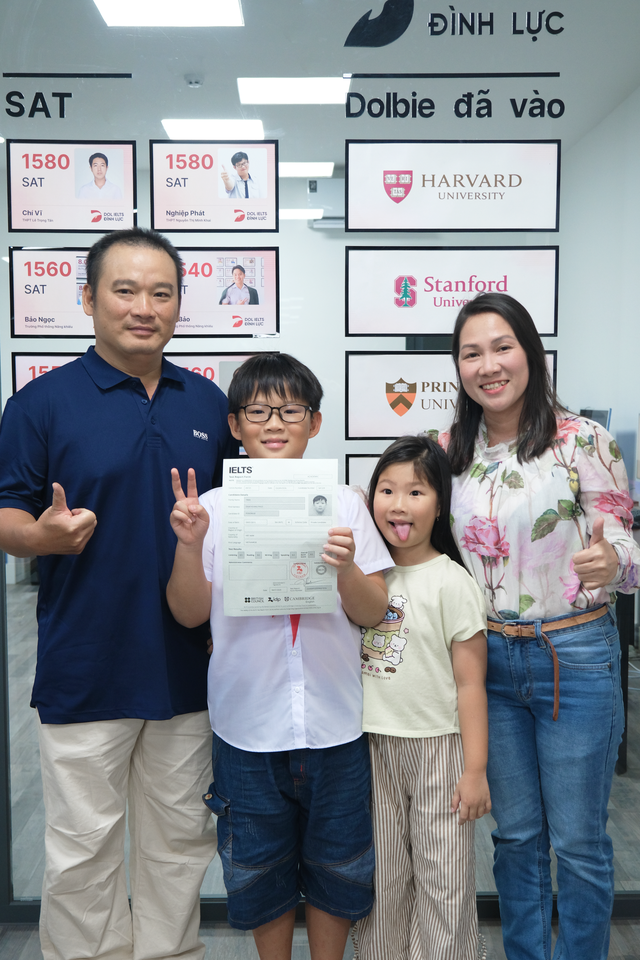
Tran Dinh Hoang Phuc (L, 2nd) poses with his family.
His father, Tran Dinh Hoang Hung, said the family was "really happy and proud" of the result. Their original goal had been more modest.
"Before DOL English, we hoped that by the end of grade 5 Phuc could reach 7.5," Hung said.
He added the decision to let his son take IELTS at a young age was about experience, not pressure.
"Phuc wants to improve his English skills, but more than that, he has a strong curiosity," Hung said. "He loves reading and learning about science and society."
The father said his biggest concern before DOL English was speaking, as Phuc spent his early years in public school with limited opportunities for English communication.
"After studying at DOL English, all his skills improved," he said. "He's more confident in speaking, and his speaking score reached 8.5."
The transition to an international school environment was also smoother, Hung added, as Phuc was already comfortable using English academically and socially.
Beyond languages, Phuc performs well in mathematics and science and has won silver and bronze medals in international Olympiads. Asked about the future, he said he dreams of becoming a scientist or an interpreter.
At DOL English, he said, teachers are "humorous and dedicated," lessons are easy to understand, and online learning tools allow him to practice at home and receive quick, detailed feedback. Even the textbooks made an impression.
"They're printed in color and look really nice," he said.
For other students preparing for IELTS, Phuc offered a simple message: "I just want to wish everyone good results."
His father's advice to parents considering early academic English study is equally straightforward.
"If you have the chance, let your child experience it," Hung said. "That's how you discover their abilities, strengths and weaknesses, and help them grow."








Max: 1500 characters
There are no comments yet. Be the first to comment.