


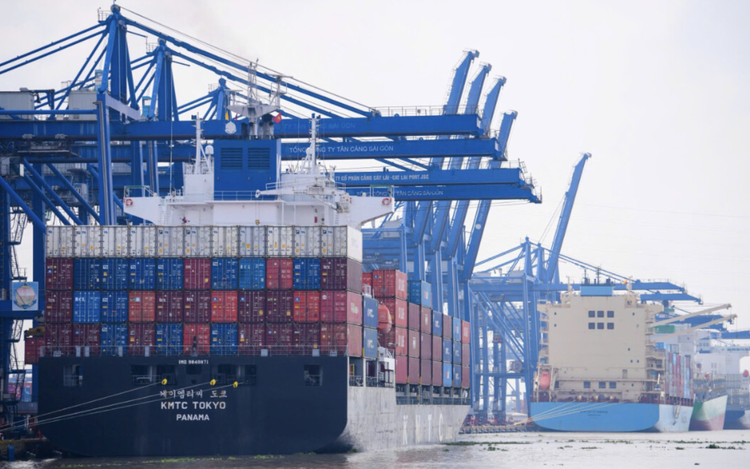
Some maritime transport companies have temporarily stopped accepting shipments to the Middle East due to concerns over rising freight rates and to ensure safety. Photo: Quang Dinh / Tuoi Tre
Though the Middle East is not a primary export destination for Vietnam, it plays a crucial role as a transit hub for global trade, serving as a key corridor linking Asia with Europe.
Firms fear that the growing instability could lead not only to delayed deliveries but also to a sharp reversal in shipping rates and surcharges after a period of significant declines earlier this year.
Nguyen Thanh Tuan, director of Ho Chi Minh City-based logistics firm Blue Sea Transportation Trading Co., told Tuoi Tre (Youth) newspaper that his company is carefully weighing new orders.
If tensions persist, forcing vessels to avoid high-risk waters, shipping costs will inevitably rise due to additional fees and longer transport times.
“If something disrupts the Strait of Hormuz, ships may have to reroute around Africa, which means more fuel and at least one to two extra weeks of travel,” Tuan said.
“Shipping lines would then impose war-risk surcharges, pushing costs up considerably.”
Given that shipments to the Middle East represent only a small share of the company’s business, the firm is considering temporarily halting new orders to limit risk.
From Sunday to Monday, rising instability in the Middle East forced several of the world’s largest shipping companies to suspend or adjust operations through the strategic sea lanes in order to ensure the safety of vessels and crews and manage insurance and legal risks.
Danish shipping giant Maersk announced a temporary halt to all sailings through the Strait of Hormuz until further notice, citing safety concerns.
Its ships will instead reroute via the Cape of Good Hope, significantly increasing both time and cost.
The company has also temporarily closed its representative offices in the UAE, Qatar, and Oman.
Similarly, other global shipping lines announced a temporary suspension of operations through the affected region.
The ripple effects are not limited to the logistics sector.
Export-oriented industries such as textiles, footwear, furniture, and electronics that compete heavily on price and delivery schedules are also growing cautious.
In these industries, even a one-to-two-week delay can cause customers to shift orders to other countries.
“Costs rise while supply chain reliability is reduced. It’s a double shock,” said a representative of an export company.
Prior to the latest tensions, the maritime shipping market had been relatively stable.
Data from freight platforms such as Xeneta and Freightos showed that rates from Vietnam to the U.S. West Coast in February ranged from about US$1,550 to $2,550 per 40-foot container, roughly 20 percent lower than the peak seen in January.
Rates to the U.S. East Coast and the Middle East had also declined 10-15 percent year on year thanks to an influx of new vessels entering the market in 2025.
Logistics firms warn that this trend could quickly reverse.
One freight forwarder in Ho Chi Minh City estimated that if the conflict expands, war-risk surcharges alone could climb by $200 to $500 per container, while higher fuel and insurance costs would add further pressure as ships detour away from unstable areas.
The Strait of Hormuz, the sole maritime gateway from the Persian Gulf to the open ocean, handles roughly 20 percent of global crude oil shipments each year.
Any disruption there can send shockwaves through energy and transportation markets worldwide.
Although Vietnam is geographically distant from the conflict zone, its exports to Europe and the eastern United States depend heavily on shipping routes passing through the Middle East and the Suez Canal.
Air cargo disruptions add to pressure
Air transport has also been affected.
At major Vietnamese gateways such as Noi Bai International Airport in Hanoi and Tan Son Nhat International Airport in Ho Chi Minh City, several Middle Eastern airlines have canceled flights due to operational challenges in regional transit hubs.
Many cargo shipments bound for Europe, the United States, and the Middle East typically transit through hubs such as Doha, Dubai, Abu Dhabi or Istanbul, said a representative from a logistics firm in the southern metropolis.
When these hubs experience disruption, supply chains quickly become congested.
With transport capacity shrinking abruptly while export demand remains high in early March, air freight rates are expected to climb 15-35 percent depending on the route and cargo type.
The representative said that booking space for shipments to Europe or the United States could remain nearly impossible for the next one to two weeks.
Flights that are still operating often detour around Saudi Arabian airspace and the Red Sea, adding two to five hours per leg and significantly increasing fuel costs.
Some cargo has already reached transit hubs but cannot continue its journey due to a lack of connecting flights, leaving electronics, garments, components, and perishable goods particularly vulnerable.
Exporters brace for uncertainty
Local exporters shared that they are closely monitoring the situation before committing to urgent new contracts.
A seafood company in Ho Chi Minh City noted that frozen exports to Europe rely heavily on connecting flights through the Middle East.
“Even a two- or three-day delay triggers customer complaints,” a representative of the firm said.
Experts said that if flight cancellations prove temporary, the market could stabilize within one or two weeks.
However, prolonged disruption would likely push more cargo onto sea routes, further straining maritime shipping capacity and driving additional price volatility.
The Ministry of Industry and Trade warned that instability in the Middle East has piled up pressure on global transportation and trade.
Rising fuel prices and logistics costs could affect Vietnam’s production and export sectors.
The Agency of Foreign Trade advised exporters to closely track developments, proactively adjust production and shipping plans, diversify supply sources and markets, and carefully review logistics, insurance and force-majeure clauses in contracts to reduce potential risks.
Risks and opportunities
Despite the uncertainty, some exporters see potential upside.
Supply chain disruptions often prompt importers to increase stockpiling, potentially boosting demand for Vietnamese products such as cashew, pepper, tea, dried fruits, seafood, charcoal, and electronic equipment.
However, companies said the immediate challenge is managing logistics risk.
In a world where a single maritime chokepoint can disrupt global supply chains, proactive transport planning, insurance coverage and alternative routing strategies will determine how well Vietnamese businesses weather the turbulence in 2026, said a representative from a Vietnamese firm.
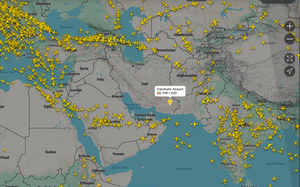
The Middle East conflict escalated on Saturday last week after the U.S. and Israel carried out airstrikes on multiple targets in Iran.
Tehran later responded with attacks on Israeli territory and missile launches targeting dozens of U.S. bases in Gulf countries, including the United Arab Emirates, Kuwait, Saudi Arabia, Qatar, Bahrain, and Oman, resulting in casualties and property damage.
Tehran declared the Strait of Hormuz closed and warning it would attack ships attempting to pass through it.








Max: 1500 characters
There are no comments yet. Be the first to comment.