


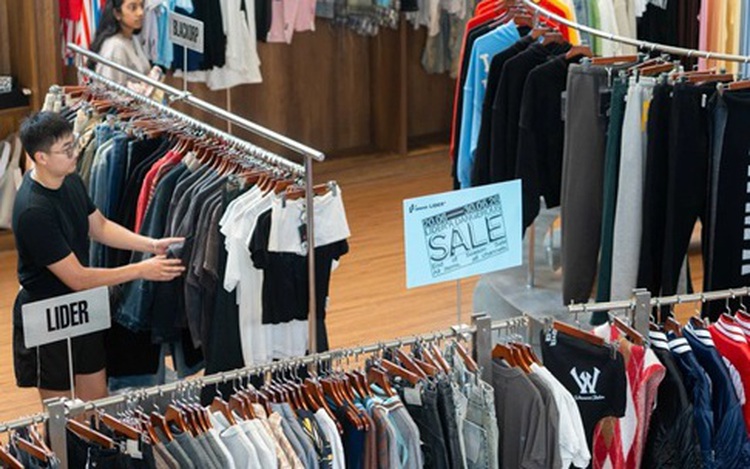
A fashion complex in Ho Chi Minh City. Photo: Huu Hanh / Tuoi Tre
Washington has imposed import tariffs of 10 to 12.5 percent on goods from 60 trading partners since midnight on July 24 (U.S. time).
Vietnam is among the economies subject to the higher rates, alongside Australia, Brazil, China and Japan.
Vietnamese goods retain competitive edge
Vietnamese textile and garment companies said they remained competitive under the new U.S. tariffs, while stressing that their operations complied with domestic laws and international labor standards.
The tariffs were introduced under Section 301 of the U.S. Trade Act of 1974.
U.S. Trade Representative Jamieson Greer said the move was aimed at pressuring trading partners to strengthen enforcement of bans on imports linked to forced labor.
The 60 economies targeted by the measures account for 99.4 percent of total U.S. imports, according to the Office of the U.S. Trade Representative.
A representative of a yarn manufacturer with a factory in Tay Ninh Province, southerm Vietnam, told Tuoi Tre (Youth) online newspaper that the announcement offered no significant country-specific exemptions for textile and garment products.
The 2.5-percentage-point gap between Vietnam's tariff rate and those applied to competing markets therefore warranted attention, the representative said.
Still, the rate remained below the 20 percent imposed on Vietnamese goods earlier this year, while Vietnam continued trade negotiations with the United States.
He added that Vietnamese yarn, textile and garment companies, particularly those exporting to the United States and other markets with strict standards, have long operated without using forced labor.
"We strictly comply with Vietnamese labor laws. Vietnam has also ratified the International Labour Organization (ILO)'s core conventions on forced labor," the company representative said.
"To demonstrate compliance, companies provide their partners with written commitments that they do not use forced labor and require suppliers to make similar pledges."
In an earlier submission to USTR, the Vietnam Chamber of Commerce and Industry, or VCCI, said Vietnam's production and business activities showed no systemic overcapacity or evidence that forced labor was used to produce exports, contrary to the concerns raised.
VCCI also said Vietnam's labor laws and practices were consistent with international standards, including those governing forced labor.
Vietnam has continued to align its legal framework with international standards, including commitments under new-generation free trade agreements and the International Labour Organization's Forced Labour Conventions No. 29 and No. 105.
The 2019 Labor Code prohibits forced labor in all forms and protects workers' rights to freely choose employment and negotiate working conditions and wages. VCCI said these rights were widely observed in practice, particularly in the manufacturing sector.
Local firms diversify export markets
Vietnamese textile and garment companies are diversifying export markets and reducing their reliance on the United States as rising costs, weaker demand and logistics disruptions weigh on the industry.
Pham Van Viet, a representative of the Ho Chi Minh City Association of Garment, Textile, Embroidery and Knitting, or AGTEK, told Tuoi Tre that fiber, yarn and fabric production continued to grow, while garment manufacturers were struggling with rising production costs and weaker demand in the U.S. market.
Viet said the new tariff would increase competitive pressure on Vietnamese goods from rival exporters subject to a 10 percent rate.
However, negotiations between the two governments continued to show positive signs, while Vietnam was working to address issues related to its trade balance with the United States.
Speaking as chairman of Viet Thang Jean Co. Ltd., Viet said the company was increasing its use of locally sourced materials, investing in technology and developing its own branded products to strengthen competitiveness.
He added that textile and garment companies were facing further challenges as prolonged instability in the Middle East had extended shipping times from about 15 days to 60-75 days, putting pressure on cash flow and insurance costs.
To reduce its reliance on the U.S. market, the company plans to cut shipments there by 20 to 30 percent in the third and fourth quarters, depending on the product category.
Viet said the company was also expanding into ASEAN, Japan, South Korea and Africa to diversify its markets.
It is increasing its use of U.S.-sourced cotton to meet traceability requirements and streamlining production to reduce costs amid intensifying competition.








Max: 1500 characters
There are no comments yet. Be the first to comment.