


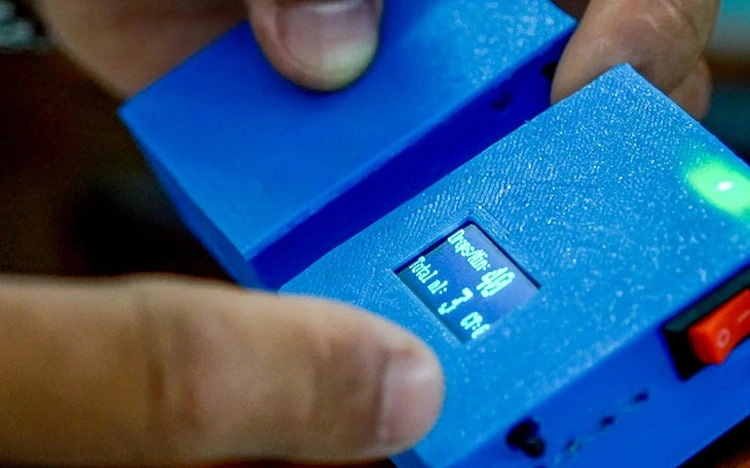
A portable, battery-powered automatic IV drip rate monitoring device developed by Huynh Minh Duong, head of the nursing department at Ca Mau General Hospital in Ca Mau Province, southern Vietnam. Photo: Thanh Huyen / Tuoi Tre
Monitoring IV infusions is a critical part of patient care because the flow rate must strictly follow a doctor's prescription.
Medical experts warn that administering IV fluids too quickly, especially to patients with cardiovascular disease or kidney failure, can cause circulatory overload, potentially leading to life-threatening complications such as acute pulmonary edema, heart failure, or sudden respiratory failure.
As a result, nurses must carefully monitor IV drip rates throughout each infusion.
However, at many hospitals in Vietnam, including Ca Mau General Hospital, this task is still performed manually using a stopwatch and visual observation.
For patients requiring infusion rates of 80-100 drops per minute, counting drops by eye can be both tiring and prone to error.
Nurses typically spend two to three minutes at each patient's bedside adjusting the IV to the prescribed rate.
Hospital statistics show that between 300 and 400 patients receive IV therapy there each day.
In a ward with around 60 patients during a morning shift, nurses may spend nearly three hours adjusting IV flow rates alone, leaving less time for other essential patient care.
Concerned by his colleagues' heavy workload, Huynh Minh Duong, head of the nursing department at Ca Mau General Hospital, set out to develop a practical solution.
After months of testing, his team developed the hospital’s first locally made automatic IV drip rate monitoring device.
This portable, battery-powered equipment operates through a simple mechanism.
Once IV fluid begins flowing and the system detects the first four drops, built-in sensors calculate the flow rate and display it on an electronic screen.
Instead of waiting a full minute to count drops manually, nurses simply read the displayed rate and adjust the mechanical valve to match the prescribed flow rate.
The device significantly shortens the adjustment process, allowing medical staff to spend more time caring for patients while reducing the risk of errors caused by incorrect IV flow rates.
Another major advantage is its affordability.
Duong said each unit costs only about VND2 million ($76.2) to manufacture, compared with imported electronic infusion pumps priced between VND30 million ($1,140) and VND40 million ($1,520).
Its lightweight, portable design also allows nurses to easily carry it between patient beds and hospital wards.
Unlike bulky electronic infusion systems that are typically installed in fixed locations, the compact device can be used flexibly throughout the hospital, making large-scale deployment more practical and cost-effective.
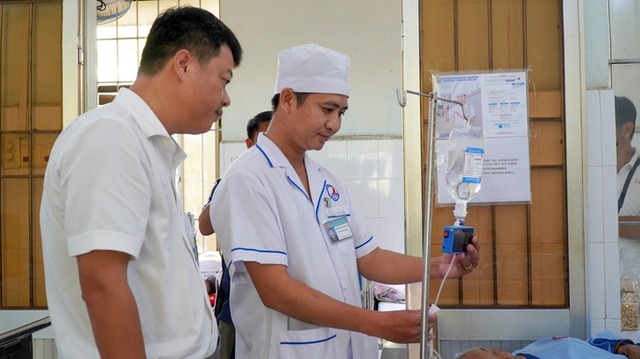
Huynh Minh Duong, head of the nursing department at Ca Mau General Hospital in Ca Mau Province, southern Vietnam, instructs a medical worker on how to use the automatic IV drip rate monitoring device. Photo: Thanh Huyen / Tuoi Tre
A key breakthrough feature of the equipment is that each patient’s infusion rate and remaining fluid volume will be directly transmitted to a centralized monitoring screen at doctors’ and nurses’ stations.
Whenever abnormalities are detected or an IV bottle is close to empty, the system will automatically issue an audible alert so medical staff can respond immediately without having to check each patient individually.
Phan Thi Chanh, whose family member is receiving treatment at the hospital’s geriatrics department, said nurses previously had to stand beside patients with a stopwatch while carefully monitoring IV bottles.
Now, nurses simply attach the device to the IV tubing and let it automatically calculate the flow rate, making their work much easier.
“In the past, family members often had to stay up all night monitoring the IV bottle. Whenever it was about to run out, they had to rush to find medical staff to replace it,” Chanh said.
“Now the device’s built-in smart alert system lets medical staff know in advance when the IV fluid is nearly depleted so they can replace it promptly without patients or their families having to worry.”
Following successful trials, the hospital’s board of directors has approved plans to deploy the device across all departments and has allocated funding for additional production.
Duong is now developing a second-generation version with several technological upgrades.
The new model will be able to accurately measure the volume of fluid already infused, automatically stop the flow once the prescribed amount has been delivered, detect air bubbles in the IV tubing, and transmit alerts remotely.
Duong hopes the upgraded device will further improve treatment quality, reduce nurses’ workload, and eventually be adopted by hospitals across Vietnam.









Max: 1500 characters
There are no comments yet. Be the first to comment.