



Cao Thi Ngoc Dung, chairwoman of Vietnamese jewelry maker Phu Nhuan Jewelry JSC. Photo: Quang Dinh / Tuoi Tre
She made the statement during an online meeting with investors after Dang Ngoc Thao, former director of PNJ’s wholly-owned gemstone certification subsidiary P-Lab, was prosecuted and detained in a transnational diamond smuggling case.
Dung emphasized that PNJ had no involvement with the 28,000 smuggled diamonds under investigation.
She said PNJ only imports diamonds legally from overseas suppliers, mainly in Thailand and Hong Kong, with full documentation.
“P-Lab has no business function involving diamond trading," Dung said.
“PNJ has no diamond purchase or sales transactions with P-Lab.
“The smuggled diamonds mentioned in the investigation never entered PNJ’s distribution network.”
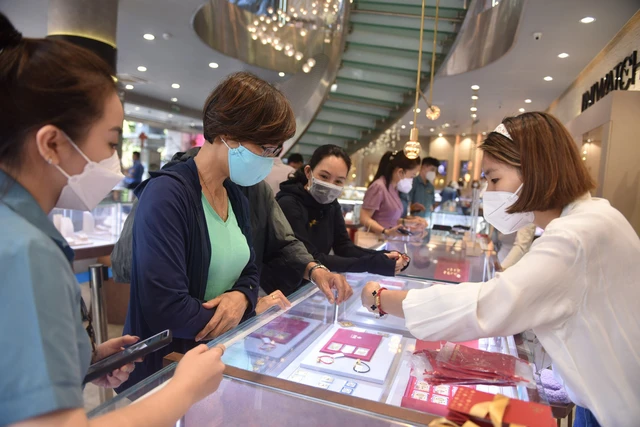
Diamond-related products account for about 33 percent of Vietnamese jewelry maker Phu Nhuan Jewelry JSC’s jewelry revenue, according to Vietnamese securities firm SSI. Photo: Ngoc Phuong / Tuoi Tre
PNJ acknowledged a temporary surge in customers selling diamonds back to the company following the July 2 announcement of Thao’s arrest, but she said transactions quickly returned to normal.
Inventory levels rose briefly but remained under control, while sales of new jewelry products continued.
Regarding governance concerns, PNJ said that although Thao and Dang Thi Lai, PNJ board member and chairwoman of P-Lab, are family members, personnel appointments were based on objective criteria, with internal audit and management systems operating independently.
Dung also confirmed plans to repurchase up to eight million treasury shares, equal to 1.6 percent of outstanding shares, and said she and some staff intend to accumulate PNJ shares through family members.
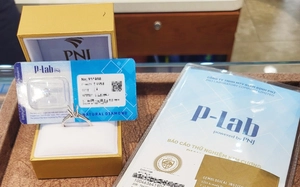
Dung added that P-Lab continues to operate normally as an independent diamond grading laboratory.
Family member registers to buy 300,000 shares
In related news, Dung’s younger brother Cao Ngoc Duy has registered to purchase 300,000 PNJ shares after the stock hit its intraday lows for two consecutive sessions.
The transaction, scheduled to take place between July 10 and August 7, is expected to raise Duy’s ownership from more than 13.5 million shares to over 13.8 million shares, or from 2.64 percent to 2.7 percent.
Meanwhile, Dung currently owns more than 15 million PNJ shares, equivalent to a 2.93-percent stake in the company.
Based on PNJ’s closing price of VND54,600 (US$2) per share on Monday, Duy would spend approximately VND16.4 billion ($624,000) on the purchase.
On Monday, PNJ dropped 6.98 percent to VND54,600, its lowest level since last August. Trading volume reached roughly 565,000 shares, while sell orders at the floor price exceeded 11.4 million shares.
Last Friday, the stock also closed at its daily lower limit with more than 12 million shares offered at the floor price.
After the two-session sell-off, PNJ’s market capitalization fell over VND4.3 trillion ($163 million) to approximately VND27.94 trillion ($1 billion).
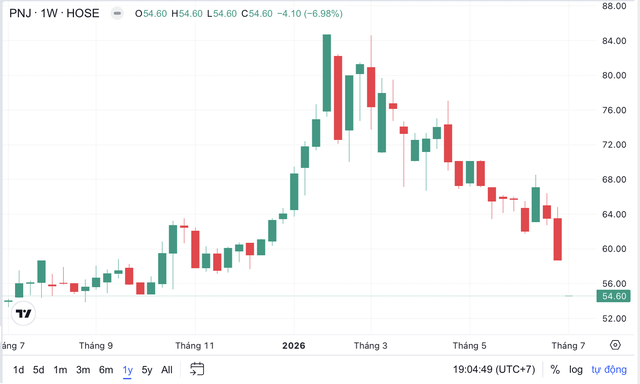
Vietnamese jewelry maker Phu Nhuan Jewelry JSC’s share price performance over the past year. Photo: TradingView
Analysts urge caution as investigation continues
Vietnamese securities firm SSI on Monday warned that while short-term risks to PNJ’s liquidity and business operations are manageable, the bigger challenge lies in consumer confidence, brand reputation, and corporate governance.
SSI lowered its forecast for PNJ’s 2026 net profit to VND3.333 trillion ($126 million) from VND3.569 trillion ($135 million).
The brokerage said it has placed its recommendation and target price for PNJ shares under review until additional findings are released by authorities.
According to SSI, diamond-related products account for roughly 33 percent of PNJ’s jewelry revenue.
As a result, any prolonged decline in consumer confidence could weigh on revenue growth in the years to come.
SSI added that recent inspections and investigations extend beyond PNJ to other companies in the jewelry sector, suggesting consumers may view the issue as an industry-wide concern rather than one affecting only PNJ.
The brokerage said that the incident has increased investor focus on PNJ’s governance and internal control systems.
PNJ maintains controls over P-Lab’s grading activities, while its diamond supply mainly comes from officially imported products and customer buybacks.
However, grading certificates verify only a diamond’s technical characteristics at the time of inspection and do not confirm its origin, SSI said.
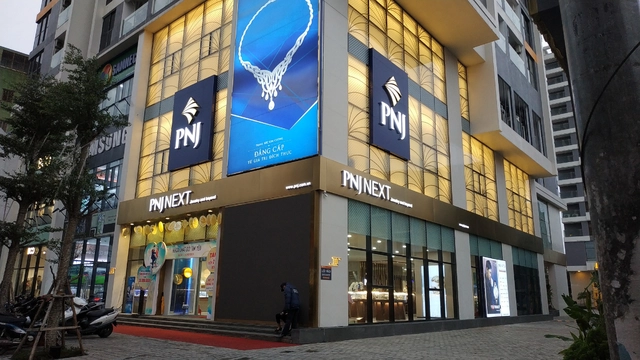
A retail store of Vietnamese jewelry maker Phu Nhuan Jewelry JSC. Photo: Supplied
Other market analysts urged investors not to react hastily before more official information becomes available.
Huynh Anh Huy, director of sector research at Kafi Securities, said the sell-off was driven mainly by market sentiment, suggesting investors carefully assess whether the case will affect PNJ’s operations and long-term prospects.
In his view, the investigation currently appears to involve legal issues related to an individual at P-Lab rather than PNJ’s core business, although developments should continue to be monitored.
Nguyen Thanh Trung, CEO of FinSuccess JSC, also said investors should wait for further disclosures from company management before fully assessing the impact on business prospects.
As of the first quarter of 2026, PNJ held approximately VND4.5 trillion ($171 million) in cash and short-term investments, excluding bank credit facilities, along with VND13.4 trillion ($510 million) in inventory.
With around 400 retail stores, the company’s short-term liquidity remains solid, Trung said.
He advised existing shareholders to remain patient and monitor further developments, while cautioning new investors against rushing to buy the stock before the investigation becomes clearer.
Rong Viet Securities warned that broader investigations could create corporate governance risks and damage PNJ’s brand if customer confidence weakens.
Vietcap Securities viewed the short-term impact on business operations and market sentiment as limited.
Meanwhile, Yuanta Vietnam outlined three possible scenarios, including a base case where violations are limited to individuals at P-Lab, a positive case where all smuggled diamonds are confirmed to be outside PNJ’s system, and a worst-case scenario where unverified diamonds enter PNJ’s supply chain, potentially damaging revenue and brand value.








Max: 1500 characters
There are no comments yet. Be the first to comment.