


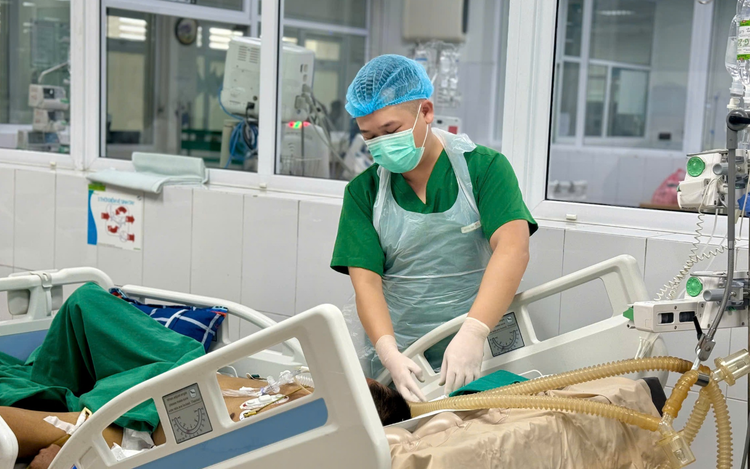
A doctor at the National Hospital for Tropical Diseases checks the health of a patient. Photo: Supplied
P. falciparum is the deadliest malaria parasite and the most prevalent on the African continent, according to the World Health Organization.
Returning to Vietnam with persistent jaundice, he took traditional herbal medicine, leading to impaired consciousness.
Dr. Vo Duc Linh of the intensive care center at the National Hospital for Tropical Diseases in Hanoi said the patient, identified as L.V.N., from Ha Tinh Province in north-central Vietnam, had a history of hepatitis B dating back to 2009 but he had never received treatment.
During his nearly two years in Congo, the man experienced multiple episodes of fever and chills, but the underlying cause was never identified.

About a month before being hospitalized, he developed progressively worsening yellowing of the skin and eyes, accompanied by fatigue and a loss of appetite.
He returned to Vietnam to seek medical attention.
Although doctors recommended hospital admission, he refused and instead purchased traditional herbal medicine, which he took for some 15 days.
On the evening of October 6, his family found him collapsed and unresponsive.
He was taken to a nearby medical facility, where doctors intubated him and placed him on a ventilator.
He was treated for suspected sepsis, while hepatic encephalopathy associated with his underlying hepatitis B was also considered.
However, his condition failed to improve, prompting his transfer to the National Hospital for Tropical Diseases.
Upon admission to the intensive care center, the patient was in critical condition, with pronounced jaundice and dark-colored urine.
Tests revealed blood clotting abnormalities, elevated bilirubin and liver enzyme levels, and kidney dysfunction, indicating damage to multiple organs.
According to Dr. Linh, the patient’s history of hepatitis B, combined with jaundice and impaired consciousness, initially led doctors to suspect severe liver disease.
However, his nearly two-year stay in a malaria-endemic region, together with his history of recurrent fever and chills, raised suspicions of another underlying cause.
Doctors ordered tests for malaria parasites, which returned positive for P. falciparum, capable of causing severe, rapidly progressing and potentially fatal malaria.
People returning from endemic regions urged to exercise caution
Malaria is an infectious disease caused by Plasmodium parasites, transmitted primarily through the bites of infected female Anopheles mosquitoes.
Common symptoms include fever, chills, headaches, fatigue, and muscle aches.
In severe cases, however, symptoms such as impaired consciousness, acute kidney injury, respiratory failure, severe anemia, blood clotting disorders, and multiple-organ damage may become more prominent than fever.
Dr. Linh stressed that the absence of fever at the time of examination does not rule out malaria, particularly in people who have lived in or recently returned from regions where the disease is endemic.
Symptoms may also overlap with those of underlying medical conditions, making diagnosis more challenging.
In this case, the patient’s untreated hepatitis B and use of traditional herbal medicine were also important factors for doctors to consider when assessing his liver damage.
Dr. Linh advised anyone who has lived or worked in, or recently returned from, a malaria-endemic region, particularly certain African countries, to seek medical attention promptly if they develop fever, chills, headaches, unusual fatigue, jaundice or other unexplained health problems.
When seeking medical care, patients should clearly inform their doctors which countries they have visited, how long they stayed, whether they experienced previous episodes of fever and what medications they have taken.
This information can help doctors determine which tests are necessary.
People who stay in malaria-endemic areas should take precautions against mosquito bites, including sleeping under mosquito nets, using insect repellents and wearing long-sleeved clothing.








Max: 1500 characters
There are no comments yet. Be the first to comment.