


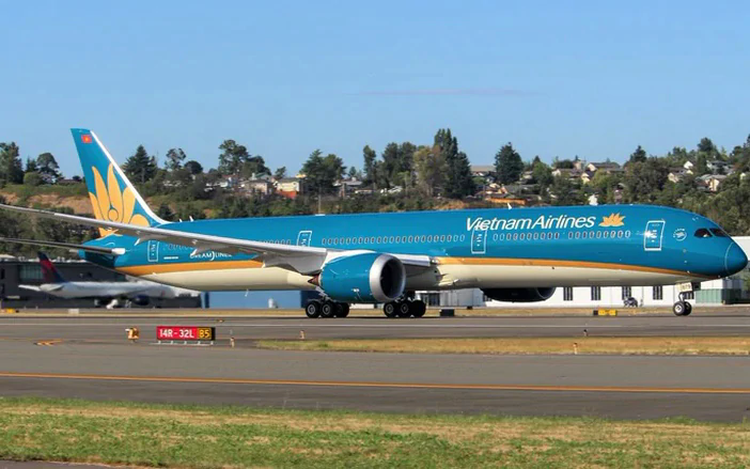
Vietnam Airlines was the first Vietnamese carrier to operate scheduled nonstop flights to the U.S. Photo: Vietnam Airlines
Nonstop flights save passengers hours of travel
From the U.S., many Vietnamese families are eagerly looking for flights home for Tet 2027.
For older travelers and families with young children, nonstop flights are a top priority as they eliminate the need to drag luggage through transit airports and wait for hours between flights.
Vietnam Airlines is currently the only Vietnamese carrier operating scheduled nonstop flights between Ho Chi Minh City and San Francisco.
For connecting flights, passengers have numerous familiar options, including EVA Air, China Airlines and Starlux Airlines via Taiwan, as well as Korean Air and Air Premia via South Korea.
Connecting flights are usually VND2-4 million (US$76.8-153.5) cheaper and offer a wider range of departure times, but they extend total travel time and add the fatigue of changing gates and aircraft.
During the Tet peak season, round-trip nonstop fares can reach VND30-60 million ($1,152-2,304) and seats sell out quickly. Still, many passengers are willing to pay more to cut around 10 hours from their journey.
Khanh Nguyen, a Vietnamese American who has lived in the U.S. for 15 years, used to travel to Vietnam via Northeast Asia and on one trip had to route through the Middle East.
After Vietnam Airlines launched its nonstop service, her family began prioritizing the Vietnamese carrier for its convenience and familiarity.
The current nonstop service is the result of years of efforts by Vietnam’s aviation industry. It was not until late 2021 that the long-standing goal of a seamless air link between Vietnam and the U.S. became a reality.
On the evening of November 28, 2021, Vietnam Airlines flight VN98 departed Tan Son Nhat International Airport and landed in San Francisco nearly 14 hours later, marking the launch of the first scheduled commercial nonstop route between Vietnam and the U.S. after around two decades of preparation.
However, the journey from the U.S. to Vietnam takes around 16 hours, making fuel costs a major factor in the route’s profitability.
Airlines offering one-stop services have an advantage in consolidating passengers and offering more competitive fares.
To attract more passengers, Vietnam Airlines has recently worked with travel agents and tourism companies in San Francisco, San Jose and Los Angeles and surveyed the Seattle market.
In the first six months of this year, Seattle ranked fourth in terms of the number of passengers traveling to Vietnam, with more than 60,000 trips, up 13.7 percent year on year.
The route could also attract passengers from Vancouver, Canada. This is seen as an additional source of passengers for the route as Northeast Asian airlines continue to expand their networks to the U.S.
Bringing Elon Musk’s satellite Internet service onboard
While Vietnam Airlines is seeking to maintain the appeal of its U.S. route, Vietjet is investing in passengers’ connectivity throughout their flights.
According to Reuters, a draft package of 29 agreements between Vietnamese and U.S. businesses could be announced in New York on September 23. Vietjet is expected to lease 17 Boeing 737s and five Airbus A321neos and cooperate with SpaceX to provide Starlink service on 120 aircraft.
Vietjet has not officially confirmed the details, but previous announcements by the airline indicate that it has taken steps toward bringing satellite Internet onto its aircraft.
In August 2026, Vietjet’s board of directors approved an additional VND250 billion ($9.6 million) investment in Galaxy Pay, increasing its capital in the company from VND50 billion ($1.9 million) to VND300 billion ($11.5 million). Galaxy Pay is wholly owned by Vietjet, with the additional capital earmarked for investment in Starlink.
In early 2025, Vietjet executives met with SpaceX and technology partners in the U.S. before negotiating with several Internet service providers for its future fleet.
On May 20, 2026, Vietjet signed an in-flight Internet service agreement with Starlink Services Vietnam. Three months later, the airline increased its investment in Galaxy Pay by VND250 billion ($9.6 million).
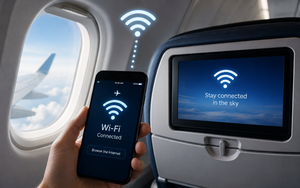
Many passengers are looking forward to having Internet access during flights, allowing them to send contracts, handle emails or contact their families while in the air. If the connection is stable, Wi-Fi could become a factor in choosing an airline for long-haul journeys.
For airlines, satellite connectivity could create additional digital services and revenue streams, but they must meet technical, safety and licensing requirements.
Ho Ngoc Yen Phuong, Vietjet’s vice chairwoman, said the airline would continue expanding its fleet while also developing training, maintenance, ground services and aircraft leasing.
Race to buy aircraft, secure international financing
In June 2026, Vietnam Airlines received a preliminary guarantee commitment worth more than $2.9 billion from the U.S. Export-Import Bank for a loan to purchase 50 Boeing 737 MAX 8 aircraft.
The commitment is not yet disbursed funding but will support the airline in arranging international financing. The aircraft are expected to be delivered between 2030 and 2032.
Four months earlier, Sun PhuQuoc Airways announced an order for up to 40 Boeing 787-9 aircraft, the largest wide-body aircraft order by a Vietnamese airline.
With a range of more than 14,000 kilometers, the aircraft could connect Vietnam's Phu Quoc directly with destinations in Europe and North America.
According to aviation experts, the three airlines are developing complementary components of the market: Vietnam Airlines is developing its U.S. routes, Vietjet is investing in digital services, while Sun PhuQuoc Airways is targeting long-haul routes linked to tourism.
Expanding routes, fleets and services at the same time will give passengers more options and reduce travel time.


Max: 1500 characters
There are no comments yet. Be the first to comment.