


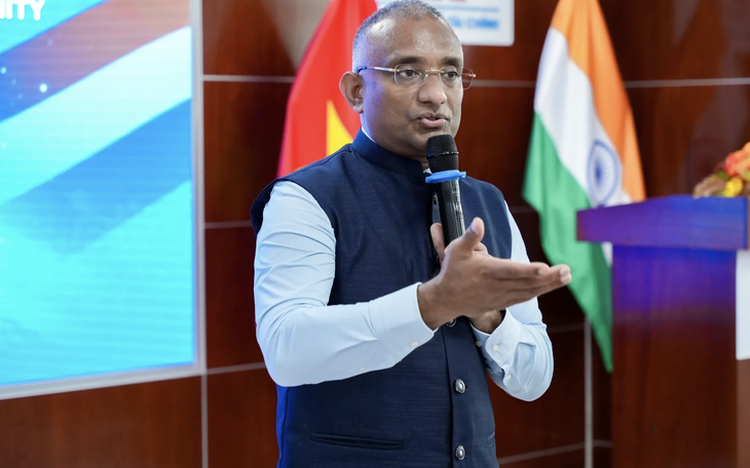
Majo George, dean of the Faculty of Economics at the Ho Chi Minh City University of Economics and Finance. Photo: Supplied
He said the country's quality of life, welcoming environment, and digital transformation convinced him to make Vietnam his long-term home.
George, dean of the Faculty of Economics at the Ho Chi Minh City University of Economics and Finance, said he originally came to Vietnam more than two decades ago with a simple plan: to work for a few years in one of Asia's fast-growing economies before continuing his career elsewhere.
Instead, Vietnam became the place where he chose to build his life.
Over the past 24 years, he has witnessed the country's rapid transformation, including strong economic growth, deeper international integration, and an increasingly important role in global value chains.
Vietnam has become one of the region's most dynamic economies, George noted.
However, he said it was not only Vietnam's economic achievements or infrastructure development that persuaded him to stay, but also the sense of being welcomed and able to integrate into Vietnamese society.
According to George, attracting foreign professionals and creating an environment that encourages them to remain long-term are two different challenges.
Career opportunities and income are usually the main factors when people first move abroad, he said.
But once they start families and plan for the future, priorities shift toward quality of life, healthcare, education, legal certainty, and social stability.
That is why many countries today compete not only to attract investment but also to retain highly skilled workers.
A good job alone is not enough, he said; people also need a place where they feel confident about building their lives.
The Indian expert described Vietnam's decision to expand social insurance coverage for foreign workers as a positive step.
For many international professionals, he said, such policies represent not only improved benefits but also recognition of their contributions through teaching, business activities, job creation, tax payments, and participation in local communities.
Even so, he believes social insurance is only part of the equation if Vietnam hopes to retain highly qualified foreign professionals.
More importantly, he said, foreign workers and their families need to be able to envision a long-term future in the country.
Based on his own experience living in Vietnam, George said foreign residents continue to face practical administrative challenges involving work permits, temporary residence cards, visa extensions, driver's license conversions, social insurance registration, and procedures related to education and healthcare.
He praised Vietnam's progress in digital transformation through the VNeID platform, saying it has laid the foundation for one of the region's most advanced digital government systems.
George suggested expanding the digital ecosystem so that all foreigners legally residing in Vietnam long-term could receive a single digital identity recognized across all government agencies.
With a securely verified digital identity, many administrative procedures could be completed more quickly, accurately, and conveniently while reducing the need to repeatedly submit the same personal information to different authorities.
Such a system would make daily life significantly easier for foreign professionals and their families, he said, simplifying procedures ranging from obtaining work permits and renewing residence documents to enrolling children in school, accessing healthcare, opening bank accounts, and purchasing property.
Faster, more transparent, and more user-friendly administrative services would allow foreign professionals to devote more time to contributing to Vietnam's economy and society instead of navigating complex paperwork.
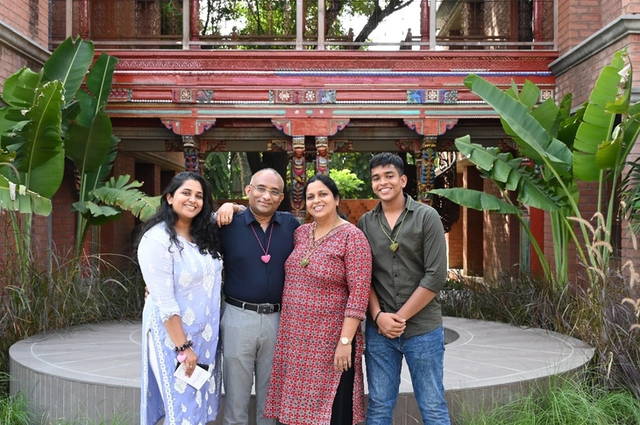
Majo George's family. He said both his son and daughter completed part of their education in Vietnam. Photo: Supplied
Since July 1, 2025, foreigners legally residing in Vietnam have been eligible to apply for a Level 2 VNeID electronic identification account.
According to guidance from Ho Chi Minh City police, the initiative marks another step in Vietnam's digital transformation by enabling foreigners to access public services more conveniently, reduce paperwork, and use a wider range of digital services in their daily lives.
Through VNeID, users can integrate information from their residence cards, complete certain administrative procedures online, verify their identity for transactions, and access digital services more securely and conveniently.
Eligible applicants include foreigners holding valid permanent or temporary resident cards in Vietnam.
Applicants are required to present a valid passport or international travel document, a residence card, a registered mobile phone number, an email address, and to appear in person at an immigration office.
Authorities said applications will be processed within three working days if biometric data are already available in the system, or within seven working days if additional biometric information is required.
The system is expected to make it easier for foreigners to live, work, and establish long-term ties in Vietnam.








Max: 1500 characters
There are no comments yet. Be the first to comment.