


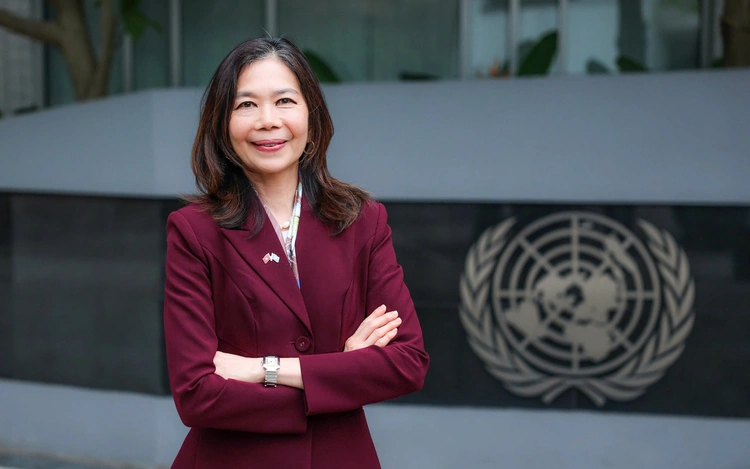
Pauline Tamesis, United Nations Resident Coordinator in Vietnam. Photo: Nguyen Khanh / Tuoi Tre
She shared these views in an interview with Tuoi Tre (Youth) newspaper on the occasion of the Lunar New Year holiday, highlighting Vietnam’s development journey, its commitment to multilateralism, and priorities for future UN–Vietnam cooperation.
Vietnam recently established diplomatic relations with the island nation of Tuvalu, becoming one of the few countries in the world to have diplomatic relations with all 193 UN member states. And moreover, Vietnam has built a diverse network of partnerships including comprehensive strategic partnerships with all five permanent members of the UN Security Council. So from the UN perspective, what does this milestone reveal about Vietnam policies of being a friend to all nations that it has pursued for decades?
Vietnam's establishment of diplomatic relations with 193 member states of the United Nations is a remarkable milestone. It reflects a long-standing foreign policy anchored in openness, dialogue and mutual respect. From the UN's perspective, this achievement speaks to Vietnam's strong commitment to multilateralism anchored in the UN Charter and its determination to contribute meaningfully to the international community.
Vietnam's expanding network of strategic comprehensive strategic partnerships including with all five permanent members of the UN Security Council demonstrates a country that is actively seeking cooperation beyond political and geographic boundaries. It underscores Vietnam's belief that global challenges require shared solutions and that constructive engagement is the best pathway to peace, stability and sustainable development. This milestone also reaffirms Vietnam's role as a responsible and trusted partner, one that listens, builds consensus and upholds the principles of the UN Charter.
The policy of being a friend to all nations is not only a diplomatic orientation, it's a reflection of Vietnam's identity as a country that values peace, harmony, resilience and balance. At a time when the world is facing increasing fragmentation, Vietnam's approach offers an important message that cooperation not division is the way forward. The United Nations appreciates Vietnam's constructive leadership and its steadfast support for multilateralism.
Vietnam is now regarded as a particularly remarkable development story. We are rising from the ruins of war, pursuing opening up and integration and it now maintains relations with all UN member states and it is recognized as one of the few countries capable of maintaining balanced relationships with virtually all international partners. So in your point of view, what inspirations can this journey offer to a world increasingly marked by divisions and could Vietnam serve as a bridge to promote dialogue, peace and cooperation among nations?
Vietnam's development journey is truly remarkable. In just a few decades, the country has transformed from the devastation of war to one of the world's most dynamic emerging economies, lifting millions out of poverty and expanding opportunities for its people. This transformation did not happen by chance.
It's a result of a clear vision, courageous reforms and a deep belief in the power of openness, inclusion and cooperation. In a world marked increasingly by division and fragmentation, Vietnam's story offers an important source of inspiration. It shows that reconciliation is possible, that bridges can be built even after profound hardship and that progress is strongest when it is anchored in peace and shared prosperity.
Vietnam's ability to maintain balanced and respectful relationships with virtually all international partners reflects a foreign policy rooted in dialogue, mutual respect and the principle of win-win cooperation. The UN acknowledged that Vietnam is well positioned to serve as a bridge builder. Its history gives it a unique perspective and its diplomacy is principled while pragmatic and anchored on consensus building.
Vietnam has already demonstrated this leadership whether it's through its active role in UN peacekeeping, its contributions to regional cooperation or its strong advocacy for climate action and sustainable development. At a time when the world urgently needs trust and cooperation, Vietnam's journey reminds us that nations can choose dialogue over division and partnership over polarization.
Vietnam accelerates toward becoming a developed high-income country by 2045, so what opportunity does this extensive network of relationship create to help Vietnam set advance closer to this objective?
Vietnam's aspiration to become a developed high-income nation by 2045 is both ambitious and attainable.
Achieving this goal will require continued innovation, strong institutions and a resilient future-ready workforce. In this journey international integration is not just a diplomatic priority, it's a strategic engine for development. Vietnam's extensive network of relationships creates several important opportunities.
First, it opens pathways for greater trade, investment and technology transfer which are essential for moving up global value chains and supporting the country's transition towards a green and digital economy. Second, it enables Vietnam to tap into global knowledge, best practices and scientific advancement, particularly in areas like renewable energy, climate resilience, digital transformation and AI governance and social protection. Third, Vietnam's partnership strengthens its ability to address complex cross-border challenges.
Issues such as climate change, pandemics, cybersecurity and clean energy transition cannot be solved by any country alone. Finally, these relationships elevate Vietnam's voice in shaping regional and global agendas. As the country becomes more integrated it is also able to convene and create consensus among different stakeholders helping to promote stability, sustainable development and shared prosperity.
Integration enhances Vietnam's international internal strengths, more skilled human capital, more resilient institutions and a more competitive economy. The UN remains fully committed to supporting Vietnam as it harnesses these opportunities to move closer to its 2045 vision.
Vietnam's Resolution 59 on international integration has defined the country transitions from a recipient to contributor mindset, from follower to pioneer in certain emerging fields. So in your opinions, which area could Vietnam take the lead in and share its experience with the international community?
Vietnam's shift from a recipient to a contributor mindset is a natural evolution of the country's remarkable development journey. It reflects Vietnam is increasingly confident in its capabilities and committed to shaping global solutions. So Vietnam has several areas where it can lead and share valuable experience with the international community.
First, Vietnam's success in poverty reduction and inclusive social policies provides important lessons. Few countries have lifted people out of poverty in such a short time while expanding access to health, education and social protection. Vietnam's people-centered approach rooted in community resilience can be a model for other developing nations.
Second, Vietnam is emerging as a strong voice on climate action and resilience. The country has first-hand experience with climate vulnerability, yet it also has demonstrated commitment to the just energy transition, nature based solutions and disaster risk reduction. Vietnam's leadership in the Just Energy Transition Partnership, or JETP, exemplifies how developing economies can pursue growth while accelerating decarbonization.
Third, Vietnam's growing role in UN peacekeeping reflects its contribution to global peace and security. The professionalism and humanitarian approach of Vietnamese peacekeepers, especially in the medical units and women's participation, has earned international respect. By championing women, peace and security, Vietnam can scale its leadership even further.
Fourth, Vietnam can contribute significantly in the fields of digital transformation and AI governance, also innovation. With a young dynamic population and increasing digital adaptation and adoption, the country is well positioned to pioneer solutions in digital government, smart agriculture, fintech, AI governance that prioritize safety, inclusiveness and public trust.
The UN actually applauds Vietnam's leadership in the signing ceremony of the UN Convention Against Cybercrime, and in the implementation of the Global Digital Compact, leading the way not only for the region, but globally as well.
Finally, Vietnam's longstanding commitment to multilateralism and consensus building is itself a form of global leadership. In a polarized world, Vietnam demonstrates that it's possible to balance relationships, promote dialogue, and champion cooperation. Vietnam is among the countries most vulnerable to climate change impacts.
And most recently, we are experiencing historic storms and floods that devastate the central regions. Recognizing these climate impacts, Vietnam's leadership has committed to achieving net zero by 2050 and pursuing energy transitions. So what initiatives or projects does the UN have to support Vietnam in addressing climate impacts? And what improvements does Vietnam need to make in its climate change response strategies?
Indeed, Vietnam is one of the most climate vulnerable countries in the world.
And the recent historic storms and floods, Ragasa in Baloi in September and Matmo in October in the central region are a stark reminder of the human and economic toll of climate impacts. The UN deeply sympathizes with the affected communities and we commend the government's strong leadership and commitment to achieving net zero emissions by 2050 and advancing a just energy transition. The UN is also working closely with the government of Vietnam through a wide range of initiatives and projects to support this transformation.
Our support includes strengthening climate resilience and disaster preparedness. We work with national and provincial authorities to improve early warning systems, risk based modeling, community based disaster management, and anticipatory action to protect lives and livelihoods.
Supporting the JETP is another.
So together with international partners, the UN provides policy advice, technical expertise, and capacity building to help Vietnam shift towards renewable energy while ensuring the transition is fair, equitable, and leaves no worker or community behind.
Another is enhancing adaptation in nature based solutions. The UN supports, for example, mangrove restoration, climate resilient agriculture, sustainable forestry, and coastal protection, all of which are critical for communities facing rising sea levels and extreme weather.
We also are very much focused on mobilizing climate finance. So we're working with government to unlock public and private investments for green infrastructure, energy efficiency, and climate resilient development, especially for the provinces that are most at risk. We're also advancing the circular and digital economy.
The UN is helping Vietnam adopt greener production models, reduce plastic pollution, and apply digital tools for environmental monitoring and resource management. While progress is significant, Vietnam can still accelerate its climate response through several improvements.
Frist, strengthening implementation at the provincial level.
National policies are strong, but climate adaptation and energy transition require deeper local capacity, clearer responsibilities, and adequate resources for provinces and communities.
Second, scaling up investments in resilience.
Adaptation finance, especially for vulnerable communities, must increase substantially. Investing now will prevent far greater losses
Third, enhancing data, innovation, and digital tools.
So accurate climate data, early warning technologies, and digital solutions will improve planning and risk reduction from the national to the community level.
Fourth, we really want to push for ensuring a just transition for all.
Workers, women, ethnic minorities, and low-income households must be fully supported to adapt to climate impacts and benefit from new green jobs and new technologies.
We can agree that Vietnam and the UN had a very fruitful years of cooperation in 2025. In the coming period, which pillar or sectors will the UN prioritize in supporting Vietnam? And what does the UN expect from Vietnam given its expanding role?
Yes, that's a big question. The UN is committed to supporting Vietnam as it rises through the new era in its development journey, and as it moves towards the 2045 vision of becoming a high-income, inclusive, and sustainable nation. So our priorities are closely aligned with Vietnam's national socio-economic development strategy and the commitments to sustainable development goals. In the coming period, the UN will focus on several key pillars, and it's really resonating with the government's own agenda.
So investing in inclusive human development and social protection. This means ensuring stronger health systems, quality education, universal social protection coverage, and gender equality remain at the heart of investments that are essential for building a resilient and future-ready workforce. Second, we want to be able to support and facilitate inclusive economic and digital transformation.
For us, ensuring that those at risk of being left behind benefit from and contribute to a more productive and gender-responsive economy. And this will guide our support moving forward. So efforts will support green and digital transformation to ensure that prosperity is shared by all.
Next, we are behind Vietnam to accelerate climate action, environmental sustainability, and disaster resilience. We will continue to support Vietnam's net zero pathway, energy transition, climate resilience, and circular economy to ensure that these transitions are inclusive, equitable, and grounded in human rights. Finally, it cannot happen without strong governance and institutions.
So we will continue to support Vietnam in advancing effective public administration, evidence-based policymaking, data governance, and rule of law. In terms of what the UN expects from Vietnam, I think it's very clear that as Vietnam becomes more influential globally, the UN hopes that the country will continue to champion the values it has long upheld, such as dialogue, multilateralism, and inclusive development.
We look forward to Vietnam to promote inclusive human development that leaves no one behind, lead by example on climate action, energy transition, resilience, and digital transformation and AI governance, support a rules-based international order and consensus building anchored in the UN in this era of a multipolar world. So this includes contributing actively to peacekeeping, humanitarian action, and global governance, as well as sharing its development experience through South cooperation.
And toward the end of the interview, what message do you have about the future of UN-Vietnam cooperation for the Vietnamese people on the occasion of the Lunar New Year? And on a more personal note, what has impressed you most about Vietnam during your time working in this country?
Well, as we welcome the Lunar New Year, the Year of the Horse, my message to the people of Vietnam is one of hope, shared purpose, and partnership.
The UN and Vietnam have walked a long journey together, almost 50 years, and this journey is built on trust, mutual respect, and a common aspiration to improving the lives of all people. So in the years ahead, our cooperation will grow even stronger as we work side by side to advance Vietnam's 2045 vision, accelerate the green and digital transformation, and ensure inclusive human development, and that Vietnam's prosperity and progress leaves no one behind.
On a personal note, in the past three years and a half serving as the UN Secretary General's representative in Vietnam, what has impressed me most about the country is the extraordinary resilience and warmth of the Vietnamese people.
In all my interactions, I witnessed how communities, especially those who face hardships, they do so with dignity and determination, and a very strong, unwavering belief in a better world. So I am moved by that spirit of solidarity that defines the Vietnamese society. I am deeply inspired also by Vietnamese youth.
They're innovative, curious, and full of energy. And Vietnam's youth, they are already shaping the country's future, and will be the driving force behind Vietnam's transformation in the decades to come. So as we enter the new year, I wish every family in Vietnam peace, health, and prosperity.
The UN remains proud to be a trusted partner and friend of Vietnam, today and for many years ahead. Chúc mừng năm mới.
Thank you very much for the interview.








Max: 1500 characters
There are no comments yet. Be the first to comment.