


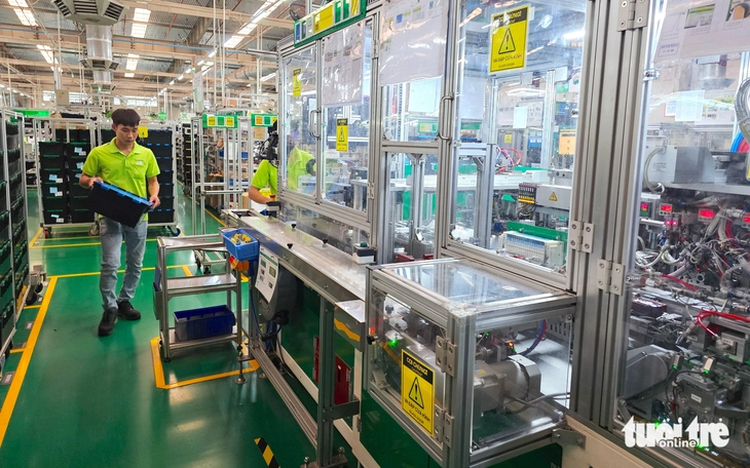
Workers at an FDI enterprise in Ho Chi Minh City. Photo: Cong Trieu / Tuoi Tre
It is creating the conditions that enable high-value investment to generate lasting gains for the domestic economy.
Foreign capital rises as investment profile evolves
Vietnam remained one of Asia's most attractive destinations for foreign investment in the first half of 2026, while the composition of incoming capital began to shift in ways that could have significant implications for the country's long-term development.
According to data released by the National Statistics Office on July 3, total registered foreign investment reached US$34.65 billion by the end of June, up 61 percent from a year earlier. Newly registered capital surged 87.2 percent to $17.39 billion, while the number of new projects rose just 1.3 percent.
The contrast between capital growth and project numbers suggests investors are committing more resources to larger and potentially more strategic projects, rather than simply increasing the volume of investments.
The composition of investors also changed noticeably. Singapore accounted for $7.31 billion, or 42.1 percent of the newly registered capital, followed by South Korea with $5.45 billion, representing 31.4 percent. Japan ranked third with $1.2 billion, while China contributed $977 million.
According to Associate Professor Dr. Nguyen Huu Huan, a senior lecturer at the University of Economics Ho Chi Minh City (UEH), these figures demonstrate that Vietnam continues to benefit from the ongoing reallocation of global capital as companies diversify supply chains amid geopolitical tensions and trade uncertainty.
Singapore's leading position, however, should be interpreted carefully. Beyond being an important investor in its own right, the country serves as a regional financial hub through which many multinational corporations channel investments. As a result, the economy where capital is registered does not necessarily reflect the ultimate source of ownership, technology or strategic decision-making.
South Korea, by contrast, represents a deeper form of industrial investment. Over the past two decades, Korean corporations have established extensive production ecosystems in Vietnam spanning electronics, semiconductor components, digital technology, and supporting industries. Continued expansion by these firms is therefore more likely to strengthen industrial clusters, develop local suppliers, and create opportunities for workforce upgrading.
Dr. Majo George, dean of the Faculty of Economics at the Ho Chi Minh City University of Economics and Finance (UEF), views the latest investment trends as evidence of a broader structural transformation rather than a temporary surge in capital inflows.
"Vietnam is no longer viewed merely as a competitive manufacturing base, but it is increasingly seen as a strategic partner in Asia's innovation ecosystem," he told Tuoi Tre News.
That shift is reflected in the growing concentration of investment in semiconductors, artificial intelligence, data centers, and high-tech electronics, while FDI is also expanding beyond traditional manufacturing into professional, scientific and technological services, energy and digital infrastructure.
Several recent projects illustrate this trend. Samsung plans to invest approximately $1.5 billion in a chip-testing facility in northern Thai Nguyen Province, while Wistron has expanded its project in northern Ninh Binh Province with an additional $24.5 million. Semiconductor companies including Amkor Technology and Hana Micron are also continuing to expand packaging, testing, and manufacturing operations in northern Bac Ninh and Bac Giang Provinces.
Yet larger investment commitments alone do not guarantee stronger economic gains. Their long-term value will depend on Vietnam's ability to absorb new technologies, develop a highly skilled workforce, and integrate domestic firms into increasingly sophisticated supply chains.
"FDI quality does not lie in the industry label or the amount of registered capital, but in the technology, added value, human capital, and capabilities of Vietnamese enterprises created after the project," Huan said.
George argues that the real test of investment quality extends well beyond headline figures.
"Do these investments strengthen Vietnam's innovation ecosystem? Do investors collaborate with universities? Do they develop Vietnamese engineers? Do they create opportunities for domestic technology firms? Do they promote research, patents, and entrepreneurship?" he asked.
Only when these questions can be answered consistently in the affirmative, he said, can Vietnam conclude that the quality of its FDI has fundamentally improved.
"The future competition among nations will no longer be about which country attracts the largest factories, but about which one captures the greatest share of the knowledge created inside those factories," George remarked.
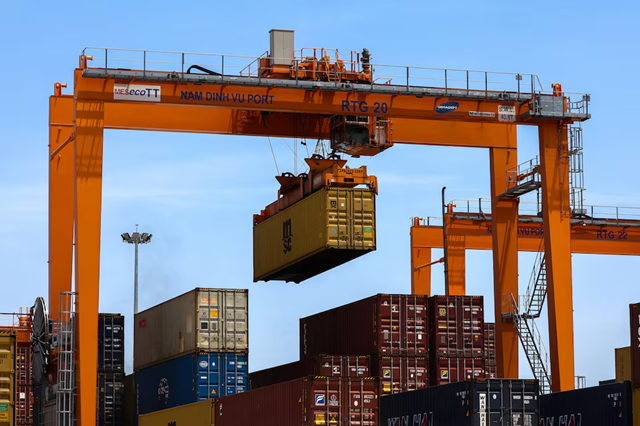
A container is loaded onto a cargo ship while docked at Hai Phong port in Hai Phong, Vietnam, April 16, 2025. REUTERS/Athit Perawongmetha
Quality capital requires quality business environment
After decades of competing primarily on labor costs and investment incentives, Vietnam is entering a new phase in its FDI strategy. The challenge is no longer attracting as much foreign capital as possible, but attracting investment that generates technology transfer, strengthens domestic enterprises, and raises long-term productivity.
This shift is reflected in the Politburo's Resolution No. 10-NQ/TW, issued on June 8, 2026, which aims to position Vietnam as a leading destination for high-quality, medium- and long-term foreign investment. Beyond increasing capital inflows, the resolution emphasizes stronger linkages with domestic firms, technology transfer, skilled workforce development, and deeper participation in global value chains.
Achieving those ambitions, however, requires more than generous incentives. Increasingly, multinational corporations choose investment destinations based on the quality of institutions, human capital, and innovation ecosystems instead of tax preferences alone.
According to Dr. George, financial incentives remain relevant but are no longer the decisive factor for technology-intensive investors. Companies increasingly assess whether a country can provide highly skilled workers, research capacity, renewable energy, digital infrastructure, transparent institutions, effective intellectual property protection, and stable, predictable policies.
He describes this combination of factors as a country's "innovation architecture."
For Vietnam, that means investing simultaneously in human capital, research and development, digital infrastructure, renewable energy, modern logistics, and more efficient public administration. These foundations are increasingly important for attracting higher-value activities such as semiconductor design, software engineering, advanced packaging, product testing, and intellectual property creation.
Associate Professor Dr. Huan argues that the government's approach to investment promotion must also evolve. Instead of focusing primarily on licensing projects and offering broad incentives, authorities should identify strategic investors, negotiate clear performance commitments, and monitor projects throughout their life cycle.
Resolution No. 10-NQ/TW already provides a policy framework by identifying technology transfer, value creation, supplier development, workforce training, and project efficiency as key evaluation criteria. The next challenge is translating those principles into measurable outcomes.
Huan proposes establishing a national evaluation framework for strategic FDI projects based on indicators such as technological sophistication, research and development activities, domestic value added, high-skilled employment, supplier development, environmental performance, efficient use of land and energy, and regulatory compliance. Such a scorecard could guide project selection, incentive design, and post-investment evaluation while ensuring greater transparency and accountability.
The incentive system should also become more performance-based. Rather than relying primarily on tax exemptions, government support could focus on research and development, workforce training, laboratories, certification, shared industrial infrastructure, supplier development, and the green transition. Assistance should be tied to clearly defined milestones, with post-investment reviews and clawback mechanisms where investors fail to fulfill their commitments.
Institutional reforms are equally important. Investors increasingly value regulatory predictability as much as financial incentives, making policy consistency, streamlined administrative procedures, and an effective one-stop mechanism critical to Vietnam's competitiveness. At the same time, infrastructure planning should become more targeted, supporting the specific needs of strategic industries rather than adopting a one-size-fits-all approach.
Workforce development must also keep pace with technological upgrading. Stronger partnerships among universities, vocational institutions, and FDI enterprises can help ensure that training programs reflect the evolving needs of industry while expanding opportunities for Vietnamese engineers and technicians.
Perhaps most importantly, developing domestic enterprises should become a central objective of investment promotion rather than a secondary consideration.
Huan argues that every major FDI project should include a supplier development strategy, with investors encouraged to disclose procurement plans, technical standards, and localization opportunities. This would give Vietnamese firms greater visibility into future demand while enabling them to invest with more confidence in technology, production capacity, and workforce upgrading.
Likewise, investment promotion should become more selective. Instead of focusing primarily on attracting manufacturing plants, Vietnam should proactively target corporations that can fill strategic gaps in priority value chains and bring higher-value functions such as research and development, design, engineering, and regional service centers.
Such a shift would represent more than a change in investment policy. It would mark a transition from competing for capital to competing for knowledge, innovation, and long-term industrial capability.
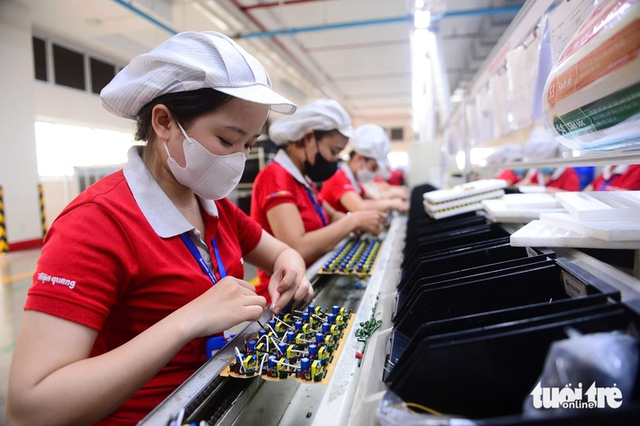
Ho Chi Minh City and neighboring provinces are accelerating the restructuring of their industrial ecosystem, logistics network, and smart supply chains to meet low-emissions and ESG standards amid the shift in high-tech FDI investment. Photo: Quang Dinh / Tuoi Tre
From factory floor to core partner
A favorable investment climate helps Vietnam attract high-quality foreign direct investment, but it does not guarantee that incoming technology and value will spill over into the broader economy. The decisive question is whether domestic enterprises can build the capability to step up as reliable suppliers, technical partners, and product co-developers.
This transition is essential if Vietnam is to avoid the middle-income trap. As the advantages of low-cost labor and simple contract manufacturing gradually diminish, future economic growth must rely on productivity, technological adoption, and the share of value local enterprises capture within global supply chains.
Currently, capabilities across Vietnamese industry remain starkly uneven. While a select few firms have climbed to tier-one status or reached foreign markets indirectly through the FDI sector, the vast majority of small- and medium-sized enterprises remain confined to basic assembly, raw materials, and low-margin services.
Local firms face several interconnected bottlenecks. Many struggle with limited access to long-term capital needed for modern machinery, testing facilities, and quality management systems. At the same time, they face high costs to meet strict international standards for certification, traceability, cybersecurity, and ESG performance. Compounding these issues is a lack of stable order volumes to guarantee a return on investment, as the central challenge is not merely producing a single compliant batch, but maintaining consistent quality at scale.
According to Dr. George, limited innovation capacity represents another major hurdle. While many enterprises can manufacture effectively to specification, they remain weak in R&D, engineering improvements, digital transformation, and intellectual property development. Meanwhile, multinational corporations increasingly choose suppliers based on innovation, digital integration, cybersecurity, and sustainability, rather than cost alone.
Information gaps further hinder these vital linkages. Domestic suppliers rarely have clear visibility into foreign buyers' procurement plans and localization roadmaps, while foreign investors lack reliable, verified databases to assess the capabilities of local suppliers.
To bridge this divide, Vietnam should establish industry-specific national supplier development programs that combine technical assistance, certification support, investment credit, and supply chain finance with a verified supplier registry. Foreign investors must participate directly by disclosing their procurement needs and opening opportunities for local firms through trial orders, technical mentoring, and long-term framework agreements.
Ultimately, businesses will invest in laboratories, machinery, workforce development, and international standards only when market prospects are clear and predictable. Domestic enterprise development must therefore be placed on an equal footing with FDI attraction, with every major foreign investment project accompanied by a concrete supplier development plan, workforce training commitments, and clear monitoring of domestic procurement rates.
Vietnam's path to high-income status will not depend on how many foreign-owned factories are built, but on how much knowledge, technology, productivity, and domestic capability remain in the economy after each project. Only when Vietnamese firms move beyond supplying basic materials to manufacturing core components, co-designing products, and mastering technology can FDI truly transform the national economic model.








Max: 1500 characters
There are no comments yet. Be the first to comment.