


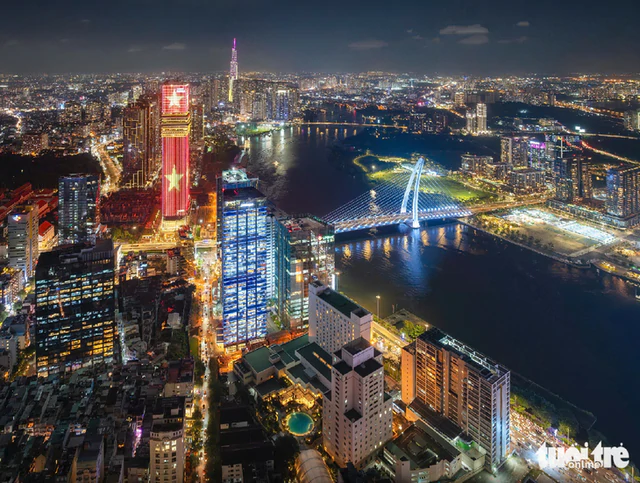
Vietnam’s International Financial Center in Ho Chi Minh City is envisioned as a global financial hub with a comprehensive and diversified financial ecosystem. Photo: Van Trung / Tuoi Tre
Turning that capital into infrastructure, technology, green transition and productive capacity will determine whether the Vietnam International Financial Center in Ho Chi Minh City (VIFC-HCMC) can become a real engine of long-term growth.
Roughly six months after its launch, the VIFC-HCMC has secured around US$20 billion in capital commitments from both domestic and foreign investors.
The city also climbed 11 places to rank 84th in the Global Financial Centers Index (GFCI 39), signaling greater international recognition of Ho Chi Minh City as an emerging financial destination.
At this early stage, however, such indicators are best seen as a measure of market interest and initial investor confidence rather than proof of the center’s long-term success.
The tougher question now is not how much more capital VIFC-HCMC can attract, but whether those commitments can be turned into actual investment in infrastructure, technology, the green transition, and productive capacity.
More capital, more choices, lower costs
The promise of VIFC-HCMC is not simply to attract capital, but to build the capacity to structure, allocate and circulate long-term funding more efficiently across the economy.
For years, businesses and major projects have relied heavily on bank credit. A deeper financial center could broaden that “capital menu” by connecting them with investment funds, international bond markets, institutional investors, venture capital and green finance.
That matters as Ho Chi Minh City prepares for a new wave of capital-intensive investment, from metro lines and ports to logistics, digital infrastructure and the green transition. The ambition is for VIFC-HCMC to help channel billions of dollars in long-term financing each year into projects and businesses that can support the city’s next phase of growth.
A broader investor base could also make financing more competitive. Projects that are better structured, more transparent and exposed to a wider pool of investors may be able to raise funds at lower cost than if they depend on only a handful of traditional lenders.
At the same time, the center could deepen the financial services that make those transactions possible – from fintech and digital banking to cross-border payments, risk management and other services supporting international trade and investment.
The real promise, then, is not just more capital, but a deeper, more diversified and potentially cheaper financial system for growth.
Connecting global finance with real economy
Turning that ambition into practice will depend largely on how VIFC-HCMC develops its four priority product groups: investment funds, international bonds, fintech and a commodity exchange.
Together, they are intended to form an integrated capital system that can pool and allocate funds, open access to long-term financing, reduce transaction frictions and help businesses manage risk: creating a pathway for global capital to reach projects, companies and productive assets in the real economy.
Nguyen Huu Huan, vice chairman of the executive board of the VIFC-HCMC, said the four priority product groups, namely investment funds, international bonds, fintech and a commodity exchange, should be designed as a complete “capital channeling system.”
Each would serve a distinct role in fundraising, capital allocation, transactions and risk management.
“Only when the four product groups work together can VIFC-HCMC move beyond attracting capital commitments to actually organizing and allocating capital across the economy,” he emphasized.
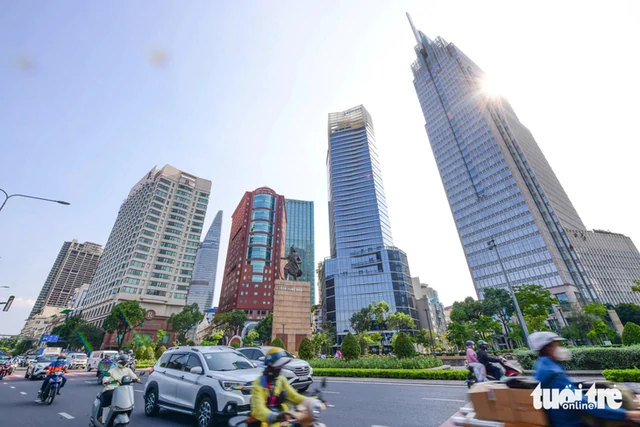
Ho Chi Minh City has climbed 11 places to rank 84th in the Global Financial Centers Index (GFCI 39), signaling greater international recognition of the city as an emerging financial destination. Photo: Quang Dinh / Tuoi Tre
Investment funds would form one of the first links in that chain. They are well suited to pooling capital from multiple international investors and allocating it across different strategies, risk profiles and sectors.
Rather than requiring each investor to identify, assess and manage individual projects in Vietnam, funds based at VIFC-HCMC could act as both a “filter” and a “converter” between global capital and the domestic project pipeline.
This could support the development of infrastructure, technology, growth and green funds, as well as specialized funds for aviation, maritime and logistics. Such vehicles could help turn large capital commitments into concrete investment portfolios with clearer governance structures and disbursement plans.
International bonds would provide a second route, allowing eligible companies and project owners to tap long-term global capital more directly. For that market to function effectively, VIFC-HCMC would need more than a venue for issuance.
Huan pointed to an ecosystem encompassing listing, disclosure, credit ratings, settlement and secondary trading under international standards. Such infrastructure could broaden the investor base and potentially lower financing costs for capital-intensive sectors with long payback periods, including aviation, seaports, logistics, infrastructure and the green transition.
Fintech would serve as the digital layer supporting the broader system.
Huan said fintech should not be viewed merely as a group of technology companies, but as “digital infrastructure” that can make the VIFC-HCMC ecosystem faster, cheaper and more transparent.
Applications could include customer identification and verification, anti-money-laundering controls, cross-border payments, digital investment processes, product distribution, data management and transaction monitoring.
Tokenization, smart contracts and digital trade-finance platforms could also sit within this fintech pillar rather than being treated as separate priority product groups.
The fourth priority group is the commodity exchange. Its role goes beyond facilitating commodity trading to include transparent price discovery and providing businesses with tools to hedge against market risks.
Airlines, for example, are highly exposed to fuel prices, while shipping and logistics companies face volatility in energy, raw materials and global trade. Effective hedging tools can make cash flows more predictable and reduce uncertainty, which in turn can make companies and projects more attractive to banks, investment funds and bond investors.
The real potential, however, lies in combining the four pillars around specific industries.
In aviation finance, specialized investment funds and international bonds could help finance aircraft fleets and supporting infrastructure, fintech could support payments and data management, while commodity-market instruments could help hedge fuel-price risks.
A similar model could emerge in maritime finance, combining investment funds and international bonds with digital trade-finance platforms, cross-border payments and commodity hedging.
If structured in this way, the four pillars could reinforce one another in a full capital cycle: investment funds pool and allocate capital; international bonds channel long-term funding directly into companies and projects; fintech lowers transaction costs and improves operating efficiency; and the commodity exchange helps businesses manage risk and strengthen their ability to obtain financing.
That, Huan said, is the mechanism through which VIFC-HCMC can move from attracting capital to actually absorbing, allocating and circulating it through the economy.
Building trust that keeps capital moving
Financial products alone will not determine whether VIFC-HCMC can turn global capital into real investment. The bigger test is whether investors can predict how their money will be treated throughout the entire investment cycle.
Huan underscored that the center needs to build an “architecture of trust” around four elements: legal certainty, execution speed, capital mobility and a controlled sandbox for financial innovation.
Legal certainty comes first. Investors need clarity over ownership and property rights, contract enforceability, custody and settlement, collateral, bankruptcy and dispute resolution. This becomes even more important in areas such as aviation and maritime finance, where high-value assets and cross-border transactions often involve multiple parties and legal systems.
“The more we can reduce ‘unknown risks,’ the lower the cost of capital investors will demand,” Huan said.
Speed is the second factor. In international finance, investment opportunities can disappear if licensing or approval processes take months.
Huan said a one-stop mechanism should therefore come with clear processing deadlines, defined responsibilities and digital procedures covering membership registration, licensing, product approval and post-licensing reporting.
The principle should be “fast but not loose,” cutting administrative delays while strengthening data-based supervision and risk management.
Capital mobility is equally critical. International investors look not only at how easily money can enter a market, but also at how profits, dividends and divestment proceeds can be reinvested, converted or transferred out.
If entry is straightforward but exit remains uncertain, investors are likely to price that uncertainty into the returns they require. Foreign-exchange, settlement, custody, cross-border transfer and reinvestment rules therefore need to work in step with VIFC-HCMC’s priority products.
The fourth element is the regulatory sandbox, particularly for fintech and new technology-based financial models.
Huan said a sandbox should be a controlled testing mechanism with a clear path to full operation, “not a legal vacuum.” Each pilot should define its customer scope, transaction limits, duration, capital requirements, disclosure obligations, anti-money-laundering safeguards, data protection and risk controls.
Just as important, he said, there should be clear criteria for “graduating from the sandbox,” allowing successful models to move more quickly toward formal licensing or wider deployment.
The four elements must work together. Strong products will struggle without legal certainty; clear rules lose value if execution is too slow; easy entry means little if capital cannot move efficiently; and innovation without effective oversight can undermine market confidence.
From financial hub to growth engine
If VIFC-HCMC works as intended, its biggest impact may be less about individual deals than about reshaping how Vietnam finances growth.
Stronger investment funds and international bond markets could gradually shift part of Vietnam’s long-term financing needs away from commercial bank balance sheets and toward deeper capital-market channels, Huan said.
The center could also help turn projects into more investable assets. Better financial structuring, disclosure, credit assessment and risk-sharing mechanisms would allow global capital to reach the right projects, companies and maturities from infrastructure and technology to aviation, maritime and green investment.
That promise is strengthened by Vietnam’s new Urban Development Law, which creates a clearer legal bridge between VIFC-HCMC and domestic businesses and projects seeking international financing. In practice, that could help the center move beyond serving financial institutions within its own ecosystem and become a tool for funding metro systems, transit-oriented development (TOD), ports, logistics, aviation, digital infrastructure and the green transition.
The long-term measure of success should therefore go beyond capital commitments. What matters is how much capital is actually deployed, how financing costs change, how many projects gain access to long-term funding and whether Vietnamese businesses raise their standards of governance, transparency and risk management in the process.
The real test for VIFC-HCMC will be whether it can turn global finance into productive assets, stronger companies and a deeper financial system for Vietnam’s next phase of growth.








Max: 1500 characters
There are no comments yet. Be the first to comment.