


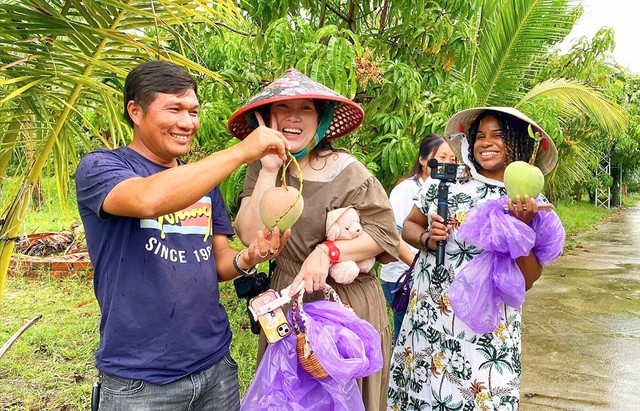
Foreign tourists enjoy picking mangoes at a mango orchard in Cam Lam Commune, Khanh Hoa Province, Vietnam. Photo: The Truyen
From livestock farms to farmstay models and organic agriculture, an ecosystem that links tourism with farming is steadily taking shape in this Vietnamese region.
In recent years, various agriculture-tourism models have emerged in the province, serving not only production but also opening to visitors for sightseeing, hands-on experiences, photography, and local food tasting.
Agri-tourism is gaining traction and is expected to become a key draw in the near future.
From spontaneous models to emerging tourism products
One of the main appeals of this agri-tourism model is visitors stepping into the role of farmers, feeding sheep, fishing, picking mangoes, harvesting grapes, or camping in farm settings.
Dang The Truyen, CEO of Camlam Online JSC, a company specializing in mango-based products and mango garden tours, said visits to local mango orchards have recently attracted a growing number of tourists, particularly foreigners.
“Currently, about 70 to 80 percent of visitors to mango gardens are foreign tourists, as they are very interested in agriculture-related experiences,” Truyen said.
According to him, the company has proactively connected with resorts, hotels, and tour groups to bring visitors to the orchards.
However, most agri-tourism models remain spontaneous and lack coordinated planning and support.
“We hope local authorities and the tourism sector will introduce policies to support more structured development, so these models can evolve into distinctive tourism products,” Truyen added.
Le Thi Hong Minh, founder of Nong Trai Vui (Fun Farm) Cooperative in Dien Lam Commune, said the cooperative began operating in 2023, when the land was still largely untouched and lacked tourism infrastructure.
Recognizing the potential of combining agriculture with experiential tourism, Minh and her team started building the concept and gradually developing the farm.
“Today, the model attracts not only local visitors but also international tourists, highlighting the growing appeal of agriculture-linked tourism,” Minh said.
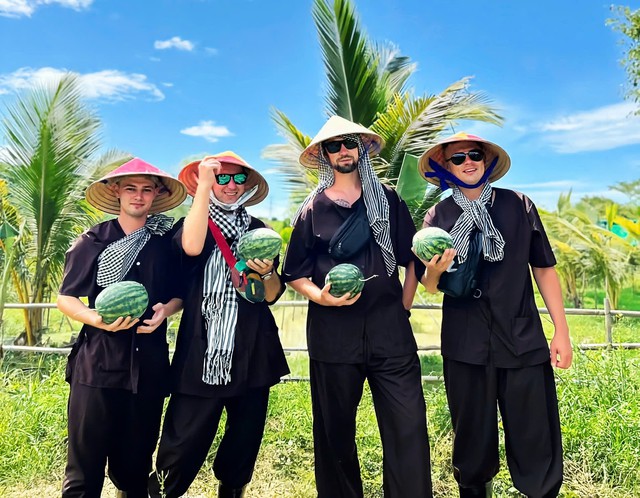
International tourists experience fruit harvesting at Nong Trai Vui (Fun Farm) in Dien Lam Commune, Khanh Hoa Province, Vietnam. Photo: Nong Trai Vui
Need for direction, stronger linkages
Nguyen Phi Hong Nguyen, vice-head of the Travel Sub-Association under the Khanh Hoa Tourism Association, said that despite clear potential, agri-tourism in the province has yet to become a fully developed product.
This is largely due to weak linkages among farmers, cooperatives, businesses, and travel agencies.
As a result, agriculture-based tours remain limited in number and have yet to attract a broad visitor base.
“Most tourists coming to Khanh Hoa still opt for sea and island tours,” Nguyen said.
“While agri-tourism products have emerged, they remain fragmented and lack the connections needed to create stronger appeal."
He added that effective development requires better connectivity among destinations, businesses, and the tourism sector to build cohesive product chains that are competitive and capable of retaining visitors.
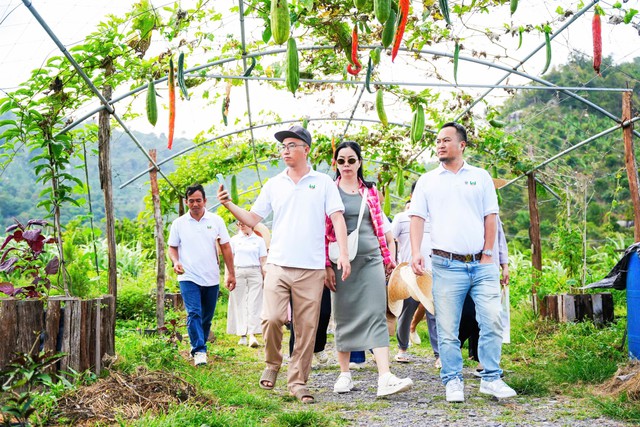
Visitors stroll through a garden at San Viet Farm tourist site in Nam Ninh Hoa Commune, Khanh Hoa Province, Vietnam. Photo: Son Kim
Meanwhile, Cung Quynh Anh, deputy director of the Khanh Hoa Department of Culture, Sports, and Tourism, said the province is finalizing a plan to develop eco-tourism, aiming to create destinations that combine nature conservation, cultural identity, and sustainable livelihoods for local communities.
Alongside infrastructure investment, the province is encouraging businesses to develop accommodation, dining, and experiential tours linked to agriculture and culture, gradually diversifying tourism offerings.
Anh noted that farmers are beginning to view tourism differently, as agri-tourism allows them to sell their produce at higher value.
In the coming period, Khanh Hoa’s tourism sector will continue promotion efforts to build an agri-tourism ecosystem centered on green experiences, positioning it as an increasingly attractive segment for visitors.








Max: 1500 characters
There are no comments yet. Be the first to comment.