


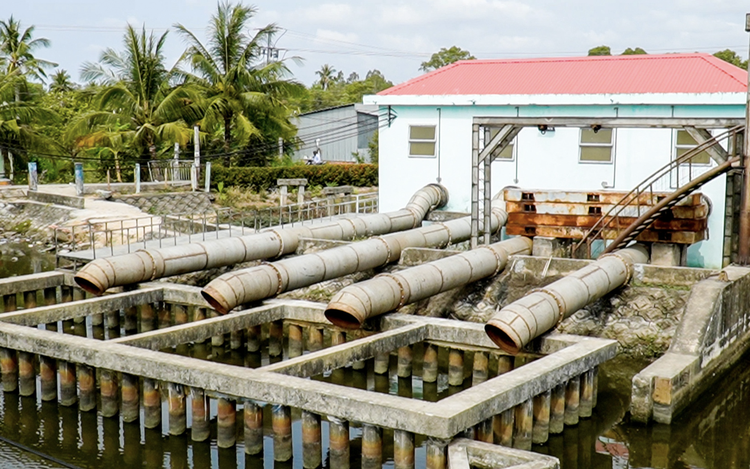
A saltwater control sluice gate system helps regulate fresh water and prevent saltwater intrusion in Khanh Binh Commune, Ca Mau Province, located in Vietnam’s Mekong Delta. Photo: T. Huyen / Tuoi Tre
On the Tien River, salinity levels have recently risen from 3.8 to over four parts per thousand within a tidal cycle, crossing a critical threshold for rice production, a water resource official said.
Across major river systems including the Hau, Ham Luong, and Co Chien, salt water has intruded 40–50 kilometers inland, and even further in some areas during high tides.
While conditions have not yet reached the extreme levels seen in 2015–16 and 2019–20, experts say the speed and unpredictability of intrusion are becoming increasingly concerning.
Saltwater intrusion worsens water shortages in hot dry season
The Southern Hydro-Meteorological Station forecasts continued hot weather across southern Vietnam, with temperatures ranging from 35 to over 37 degrees Celsius, alongside rising salinity in the Mekong Delta toward mid-April due to tidal cycles.
Local officials in Vinh Long Province noted that salt water now advances much faster than in the past, sometimes reaching critical levels within just a few days.
In Ca Mau Province’s Bien Bach Commune, where three sides border the sea, freshwater shortages remain a recurring seasonal problem.
Residents say each dry season brings renewed hardship, as saltwater intrusion worsens the situation.
Vo Thi Tho, a local resident, said her family relies on rainwater and has to purchase water out of the lack of a stable piped supply.
Although a pipeline runs in front of her house, it remains unused because of very low water pressure at the end of the network.
According to Le Cong Nguyen, deputy director of the Ca Mau Center for Rural Water Supply and Environmental Sanitation, long transmission distances of over 100 kilometers and high seasonal demand often result in pressure loss, leaving downstream households with limited or no water.
Boosting freshwater storage to lessen impacts
In the face of severe saltwater intrusion, localities across the Mekong Delta are prioritizing freshwater storage and more flexible water regulation.
Accordingly, along with measures to limit salinity, authorities and experts are now advising farmers to store fresh water during low tides for use in daily life and agricultural production.
Dong Thap Province is preparing to restart a project to build three freshwater reservoirs worth more than VND1.2 trillion (US$45.6 million), expected to supply water for both daily use and production.
In former Ben Tre Province, now part of Vinh Long following a national administrative restructuring effective July 1, 2025, coastal areas are also expanding freshwater storage infrastructure as part of early adaptation efforts.
Le Minh Truyen, deputy head of the Vinh Long Agricultural Project Management Board, said the region is highly vulnerable to climate change impacts such as sea level rise and salinity intrusion, which have become more severe in recent extreme dry seasons.
Alongside reservoirs, Can Tho and Dong Thap are operating sluice gate systems based on tidal cycles, opening gates to store freshwater when salinity is low and closing them when intrusion increases.
At the household level, adaptation is also becoming more widespread, with residents adopting various practical measures to store as much fresh water as possible.
In Tay Yen commune of An Giang Province, residents are drilling deep wells, storing rainwater and using tanks and small ponds to secure water during the dry season.
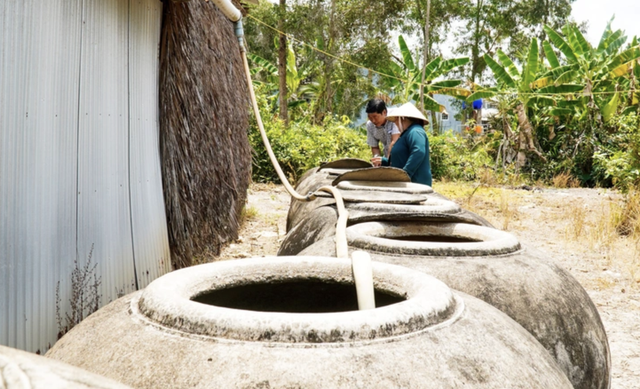
Some of 25 large jars used by a farmer to collect rainwater in Bien Bach Commune, Ca Mau Province, located in Vietnam’s Mekong Delta, amid water shortages caused by hot weather and saltwater intrusion. Photo: Thanh Huyen / Tuoi Tre
‘Living with salinity’ through mixed farming and aquaculture models
Authorities warn that salinity at four parts per thousand may extend 40–50 kilometers inland along major rivers such as Vam Co Dong and Vam Co Tay, while other river systems may also see significant intrusion.
Despite these challenges, overall salinity levels this year are expected to be lower than in the 2025 dry season, though short-term peaks remain likely.
Amid this shifting environment, a new production mindset is emerging, moving from resisting saltwater intrusion at all costs to adapting to it.
In Ca Mau, officials say salinity follows a four-year cycle, with severe episodes in 2015–16, 2019–20, and 2023–24.
While the 2026 dry season is not expected to be extreme, salinity could still reach 40–60 kilometers inland.
The province is promoting climate-adaptive agriculture by adjusting crop calendars and monitoring salinity to avoid high-risk periods.
A key example is the expanding rice–shrimp model across coastal provinces.
In Tri Phai Commune, farmer Nguyen Minh Chien combines rice, shrimp, crab, and fish on more than two hectares, generating stable income while reducing costs.
Similar models in Nguyen Phich Commune and other areas also generate strong profits, helping households diversify income and reduce climate vulnerability.
Authorities say around 80,000 hectares in Ca Mau is now under rice–shrimp cultivation, reflecting the shift toward adapting to saltwater intrusion.
In An Giang, farmers also apply similar models, switching between rice and aquaculture depending on seasonal salinity.
This approach has helped stabilize incomes and reduce exposure to climate extremes.








Max: 1500 characters
There are no comments yet. Be the first to comment.