


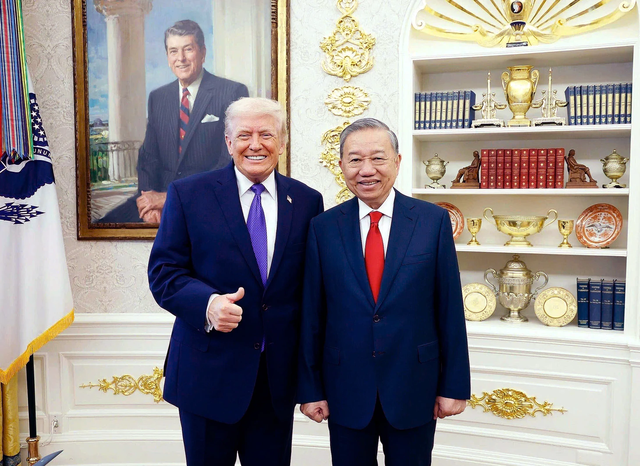
Vietnam's Party General Secretary and State President To Lam (R) meets U.S. President Donald Trump at the White House in February 2024, when he was serving as general secretary. Photo: Vietnam News Agency
From September 20 to 25, Party General Secretary and State President To Lam will attend the general debate of the 81st session of the United Nations General Assembly and hold bilateral activities in the U.S., before making a state visit to Canada at the invitation of Governor General Louise Arbour.
Turning political trust into substantive results
Speaking to Tuoi Tre (Youth) online newspaper, Vietnamese Ambassador to the U.S. Nguyen Quoc Dung said the trip is significant in two respects.
First, Party General Secretary and State President Lam's visit reaffirms Vietnam's responsible role and contribution to issues of common concern to the international community.
At the same time, the visit by Vietnam's top leader to the U.S. would provide further momentum for the bilateral relationship to develop in a more substantive, effective, and sustainable manner.
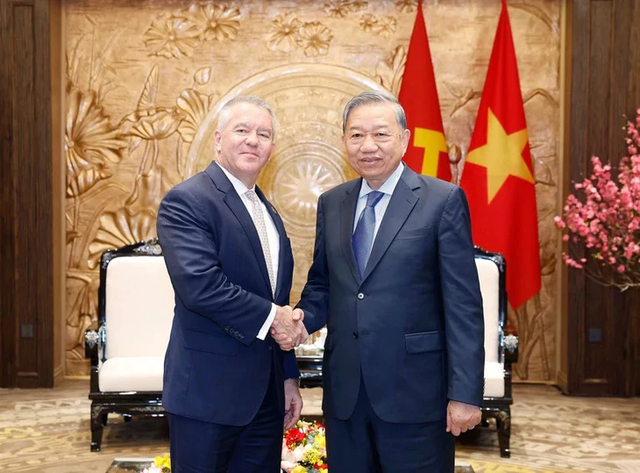
Vietnam's Party General Secretary and State President To Lam (R) shakes hands with Michael DeSombre, Assistant Secretary of State for East Asian and Pacific Affairs, in Hanoi in February 2026. Photo: Ministry of Foreign
According to Dung, beyond maintaining the positive momentum of the comprehensive strategic partnership between Vietnam and the U.S., it is now important to turn commitments and political trust into concrete, measurable results that can be felt in practice.
"These could be investment projects that create quality jobs, training programs that help workers acquire new skills, technological solutions that help businesses improve productivity, or cooperation models in energy, healthcare, education, and the environment that help improve people's quality of life," he said.
In its relations with the U.S., Vietnam has specific needs in the areas of the economy, technology, and high-quality infrastructure, which can help leverage the strengths of U.S. businesses and corporations in technology, capital, management, and experience.
He said the two sides should in the coming period focus on areas that can both create new growth drivers and help strengthen the stability, self-reliance, and resilience of each economy.
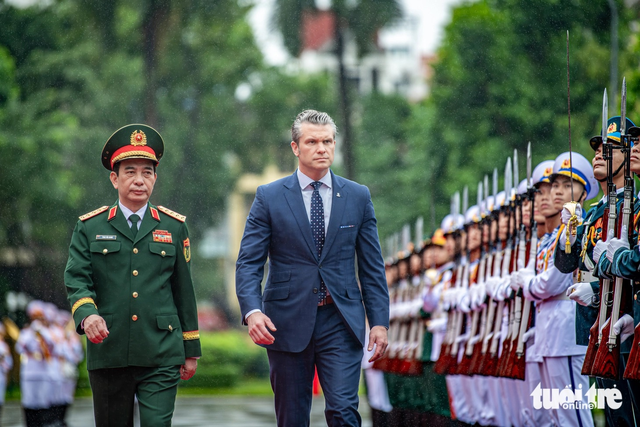
U.S. Secretary of War Pete Hegseth (R) visits Vietnam in November 2025. Photo: Nam Tran / Tuoi Tre
Among these, the economy, trade, and investment will remain important foundations of the bilateral relationship.
Vietnam wants to attract long-term, high-tech and environmentally friendly investment flows that can generate spillover effects.
What Vietnam is concerned about is not only the scale of investment capital, but also the extent to which projects contribute to technological innovation, the development of research and development (R&D) capacity, human resource training, the development of supporting industries, improved management capacity, and greater participation by Vietnamese businesses in global value chains.
Vietnam wants to cooperate with U.S. investors, businesses, and financial institutions in a long-term, transparent, and mutually beneficial manner, thereby meeting capital needs for development investment while helping strengthen a stable and predictable economic and financial environment.
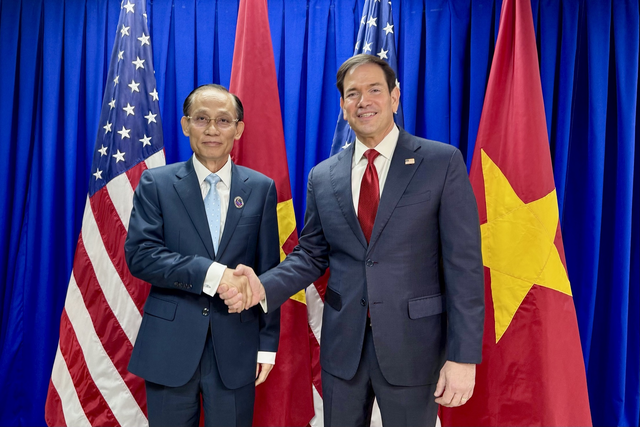
Vietnamese Minister of Foreign Affairs Le Hoai Trung (L) meets with U.S. Secretary of State Marco Rubio in July 2026.
Another potential area is high-quality infrastructure, such as clean energy, modern power grids, logistics, digital infrastructure, data centers, high-tech agriculture, and climate change response.
These are areas that both meet Vietnam's needs and create conditions for U.S. businesses to leverage their strengths in technology, finance, management, and public-private partnership models.
Against the backdrop of Vietnam's focus on making the private sector an important driving force of the economy, Vietnam-U.S. cooperation can provide practical support through technology transfer, management experience sharing, market connections, brand building, and capacity improvement to meet international standards on quality, the environment, labor, traceability, and sustainable development.
Science, technology cooperation builds Vietnam's domestic capacity
Vietnam identifies science and technology, innovation, and digital transformation as important drivers for improving productivity and the quality of growth.
The U.S., meanwhile, has leading strengths in technology, research, education, investment capital, innovation management, and the startup ecosystem.
However, Dung said it is important that cooperation not stop at agreements or the number of projects, but help Vietnam build domestic capacity.
For semiconductors, the focus should be on training engineers, developing design, testing and packaging, laboratories, and supplier networks.
For AI and digital transformation, technology needs to be applied to addressing practical problems in healthcare, education, agriculture, urban management and supporting small- and medium-sized enterprises.
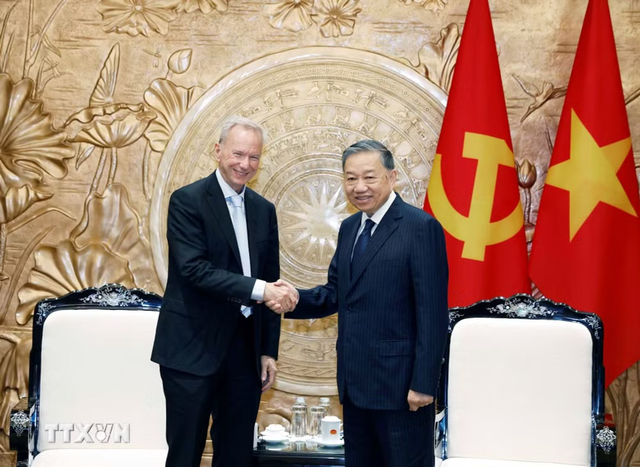
Vietnam's Party General Secretary and State President To Lam (R) meets with Eric Schmidt, former chairman of Google, who led a delegation of artificial intelligence experts on a working visit to Vietnam in June 2026. Photo: Vietnam News
"When technology creates new skills, better jobs, higher business productivity, and improved services for people, that is the substantive result of cooperation," he said.
Alongside future-oriented cooperation, Ambassador Dung said the two sides could also continue promoting humanitarian efforts, war legacy remediation, and reconciliation.
"These are tasks that require perseverance, empathy, and responsibility, but they are deeply meaningful to many Vietnamese families as well as to the process of strengthening trust between the peoples of the two countries," he said.
In a world facing growing uncertainties, Vietnam-U.S. relations need to be developed in an increasingly stable, balanced, long-term, and mutually beneficial direction, thereby not only serving the interests of each country but also contributing to peace, cooperation, and development in the region and the world, Dung said.
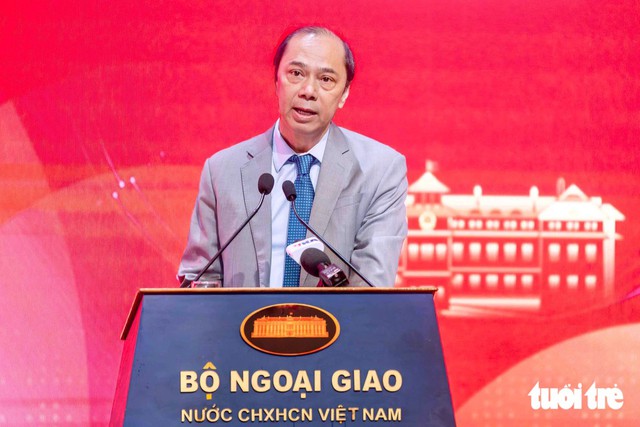
Vietnamese Ambassador to the U.S. Nguyen Quoc Dung. Photo: Danh Khang / Tuoi Tre
Creating opportunities for Vietnamese Americans to contribute to Vietnam's development needs
"The Vietnamese community in the U.S. is a dynamic and diverse community with many achievements in science and technology, education, healthcare, business, culture, and social activities," the diplomat said.
"It is an integral part of the Vietnamese nation and, at the same time, a natural and highly valuable bridge between the peoples of the two countries.
"In my view, conditions should be created for the community, particularly intellectuals, businesspeople, and younger generations, to participate directly in Vietnam's specific development needs."
This could include providing technology advice, training human resources, supporting startups, connecting investment, sharing management experience, or helping Vietnamese businesses access the U.S. market, standards, and supply chains.
Such contributions do not necessarily require returning to Vietnam to work long-term. Many experts can contribute through research projects, advisory networks, online training programs or industry- and locality-based networking activities.
"The embassy will continue to listen, provide support, and create practical channels of connection so that every Vietnamese person in the U.S. can contribute, in a way that suits them, to the country's development and Vietnam-U.S. friendship and cooperation," Ambassador Dung remarked.








Max: 1500 characters
There are no comments yet. Be the first to comment.