


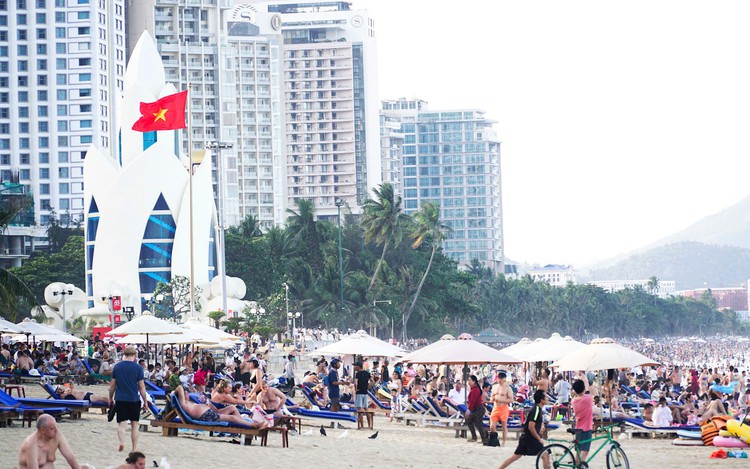
Nha Trang Beach in Khanh Hoa Province, south-central Vietnam, is crowded with domestic and international tourists. Photo: Nguyen Hoang / Tuoi Tre
Huynh Quang Tu, deputy chairman of the Nha Trang Ward administration, made the statement at a recent conference on measures to strengthen security and public order in tourism activities in Khanh Hoa in general and Nha Trang in particular.
The move comes as Khanh Hoa's tourism sector posted positive growth in the first nine months of 2026, welcoming more than 20.4 million tourist arrivals, up 45.66 percent year on year.
Of the total, international arrivals exceeded 7.1 million, up 69.05 percent.
In Nha Trang Ward alone, more than 2.29 million foreign visitors arrived by the end of September, accounting for over 32 percent of the province's total international arrivals, Tu said.
Tourism security measures
The ward has proactively developed security plans for different periods, particularly during peak tourism seasons, holidays, the Lunar New Year (Tet) holiday and major events, Tu said.
Nha Trang has also assigned clear responsibilities to different forces so that incidents can be promptly received and handled, while regularly reviewing areas, roads, businesses and service types that may pose security and public-order risks, he said.
Local authorities have also encouraged and guided accommodation establishments, restaurants, entertainment venues and other businesses to comply with the law and protect tourists' property, Tu added.
Phan Minh Nhut, chairman of the Khanh Hoa Tourism Association, said tourism businesses in the province continue to face challenges including unfair competition and cheap tours that may pose risks to economic security.
He called for stronger inter-agency inspections to tackle fraudulent tours and illegal payment practices.
Other problems include overcharging, soliciting and pressuring tourists to make purchases at shopping outlets, particularly as part of cheap tours whose service quality falls below standard, according to Colonel Pham Anh Tuan, deputy director of the provincial Department of Public Security.
Some tour guides have also violated the law, behaved improperly toward tourists or submitted fake diplomas and certificates when applying for tour guide cards, Tuan noted.
Meanwhile, scammers have used social media to impersonate the fan pages of reputable accommodation establishments to defraud customers and steal their money, he added.
Tightening management of foreigners
A particular concern is foreigners using Vietnamese legal entities to operate service establishments and employ workers and tour guides without proper authorization, Nhut said.
He said such practices create loopholes in state management and cause frustration among legitimate tourism businesses.
The association has worked with the Khanh Hoa Department of Culture, Sports and Tourism and the External Security Division under the provincial public security department to rectify and handle such violations, according to Nhut.
Nhut also urged cross-agency task forces to crack down on disguised investments.
Addressing additional concerns, Colonel Pham Anh Tuan, deputy director of the public security department, said tourism is directly linked to areas including immigration, residence, employment and investment.
Any loopholes in management, weak coordination or delays in detecting violations could have a major impact on public security and tourists' rights, he said.
State management efforts have uncovered foreigners violating immigration and residence regulations, while some accommodation establishments have failed to properly declare their guests' stays, Tuan said.
Khanh Hoa police will step up scrutiny of foreign residents, immigration and entry-exit activities, tour operations, tour guides, accommodation establishments, foreign-related investment and business activities, payments, employment and activities in cyberspace, according to Tuan.
The police will proactively prevent people from exploiting tourism to organize or broker illegal immigration, conduct disguised investment and business activities, work or practice professions illegally, or engage in transnational crime in Khanh Hoa, particularly in Nha Trang, he said.
Nha Trang has long been a major tourism center of Khanh Hoa and Vietnam's south-central region, attracting both domestic and international visitors, particularly from Russia, South Korea, China and India.









Max: 1500 characters
There are no comments yet. Be the first to comment.