


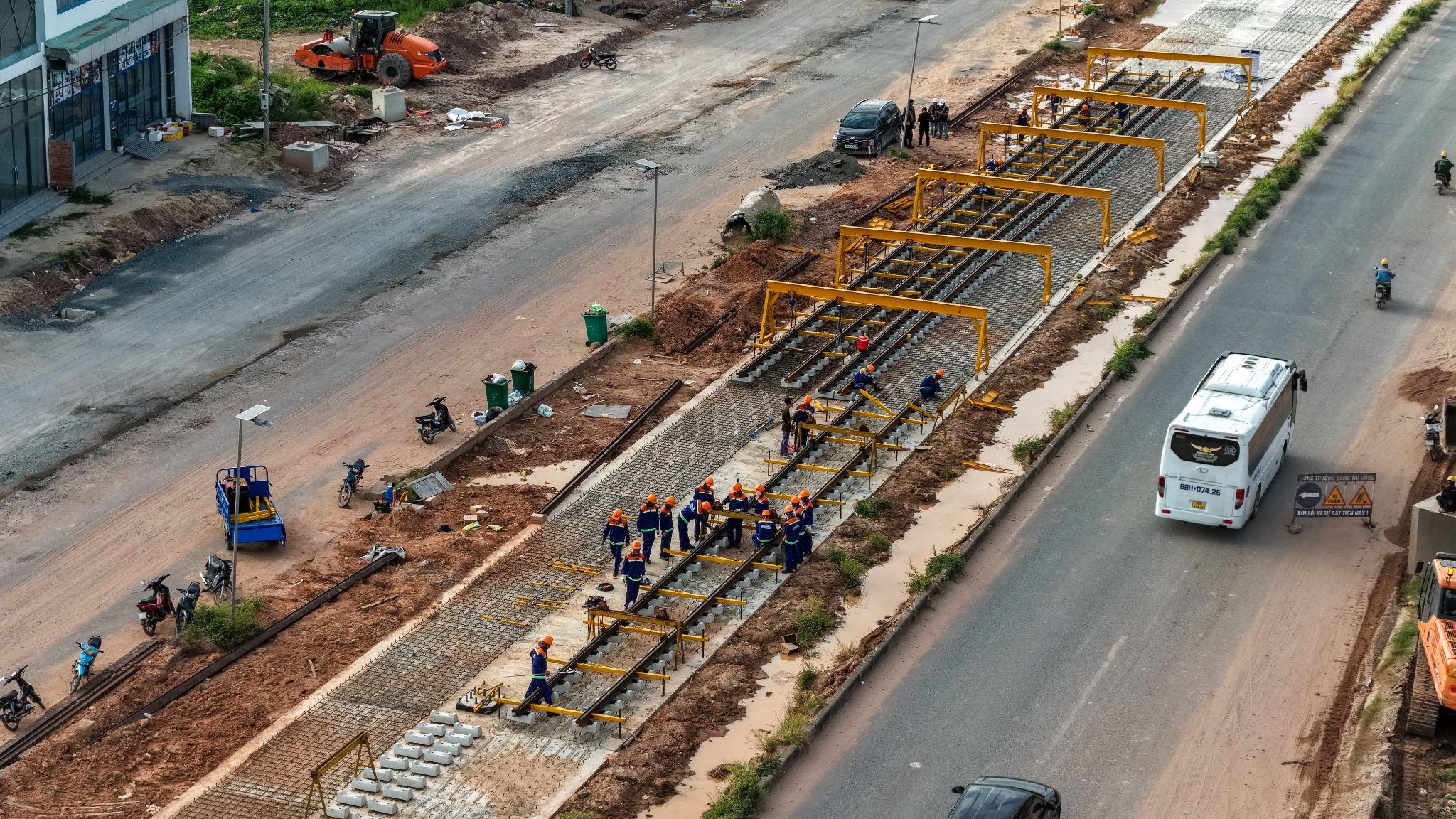
The first mainline rail sections are installed on the Phu Quoc LRT. Photo: TDC
The entire 17.59-km double-track line is expected to have its rails installed within the next six months, putting the project among Vietnam’s fastest-deployed urban rail projects.
4,200 metric tons of rails
Less than two weeks after the first batches of equipment arrived, nearly 1 km of standard-gauge 1,435-mm rails has been laid on the track bed, ready for fastening and final installation as work progresses on the project to connect Phu Quoc International Airport with the APEC Conference and Exhibition Center.
Each 25-meter rail, weighing around 1.5 metric tons, is being positioned and joined to form the first sections of track on the LRT line.
Once all 2,850 rails have been installed, more than 4,200 metric tons of steel will stretch across the construction site, gradually taking shape as a “steel ribbon” running along southern Phu Quoc.
To extend the line each day, the Vietnamese contractor alone has mobilized nearly 200 engineers and workers, divided into multiple teams working simultaneously.
The pace did not let up even during the National Day (September 2) holiday.
While many families were enjoying the holiday, rail installation teams remained on site, steadily extending the first urban railway in Phu Quoc Special Zone.
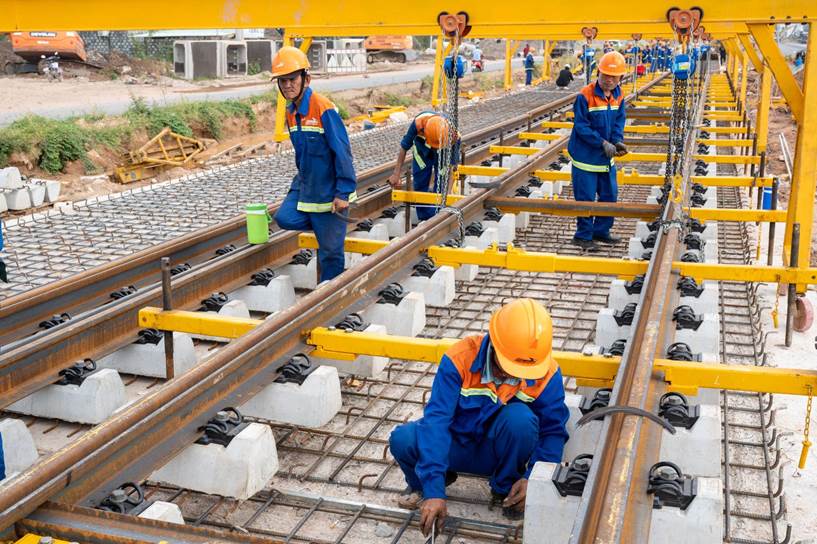
Many workers volunteered to work through the National Day holiday to meet the project schedule. Photo: TDC
One of those assigned to Phu Quoc during this period was Le Quy Cong, a rail installation worker.
With more than 36 years of experience in the railway industry, he is among the skilled workers trusted by the contractor as the project enters the rail installation stage.
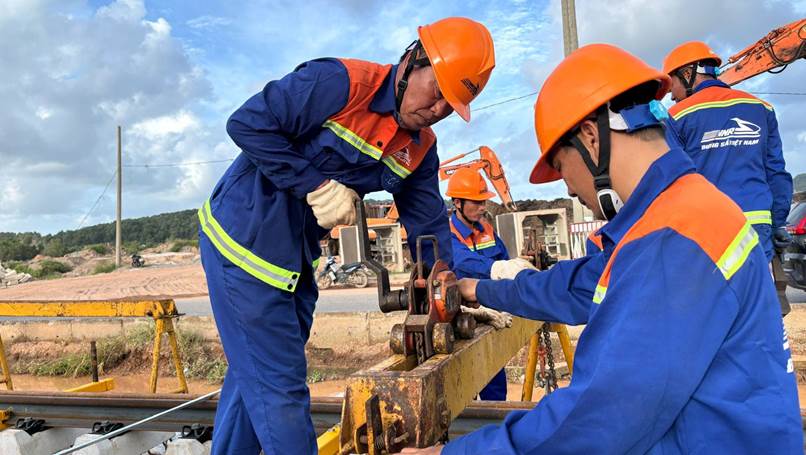
Le Quy Cong (left) was assigned from Hanoi to Phu Quoc to work on the LRT line. Photo: Thanh Vu
Mobilizing experienced workers is particularly important because the Phu Quoc LRT uses the standard 1,435-mm gauge and 60R2 grooved rails.
Both are international standards that have been used on Vietnam’s urban railway systems.
“Before starting work, all the workers were thoroughly instructed on the procedures, construction methods and specific technical requirements for this type of rail,” Cong said.
“The work is challenging, but it is also an opportunity for skilled workers to put the experience they have accumulated over decades to use,” he added.
Racing against the clock
According to Nguyen Tat Dat, chief site commander for package XL-03, which covers the supply and installation of the rails, one of the key advantages of 60R2 grooved rails is their ability to integrate with the urban landscape.
Once completed, the surface between and around the rails can be finished at the same level and grassed in suitable areas, helping the railway blend into the surrounding urban landscape.
This is particularly important for Phu Quoc, where the railway must not only meet transportation needs but also form part of the landscape of a tourism-oriented locality.
In addition, 60R2 rails have a large cross-section, high load-bearing capacity and high stability.
The rail design, combined with the track structure, also helps reduce vibration and noise while providing a smoother ride.
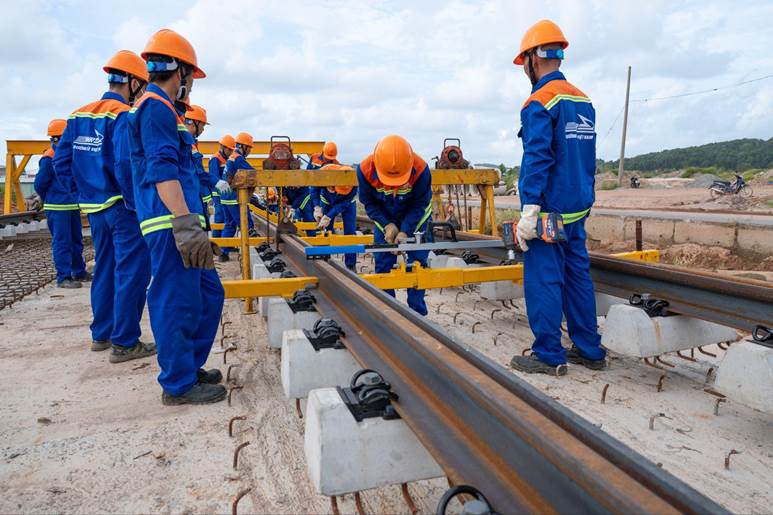
A close-up of the first 60R2 grooved rails installed in Phu Quoc. Photo: TDC
“The project has been designed according to modern international standards. This will also enable the system to meet long-term operational needs after completing its role in serving APEC 2027,” Dat emphasized.
Construction of the Phu Quoc LRT began in December 2025.
Under the project schedule, all rails on the track bed, bridges and tunnels must be installed by February 2027.
This means that, counting from the official start of rail installation in late August 2026, the rail-laying work will take just six months.
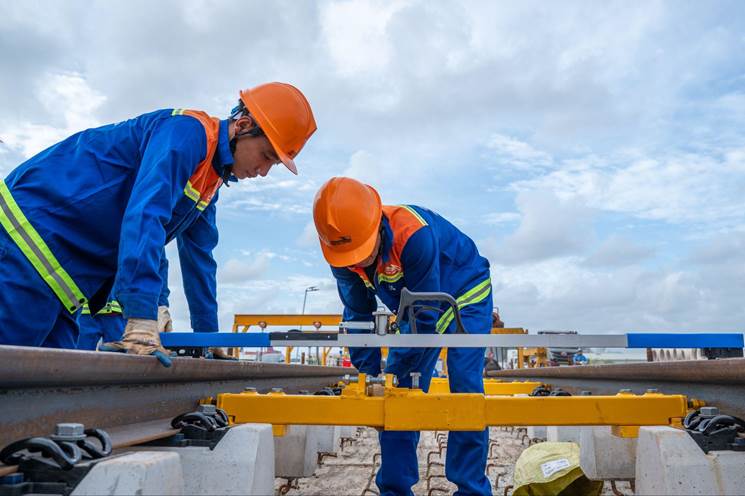
The 1,435-mm gauge being installed is widely used around the world. Photo: TDC
Tran Anh Tuan, deputy general director of Vietnam National Railway Group and representative of the consortium of contractors supplying and installing the rail system, said completing 17.59 km of double track, equivalent to nearly 36 km of urban railway track, within about six months would be an “impressive” pace.
If weather does not disrupt the transportation of the rail system from the supplier, the project could potentially shorten the schedule even further.
Based on the consortium’s experience, projects of a similar scale in China, one of the countries with the world’s largest urban railway networks, typically take around three years to build and can take up to five years when underground sections are included.
The rapid progress of the Phu Quoc LRT project has been driven by strong and consistent direction from the An Giang provincial People’s Committee and the An Giang Department of Construction, along with coordinated efforts across the political system.
Behind the continuous construction effort is also solid financial backing: NCB is providing financing to the general contractors and contractors, as well as comprehensive guarantees, letters of credit and factoring services, enabling contractors to proactively secure resources and maintain the project schedule.
The Phu Quoc LRT is being developed under a build-operate-transfer (BOT) model with a total investment of nearly VND9 trillion (US$347 million).
The state accounts for 70 percent of the funding, while the remaining 30 percent is contributed by the private investor.
In the short term, the line will be an important part of the transportation system serving the APEC 2027 Economic Leaders’ Week.
In the longer term, the project will give Phu Quoc an additional high-capacity public transport option directly connecting the airport gateway with the urban and tourism areas in the island’s south.
The project aims to complete trial operations in July 2027 and begin commercial operations in November 2027.
Based on the planned scale of investment, up to 14 trains could operate simultaneously.
In the first phase, An Giang Province and Sun Group plan to operate six to 10 trains, each consisting of three cars and powered by clean energy.
The entire line is expected to eventually have a maximum capacity of around 4,500 passengers per hour.
Once completed, the LRT will cut travel time from Phu Quoc International Airport to the APEC Conference and Exhibition Center and the resorts and entertainment complexes in the island's south to around 20 minutes.










Max: 1500 characters
There are no comments yet. Be the first to comment.