


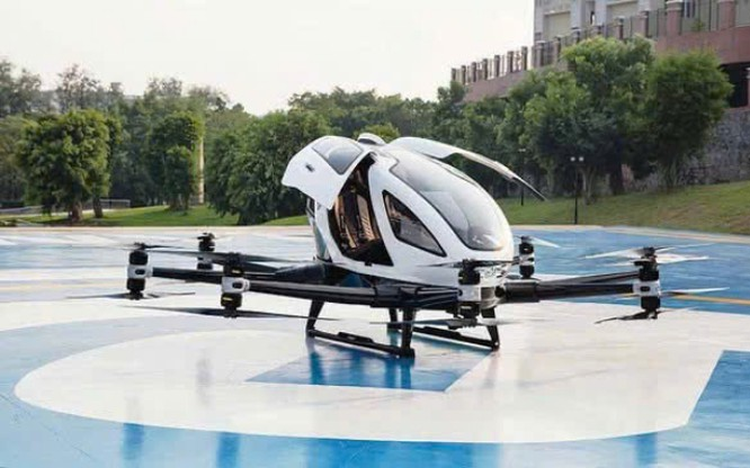
The EHang EH216-S air taxi. Photo: Hanoi Department of Science and Technology
The EHang EH216-S is an electric vertical takeoff and landing (eVTOL) aircraft.
The Hanoi Department of Science and Technology and Hung Viet Technology Investment and Trading JSC signed a cooperation agreement on Sunday to study and propose controlled trials of EHang autonomous vehicles for passenger and cargo transport.
The parties also plan to develop an unmanned aircraft traffic management model and an operations control center at the hi-tech park.
If the trial proves successful, they will study an appropriate model for commercial operations.
Hanoi also aims to develop an eVTOL operations center, train personnel, and study technical standards, regulations, and safety requirements for operating the aircraft.
If all goes well, the EH216-S could become Vietnam’s first air taxi. So, what does the EH216-S offer?
2-seat air taxi with no pilot
The EH216-S was developed by EHang, a Chinese company specializing in eVTOL aircraft.
Unlike conventional helicopters, the EH216-S is powered entirely by electric motors and is designed to operate without a pilot on board.
According to its manufacturer, the flight route is preset, while the aircraft uses GNSS positioning and navigation technologies to conduct flights autonomously.
The EH216-S is relatively compact, measuring 1.93 meters in height and 5.73 meters in width. Its maximum takeoff weight is 620kg.
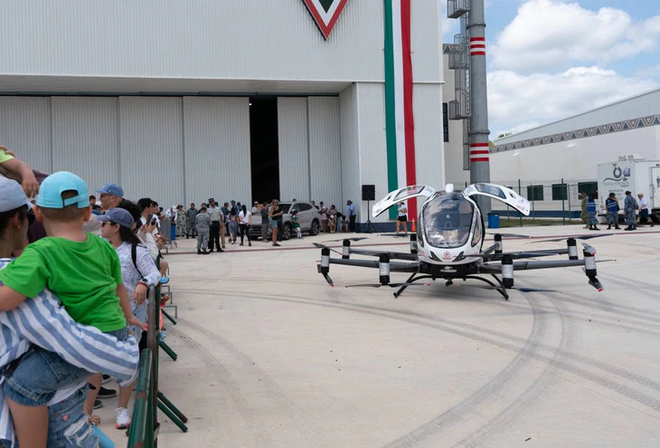

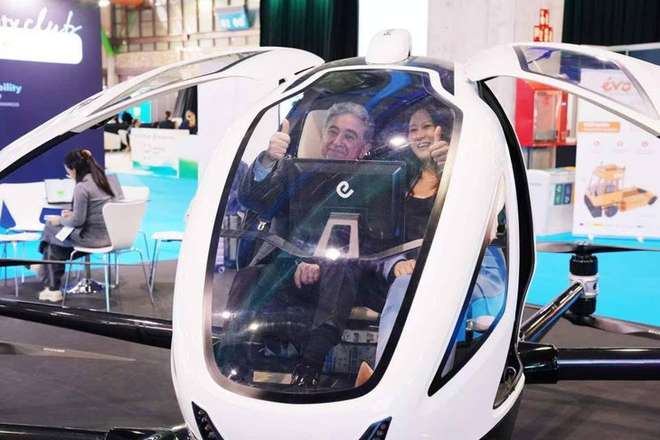
The pilotless aircraft is designed to carry up to two passengers. Photo: EHang
Its cabin has two seats and features gull-wing doors. The fuselage uses carbon-fiber composite materials to reduce weight.
A system of arms and coaxial rotors surrounds the cabin. Its multiple electric motors allow the aircraft to take off and land vertically, eliminating the need for a conventional runway.
This is one of the key features that makes eVTOL aircraft suitable for potential use in urban environments.
Top speed of 130km/h, range of 30km
According to specifications released by EHang, the EH216-S has a maximum design speed of 130km/h and a range of around 30km.
The aircraft is equipped with a smart battery system and supports fast charging, the manufacturer said.
Its 30km range makes the air taxi more suitable for relatively short trips, such as urban transport, connections between nearby areas or aerial tourism, rather than replacing conventional aircraft or helicopters.
EHang designed the EH216-S to operate within a centralized management system.
Its operations control center can monitor, coordinate and manage the fleet, receive real-time data, and intervene when abnormal situations arise.

The air taxi is designed for short-distance trips. Photo: EHang
Backup systems in case of failures
For a pilotless aircraft, one key question is how it handles technical failures.
According to EHang, critical components, including the flight control and propulsion systems, are designed with multiple layers of redundancy.


If a component fails, a backup system is designed to take over. The aircraft also continuously monitors its operating status and can determine whether to continue the flight or make an emergency landing.
Communications between the aircraft and ground systems are encrypted. The command center is responsible for monitoring the fleet and can intervene in emergencies.
The EH216-S underwent a certification process in China that lasted more than 1,000 days and involved more than 500 evaluation items and over 40,000 flights during its development, testing and certification.
In October 2023, the eVTOL received a type certificate from the Civil Aviation Administration of China.
EHang received a production certificate in 2024, while the first EH216-S operators received air operator certificates for passenger-carrying operations in March 2025.
EHang said the EH216-S is the world's first pilotless passenger-carrying eVTOL to reach the commercial operation stage.

An operations control center monitors and coordinates flights. Photo: EHang
The EH216-S has been tested outside China.
According to EHang, as of August 2026, its aircraft had completed more than 90,000 flights across dozens of countries, including the U.S., Spain, Thailand, South Korea, Japan and the UAE.
However, the September 28 agreement represents only a step toward studying and proposing a trial in Vietnam. It does not mean that the EH216-S has been licensed for commercial air taxi operations in the country.
The parties involved still need to complete the procedures for the proposed pilot program before submitting it to Hanoi authorities for consideration and approval.








Max: 1500 characters
There are no comments yet. Be the first to comment.