


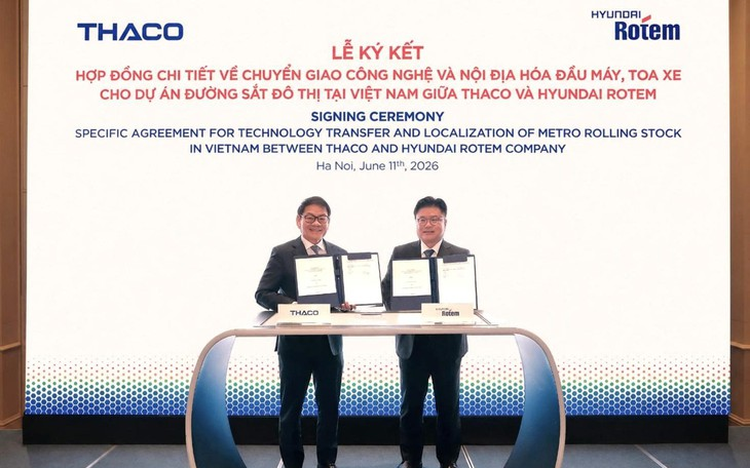
Leaders of THACO and Hyundai Rotem sign a detailed agreement on technology transfer and localization of railway rolling stock in Vietnam. Photo: Supplied
The signing marked a new stage in cooperation between the two groups after nearly a year of implementing strategic agreements aimed at developing Vietnam’s railway industry.
Under the agreement, Hyundai Rotem will transfer to THACO a comprehensive set of product design documents, technical documentation, manufacturing processes, quality management systems, and product control standards.
THACO’s engineers and managers will also receive intensive training in South Korea, while Hyundai Rotem experts will directly participate in training, guidance, and support for production, assembly, testing, and quality control activities in Vietnam.
As Vietnam accelerates investment in urban railways, regional railways, and high-speed rail projects, the need to build domestic manufacturing capabilities has become increasingly urgent.
Cooperation with Hyundai Rotem, one of South Korea’s leading railway rolling stock manufacturers, is viewed as a strategic step that will enable THACO to access advanced technologies, gradually increase localization rates, and participate more deeply in the railway industry value chain.
The cooperation roadmap began in August 2025 when the two sides signed a memorandum of understanding on developing Vietnam’s railway industry.
In December 2025, they signed a localization agreement establishing a long-term framework for technology transfer, workforce training, and supply chain development.
Building modern railway industry foundation in Vietnam
One of the key milestones in the partnership was the signing on April 23 of a contract to supply 162 railcars for urban railway projects in Ho Chi Minh City.
Under the contract, Hyundai Rotem will provide six fully assembled railcars manufactured in South Korea, along with 156 completely knocked down (CKD) kits for THACO to produce and assemble in Vietnam.
The project is considered the first practical opportunity for a Vietnamese company to gain deep access to modern train manufacturing technology.
To support its long-term development strategy, THACO has invested in a 320-hectare railway and multifunctional mechanical engineering industrial complex within a 786-hectare specialized mechanical engineering and supporting industries zone in Ho Chi Minh City.
The complex is designed as a highly automated integrated manufacturing facility, featuring centers for aluminum alloy car body production, precision machining, intelligent automated welding, surface treatment, rolling stock assembly, testing, maintenance, and repair.
Notably, the car body manufacturing center is equipped with aluminum extrusion systems capable of generating pressures of up to 10,000 tonnes.
The machining center can process large-scale components, while robotic painting systems and modern surface treatment lines meet the railway industry’s stringent international standards.
According to industry experts, developing domestic manufacturing capabilities will not only reduce dependence on imports but also help establish a supporting industrial ecosystem for the railway sector, creating opportunities for Vietnamese companies to join global supply chains.
From the memorandum of understanding signed in 2025 to the technology transfer and localization agreement concluded in 2026, THACO and Hyundai Rotem are steadily advancing their goal of building a modern railway industry in Vietnam.
The cooperation carries significance beyond commercial interests, contributing to the enhancement of national industrial capabilities, the development of a highly skilled workforce, and the creation of a foundation for Vietnam to gradually master railway rolling stock manufacturing technologies in the future.
As the railway system has been identified as one of the key drivers of the country’s strategic infrastructure development, technology transfer partnerships such as the one between THACO and Hyundai Rotem are expected to provide new momentum for Vietnam’s manufacturing industry in the years ahead.








Max: 1500 characters
There are no comments yet. Be the first to comment.