


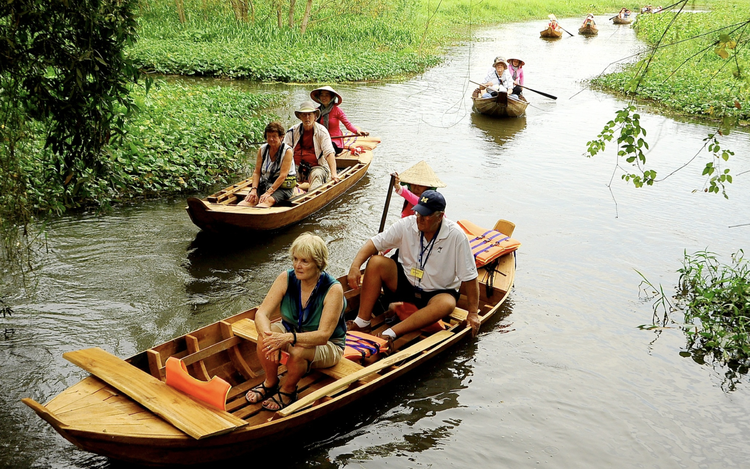
Foreign tourists on a boat tour in the Mekong Delta region of Vietnam. Photo: Tung Thien / Tuoi Tre
Many tour operators attributed their weak performance to unappealing mass-market products and the growing trend of independent travel.
Pham Quy Huy, director of Kiwi Travel Company, said that the lucrative MICE (meetings, incentives, conferences, and exhibitions) segment has dropped sharply.
Once a reliable source of high revenue for hotels, cruise services, event organizers, and tour operators, MICE groups of 100-200 guests were common.
“Now, securing a group of around 100 MICE tourists is considered excellent and rare,” Huy said.
While group travel falls, independent international travelers are arriving in larger numbers.
These visitors typically do not use traditional tour services.
They benefit from relaxed visa policies, book flights and hotels through foreign-owned platforms such as Traveloka, Agoda or Booking.com, and follow their own itineraries instead of joining Vietnamese-organized tours.
“As a whole, inbound arrivals are high, but not every tour operator benefits.
“Backpacking and self-guided travel are cutting into revenue for many companies,” Huy noted.
Tony Hung Tran, a representative from Golden Smile Travel, said many travelers find traditional tours outdated and restrictive, preferring independent trips that allow freedom and customization.
With global economic challenges pushing customers to bargain harder, even a price increase of US$1 - $2 can cause cancellations.
Despite tightened cost controls, pressure to lower prices continues to mount.
He warned that an aggressive price war risks eroding service quality, ultimately harming Vietnam’s image and competitiveness.
Adapting to ‘Free & Easy’ era
Thi Quoc Duy from BenThanh Tourist said the rise of self-guided travel is irreversible in the digital age.
The company has responded by developing flexible ‘Free & Easy’ packages alongside traditional tours.
A strategic shift toward the inbound travel segment has paid off, he said.
BenThanh Tourist reported over 100-percent growth in international arrivals to Ho Chi Minh City during the 11-month period, leading to increases in revenue and profit.

The firm has also expanded its tourist source markets to Europe, India, and Chinese-speaking regions, while successfully organizing multiple tours for European groups.
Duy attributed this performance to two pillars, including unique products and international digital marketing.
The tour operator highlights authentic cultural experiences such as farming in Tra Que, Hoi An, central Vietnam, local cooking classes, homestays in northern highlands, and seasonal tours.
Strong partnerships with airlines, hotels, and transport providers allow the firm to maintain stable prices and quality.
“Great itineraries mean nothing if the services don’t hold up,” Duy stressed.
As independent travel grows, tour operators are rethinking operations.
Many now accept bookings for groups of just one or two people, introduce ‘sharing tour’ models that run even with a single guest, and add travelers later to optimize costs without inflating prices.
Travel firms are also increasing partnerships with online travel platforms and local suppliers.
Tour operators are offering flexible, customizable products tailored to each group’s budget and preferences,” Tony said.
When high-spending visitors don’t spend
Data from the 2024 Statistical Yearbook highlighted a mismatch: despite strong visitor numbers, tourism revenue remained underwhelming.
Average spending per international visitor reached $1,449.7 in 2023, up nearly 27 percent from pre-pandemic levels, but spending patterns shifted, making it hard for travel firms to benefit.
Budgets for accommodation, dining, and shopping fell, while spending on individual services, experiences, and entrance fees doubled.
Most striking was the drop in shopping expenditure to just 8.4 percent, the lowest in years.
Spending varied dramatically by market.
American visitors spent nearly $4,800 per trip, triple the national average, while large-volume markets like China and South Korea spent average or below-average amounts.
The imbalance meant that high visitor numbers did not automatically translate into proportional revenue gains.
Huy noted that Vietnamese travelers heading to South Korea often spend generously on shopping, sometimes double the cost of their tour packages.
However, inbound visitors to Vietnam lack compelling reasons to spend.
The shopping experience remains weak because of few world-class malls, inconvenient tax refund procedures, and a lack of unique, high-quality local products.
Night markets in Ho Chi Minh City tend to look alike, offering repetitive selections and mostly inexpensive street food, making them ill-suited to attract high-spending tourists.








Max: 1500 characters
There are no comments yet. Be the first to comment.