


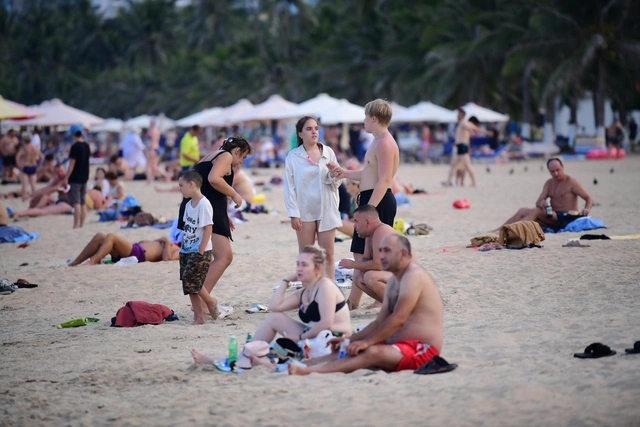
Russian tourists relax on Nha Trang Beach in Khanh Hoa Province, south-central Vietnam. Photo: Quang Dinh / Tuoi Tre
The Association of Tour Operators of Russia reported that more than 742,000 Russian travelers visited Vietnam in the first half of 2026, up 2.8-fold year on year.
Vietnam ranked fourth in package tour sales in Russia in July, with its market share rising from 4.6 percent to 7.8 percent in just one year, surpassing Thailand (4.7 percent) and China (4.3 percent).
According to the association, search interest in Vietnam among Russians reached 6.8 percent, compared to the last-year figure of 3.9 percent.
Russians spent nearly US$50 billion on outbound tourism in 2025, the second-highest level since 2001.
Industry insiders said the significance of the Russian market lies not only in visitor numbers but in Russians’ preference for long stays and spending on experiences rather than shopping.
A representative of Mövenpick Resort Cam Ranh, located in Khanh Hoa Province of south-central Vietnam, said Russian guests now outnumber South Koreans.
While Russians previously traveled mainly on package tours lasting five to 10 days, the resort has recently welcomed more independent travelers and family groups who plan their own itineraries and spend relatively well.
Martin Koerner, group commercial director of The Anam Group, said visitors from Russia and the Commonwealth of Independent States (CIS) have become one of the fastest-growing customer segments for the group's resorts.
In the first quarter of this year, Russian and CIS guests accounted for about 15 percent of total room nights across The Anam's properties.
Compared with the same period last year, Russian arrivals at The Anam Cam Ranh increased about 13-fold, while The Anam Mui Ne recorded growth of approximately 79 percent.
Koerner said the return of Russian tourists was driven by restored air connections.
Charter flights from Moscow to Vietnam’s Cam Ranh resumed in March 2025, followed by more routes to Phu Quoc, an island destination in southern Vietnam, making travel easier and boosting arrivals.
Vietnam’s combination of affordable long-stay packages, improving service quality, and safety has further strengthened its appeal.
Russian tourists typically stay between seven and 21 nights, favor beach resorts, and spend heavily on extras such as dining, spa, and wellness services.

A Russian couple visits Da Lat, a highland destination in Vietnam’s Lam Dong Province. Photo: Quang Dinh / Tuoi Tre
Nguyen Tran Hoang Phuong, head of the Institute of Social Tourism Research, said the recovery of the Russian market presents an opportunity for Vietnam to shift its focus from increasing visitor numbers to raising per-visitor spending.
“The value of the Russian market is in long stays and willingness to pay for experiences,” Phuong said.
“We need products that encourage spending beyond hotel rooms.”
Nguyen Duc Quynh, vice-chairman of the Da Nang Tourism Association and chairman of the Da Nang Hotel Association, emphasized that Russia should be viewed as a long-stay leisure market.
“In the past, Russian tourists mainly arrived on charter flights and package tours for extended beach holidays,” Quynh said.
“This time, we also need to focus on independent travelers, families, long-stay visitors, wellness tourists, those combining beach vacations with cultural exploration, and travelers seeking safe, reasonably priced winter destinations.”
Quynh said that Da Nang, a coastal destination in central Vietnam, is well positioned thanks to its beaches, luxury resorts, modern infrastructure, and the ability to connect attractions such as Hoi An, Hue, My Son Sanctuary, Ba Na Hills and Son Tra Peninsula into a broader tourism experience instead of offering only beach vacations.
In addition, language barriers are easing thanks to Russian-language training at local universities.
To attract Russian travelers in the long term, Quynh urged destinations to focus on three factors, including convenient air connectivity, quality long-stay accommodation, and services tailored to Russian visitors.
Le Truong Hien Hoa, deputy director of the Ho Chi Minh City Department of Tourism, highlighted new opportunities along the extended southern coastline from Long Hai, Vung Tau, Ho Tram to Con Dao.
He said the city is focusing on high-spending markets, training guides in Russian, and developing beach products for winter travelers seeking warm climates.








Max: 1500 characters
There are no comments yet. Be the first to comment.