


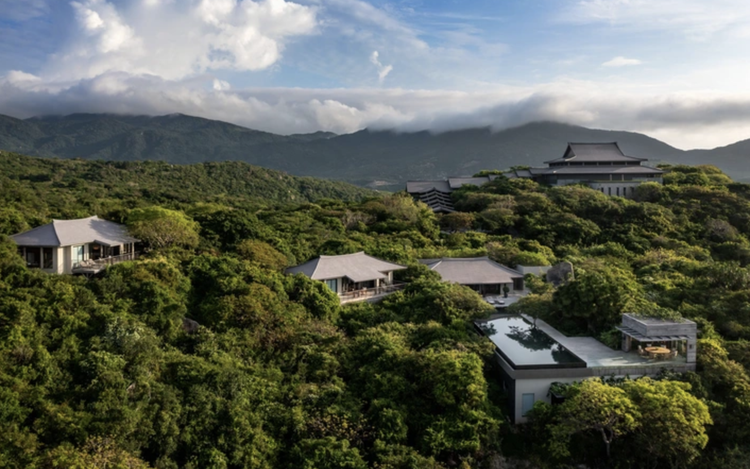
Many ultra-luxury tourism projects are being developed in Vietnam. Photo: Tuoi Tre
Vietnam's competitive advantage in tourism should lie in becoming a destination loved for the quality of its experiences, natural landscape preservation, and cultural identity protection rather than becoming the country that receives the largest number of visitors, according to Luc Van Nerom, co-founder of the Amanoi project in south-central Vietnam.
Therefore, tourism development should not be viewed as a choice between attracting more visitors and improving the quality of experiences.
He suggested that Vietnam build a balanced tourism ecosystem where economic growth goes hand in hand with environmental conservation, cultural preservation, and greater value creation for local communities.
The Belgian investor told Tuoi Tre (Youth) online newspaper that the country should not change its identity simply to meet the demands of any particular visitor market, even large ones.
“What attracts international travelers to Vietnam is its culture, its people, and unique experiences that they cannot find anywhere else,” he said.
“If we lose those values, we will also lose our competitive advantage,” he emphasized.
Tourism can create jobs, drive economic growth, and improve workforce skills.
However, if the industry focuses only on increasing tourist arrival figures while ignoring the carrying capacity of destinations, it risks destroying the very values that originally attracted travelers.
Tourism development requires a long-term vision, with coordination among state agencies, businesses, and stakeholders to determine appropriate scales for each destination rather than allowing uncontrolled market-driven expansion, he elaborated.
According to Amanoi’s co-founder, many people often associate luxury tourism with building more five-star hotels or resorts.
However, the true value of a high-end destination lies in the experiences it offers.
For the ultra-luxury hospitality segment, sustainable development is no longer an option but a prerequisite.
“An ultra-luxury resort cannot simply have beautiful rooms or flawless services.
“Its value also lies in how the project creates benefits for the land, the community, and nature.
“Without contributing sufficiently to these factors, it cannot truly be considered an authentic ultra-luxury product,” he said.
Over the next 10 to 20 years, Vietnam’s greatest opportunity is not becoming the country with the most tourists, but becoming a destination that is admired for the quality of its experiences, the diversity of its products, and its ability to preserve its natural, cultural, and unique identity.
“When a country can develop tourism while still protecting the things that define its identity, that is true long-term success,” he said.
Project built on quality, sustainability
After two decades of development, ultra-luxury resort Amanoi, located inside Nui Chua National Park in Ninh Thuan Province, has announced an additional investment of VND800 billion (US$30.4 million) for its second phase.
The expansion will bring the resort’s total number of rooms to 78, up from 68.
Amanoi once attracted significant attention in the resort real estate market when it introduced a three-bedroom villa priced at $15,000 per night.
Guests are required to stay for at least three nights, paying a total of VND1 billion ($38,000) for the experience.
As such, the resort’s decision to increase its number of rooms has drawn considerable interest.
Nerom said that despite having more than 90 hectares of land, Amanoi has no plans to exceed 90 rooms even in the long term.

Luc Van Nerom, co-founder of the Amanoi project in south-central Vietnam. Photo: H.K. / Tuoi Tre
Rather than simply expanding capacity, most of the new investment will focus on creating new experiences, including a Vietnamese cultural space called Vietnam House, family-oriented facilities, an executive conference center, and improved living conditions for employees.
“Growth does not necessarily mean having more rooms.
“We want to create more value within the same scale,” he said.
Amanoi currently has more than 400 employees serving 68 rooms.
“This ratio reflects our investment philosophy of prioritizing service quality rather than maximizing occupancy,” he stressed.
A sustainable destination must be built on a balance among different market segments rather than pursuing a single objective.
However, to put a new destination on the global tourism map, iconic products are essential.
The key is not choosing between luxury and mass tourism, but creating a reasonable balance among different segments, he underlined.
Millennials, Gen Z account for over 60% of ultra-luxury guests
Data from the resort show that consumption trends among high-end travelers are changing significantly.
Previously, luxury resort guests were mainly aged 50 to 60 and sought elegant, exclusive spaces.
Today, more than 60 percent of Amanoi’s guests belong to the Millennial and Gen Z (born from around 1997 to 2012) generations.
The new generation of luxury travelers no longer defines luxury through material possessions or extravagance.
Instead, they seek authentic experiences and memorable moments.
During the first half of 2026, Vietnam welcomed 12.3 million international visitors, rising by 14.9 percent year on year and nearly reaching half of the full-year target.
The tourism industry aims to attract a total of 25 million international travelers this year.








Max: 1500 characters
There are no comments yet. Be the first to comment.