


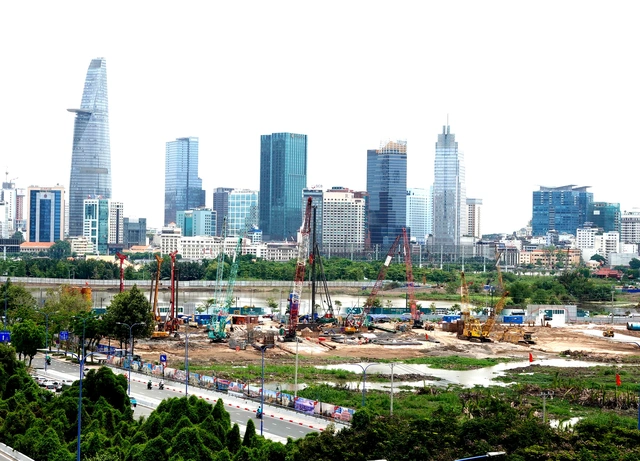
The construction site of the new administrative center and central lake park in Thu Thiem, Ho Chi Minh City. Photo: T.T.D. / Tuoi Tre
According to data from Vietnam’s Department of Customs, the country recorded a merchandise trade deficit of US$2.77 billion in the first half of June.
As of June 15, the country had accumulated a record trade deficit of $16.8 billion, marking six and a half consecutive months of negative trade balances.
From January to June 15, total trade reached $496.6 billion, up 27 percent year on year.
Exports rose 21 percent to $239.9 billion, while imports jumped 33.1 percent to $256.7 billion. This contrasts sharply with the same period in 2025, when Vietnam posted a surplus of nearly $5 billion.
During previous high-growth cycles, Vietnam’s demand for imported machinery, components, raw materials, and energy rose sharply.
Despite Vietnam’s efforts to localize supply chains, its economy remains heavily dependent on imports, making trade deficits a recurring feature of rapid expansion.
A prolonged deficit increases demand for foreign currency, potentially pressuring exchange rates and foreign reserves.
Rising import costs for fuel and equipment could feed into higher domestic production costs, creating inflationary risks.
The deficit is most pronounced among domestic firms.
During the first five months of 2026, the domestic sector exported $42.9 billion worth of goods, down 13.7 percent from a year earlier, while imports rose 1.4 percent to $62.9 billion. This resulted in a trade deficit of $20.03 billion, significantly higher than the $12.37 billion recorded during the same period last year.
This reflects local businesses’ weak competitiveness and limited participation in global supply chains.
Meanwhile, the foreign-invested sector continues to drive Vietnam’s exports.
Export turnover from foreign-invested enterprises reached $172.4 billion, up 31.9 percent.
However, imports by the sector also surged 44.8 percent to $164.5 billion, reducing its trade surplus from $17.1 billion to $7.88 billion.
Import data indicate that most of the increase is linked to production and investment activities rather than consumer demand.
While this may signal healthy economic expansion, economists cautioned against overlooking deeper structural weaknesses that have persisted for decades.
One of the most significant concerns is Vietnam’s continued dependence on external sources of capital, technology, export markets, and production inputs.
The trade deficit also reflects an imbalance between savings and investment.
Investment should be financed by domestic savings.
When investment expands faster than national savings, the economy must rely on external resources, often leading to current account deficits.
To sustain high growth while maintaining macroeconomic stability, Vietnam should maintain investment at 35-37 percent of GDP, improve capital efficiency, reduce the incremental capital-output ratio, prioritize high-impact public investment projects, and avoid wasteful spending.
The country is also recommended to raise national savings back to approximately 35-37 percent of GDP, strengthen the domestic private sector, support businesses’ participation in regional and global supply chains, expand supporting industries, and promote greater localization of production.
Future foreign direct investment policies should focus more on technology transfer, local supplier development, and stronger integration of Vietnamese companies into global value chains.
At the same time, authorities are encouraged to maintain adequate foreign exchange reserves, allow greater exchange-rate flexibility, coordinate monetary and fiscal policies effectively, and keep budget deficits within safe limits to safeguard economic stability as growth accelerates.
* This article was originally written in Vietnamese by Do Thien Anh Tuan from the Fulbright School of Public Policy and Management.








Max: 1500 characters
There are no comments yet. Be the first to comment.