



A series of securities companies recorded declines in customer deposits in the second quarter of 2026. Photo: Huu Hanh / Tuoi Tre
The Q2/2026 picture of Vietnam's stock market showed investors' idle cash held at securities firms declining in tandem.
A Tuoi Tre (Youth) online newspaper's review of financial statements from more than 20 securities companies found that most of the firms recorded lower customer deposit balances compared to the end of the first quarter of 2026.
Investor deposits shrink across the board, VPS falls most
In percentage terms, Yuanta Securities Vietnam posted the steepest decline, with customer deposits down nearly 50 percent in just one quarter.
In absolute terms, however, VPS Securities Joint Stock Company recorded the largest drop. Customer deposits at VPS fell by some VND8.85 trillion to VND14.449 trillion by the end of June 2026.
While VPS remains the securities firm holding the largest volume of investor deposits in the market, its lead over second-ranked Techcom Securities Joint Stock Company (TCBS) has narrowed, as TCBS saw its deposit balance decline by only around 12.68 percent quarter-on-quarter.
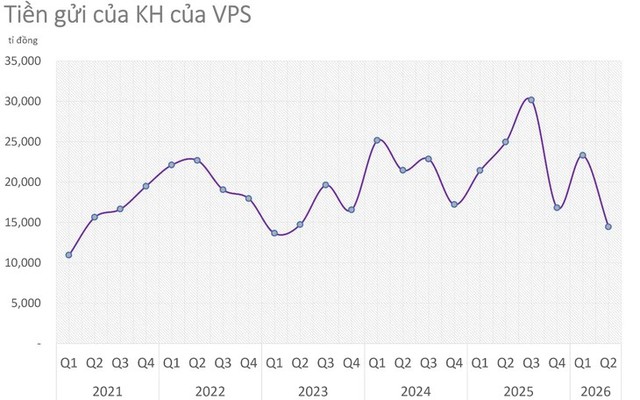
Investor deposits at VPS have fallen to their lowest level since the first quarter of 2023. Unit: billion VND
According to FiinTrade, total investor deposits at securities companies fell 25.9 percent quarter-on-quarter in Q2/2026 to around VND86.6 trillion, the lowest level in four quarters.
Compared to the historical peak set in the third quarter of 2025, investor deposits have dropped by more than VND52.3 trillion, or 37.7 percent.
FiinTrade said the trend indicates that the additional buying power available from cash reserves is no longer as abundant as before, at a time when outstanding margin lending in the market remains elevated.
What can securities firms do with investor deposits?
Under current regulations, securities companies are not permitted to accept deposits and pay interest to investors the way banks do.
The State Securities Commission has taken firm action to address and rectify the practice of raising investor capital to pay interest in a bank-like manner.
In practice, however, demand for such products persists in the market, particularly during periods of weak market momentum and limited trading opportunities.

Speaking to Tuoi Tre, the head of brokerage at a traditional-model securities firm said the market has changed considerably compared to previous years.
"There is no longer a clear boundary between banks and securities companies, as many securities firms now operate within banking ecosystems," the source said.
"If customers leave their money in a securities account, they earn no interest, but with just a few steps they can transfer it immediately to the parent bank to earn interest.
"This inadvertently puts securities companies that operate independently at a disadvantage."
The company representative expressed hope that money market fund (MMF) products would soon be rolled out.
Such products are already common in developed markets, allowing investors' idle cash to be invested in highly safe assets that can be quickly converted to cash when trading needs arise.
Once such products are developed in an integrated way on trading platforms, investors will no longer need to choose between leaving cash idle in a securities account or moving it to a bank to earn interest.
Regulators have paved the way for MMFs since early 2026
Regulators laid the groundwork with Circular 136/2025/TT-BTC in early 2026.
Under the circular, MMFs were brought into a legal framework for the first time, with a requirement that at least 80 percent of net asset value (NAV) be invested in highly safe assets such as deposits, certificates of deposit, and government debt instruments.
At the same time, infrastructure bond funds were also given a formal legal basis for establishment, aimed at creating an additional channel for medium- and long-term capital for key infrastructure projects.
Under the regulations, at least 65 percent of a fund's NAV must be allocated to infrastructure project bonds, helping diversify the range of fund products and ease pressure on state budget capital mobilization.








Max: 1500 characters
There are no comments yet. Be the first to comment.