


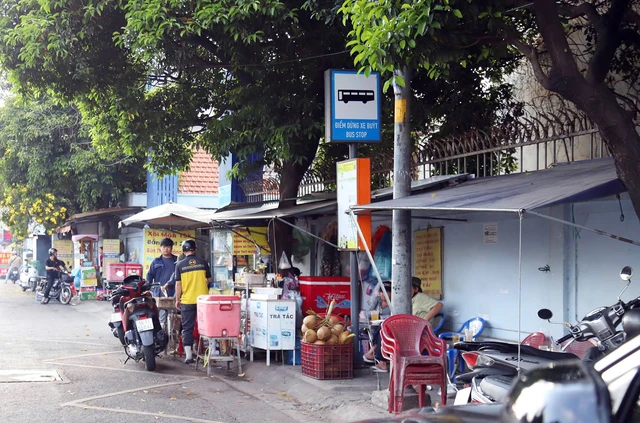
A bus stop is squeezed between encroaching food stalls on Che Lan Vien Street in Tay Thanh Ward, Ho Chi Minh City. Photo: Ngoc Lan
Editor's note: As cities across Vietnam tighten enforcement of sidewalk regulations, discussions over public space, street culture, and urban order have resurfaced. In this commentary, Dr. Pham Hoa Hiep draws on his experiences living and traveling abroad to reflect on what makes Vietnam’s sidewalks distinctive, and whether greater order must come at the cost of the vibrant street life that gives Vietnamese cities their character.
The piece is translated and edited by Tuoi Tre News.
The smell of food from tiny roadside stalls mingles with people calling out to one another, creating something distinctly Vietnamese in urban life: lively and intimate.
Morning, afternoon, or even late at night in major cities, sidewalks are never empty. Someone is eating a steaming bowl of pho on a low plastic stool. Someone else is slowly sipping coffee or iced tea beneath the shade of a tree. Others clink beer glasses and laugh amid the sounds of motorbikes and street vendors.
Where streets have soul
Celebrated food writer and TV host Anthony Bourdain once said that what he loved about Vietnam was the feeling that life was always present on the streets, where people could sit on a low plastic chair, eat a hot bowl of noodles, and watch the whole city move around them.
Many of my foreign friends who visit Vietnam say the streets here have 'a soul.' Some tell me what they love most is that something always seems to be happening outside.
Simply sitting on a street corner is enough to watch life unfold before your eyes.
By contrast, cities in New Zealand and many Western countries are far cleaner, more orderly, and better organized. Yet sometimes that very order creates a sense of excessive quietness.
Wide roads and spacious sidewalks, but with few voices and little human activity, make urban spaces feel colder.
As someone who loves city life and sidewalk cafés, I always miss the atmosphere of Vietnamese streets when I am away, even if it sometimes means squeezing through rows of parked motorbikes blocking the way, dodging street vendors spilling into the road, or carefully stepping around tables and chairs placed right along the curb where diners sit.
I understand that behind those street stalls are livelihoods, the everyday struggles of people trying to survive in expensive cities.
I remember once walking into a bar with my daughter in a tourist city in New Zealand.
Seeing empty tables and chairs on the sidewalk outside, we sat down. But a few minutes later, a staff member came over and politely said: "Sorry, this area hasn't been licensed for use yet, so we'd like to invite you to sit inside."
I was surprised. The tables were only a few meters from the entrance, yet there seemed to be a very clear boundary: what was public space, and what was space legally permitted for business use.
Later I learned that even placing a few tables and chairs on the sidewalk required businesses to obtain permission from local authorities, pay fees, and comply with regulations on safety, hygiene, and pedestrian access.
A friend of mine who owns a pho restaurant in the city where I live also told me that he had to pay for every set of tables and chairs placed outside, and comply with regulations regarding sanitation and alcohol service.
These days, in some places, many Vietnamese businesses have had to reduce their space or switch to takeout as cities tighten urban order regulations. Some have lost a significant portion of their revenue because outdoor seating is no longer allowed.
But everyone cannot just simply take over public space as they wish. When pedestrians are forced into traffic lanes, when elderly people, people with disabilities, or parents pushing strollers have to navigate through motorbikes and scattered tables, sidewalks no longer function as public spaces.
And when everything runs on informal flexibility, eventually those who follow the rules are the ones who lose, while those who encroach more gain more.
Legalization, regulation
Sidewalk economies are undoubtedly a unique part of urban life. They are not simply about commerce or survival, but a form of street culture deeply embedded in many cities.
For many low-income workers, a few square meters of sidewalk can mean an opportunity to survive in increasingly expensive urban environments.
But that does not mean sidewalks should be left to whoever claims them first.
Many countries do not eliminate street economies entirely. Instead, they legalize and regulate them through clear rules.
In Australia, businesses can still use part of the sidewalk for outdoor seating, but only with permits, fees, and strict standards.
Singapore once had sidewalks overflowing with street vendors, much like many Asian cities, but authorities gradually moved them into properly planned and regulated hawker centers.
Across many European cities, businesses are allowed to legally lease portions of sidewalks, provided they maintain pedestrian access and meet strict urban standards.
The common thread in these models is that they do not see street vendors or sidewalk economies as something to erase. They see them as part of urban life that deserves transparent and stable management.
Keeping the soul without losing the order
Every country has its own urban history, population density, and street culture. Vietnam cannot simply copy another model wholesale.
Still, perhaps we can begin with practical changes. In central districts such as the former District 1 in Ho Chi Minh City or Hoan Kiem in Hanoi, wider sidewalks could legally allow outdoor seating through permits, fees, and clearly defined pedestrian pathways.
Narrow alleyways, meanwhile, should return to their intended purpose.
Cities could also develop better-planned street food zones where vendors preserve the familiar sidewalk atmosphere while benefiting from parking areas, improved sanitation, and an end to chaotic ‘competition’ over space.
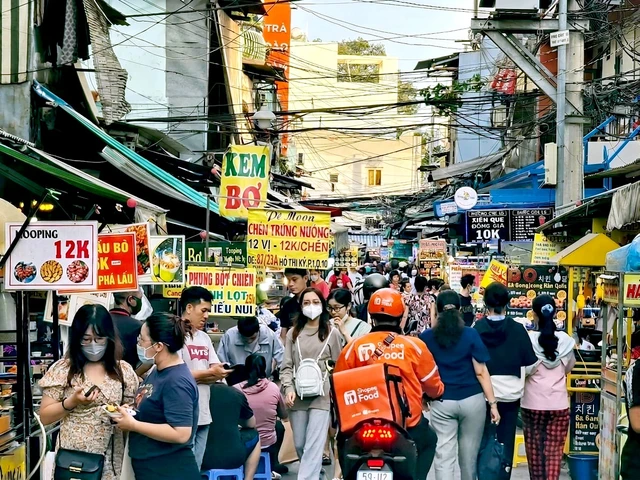
A bustling and lively street food area in Ho Chi Minh City. Photo: Nhat Xuan/ Tuoi Tre
It would be sad if one day every sidewalk became spotless, yet cold and identical. Perhaps many Vietnamese people, like me, are not afraid of losing a few plastic stools on the sidewalk. They fear losing the feeling that the city still belongs to people.
But a city that truly belongs to people must also be a place where people can walk without stepping into the road.
- REFERENCE MORE








Max: 1500 characters
There are no comments yet. Be the first to comment.