


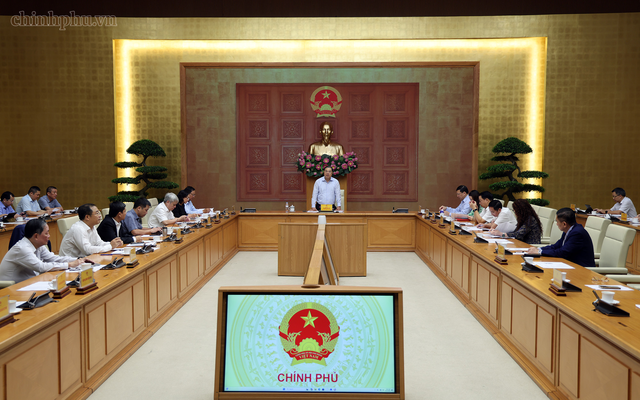
Standing Deputy Prime Minister Pham Gia Tuc meets with leading associations and businesses in the agriculture, forestry, and fisheries sectors. Photo: Chinhphu.vn
On Friday, Standing Deputy Prime Minister Pham Gia Tuc met with leading associations and businesses in the agriculture, forestry and fisheries sectors. Participants discussed the gap between Vietnam’s rising durian output and the value it generates, as well as the need to shift from increasing production to improving quality and export value.
Vietnam's durian output exceeds Thailand's, but value remains lower
Deputy Minister of Agriculture and Environment Vo Van Hung said Vietnam’s agricultural, forestry and fisheries exports were estimated at US$56.3 billion in the first nine months of 2026, up nearly 8 percent year on year, with a trade surplus of about $16.9 billion.
Wood and wood products continued to provide a stable source of export revenue, while seafood maintained its growth momentum and fruit and vegetables emerged as one of the key growth drivers.
However, growth was uneven across sectors. Some commodities saw higher export volumes but lower export value.
Coffee exports, for example, rose by more than 15 percent in volume, while export turnover fell by more than 7 percent as average export prices declined.
Rice, rubber, cassava and cassava products also recorded declines in export value.
To achieve its full-year agricultural export target of more than $74 billion, the Ministry of Agriculture and Environment will focus in the final three months of the year on maintaining growth in three key groups, including wood and wood products, seafood, and fruit and vegetables, while addressing difficulties facing sectors that are falling short of their targets.
For seafood, the focus will be on shrimp and pangasius, along with quality control, supply-chain safety, efforts to address illegal, unreported and unregulated fishing, and trade defense measures.
For fruit and vegetables, particularly durian, authorities will tighten management of growing-area codes, packing facilities and product quality.
At the meeting, businesses and industry associations called for a shift from increasing production to improving the quality, value and global position of Vietnamese agricultural products.
A key concern raised at the meeting was that higher production and export turnover do not necessarily translate into a corresponding increase in value. Durian was cited as a notable example.
Le Vu Tuan Anh, deputy general director of Chanh Thu Co., said Vietnam’s durian output had increased about threefold in five years, even surpassing Thailand’s, but the value generated remained lower.
Notably, the company’s processing experience showed that the share of high-quality durians had fallen sharply, while the proportion of lower-quality produce had increased.
The causes were linked not only to weather conditions but also to over-harvesting, the use of agricultural inputs and weak links across the supply chain.
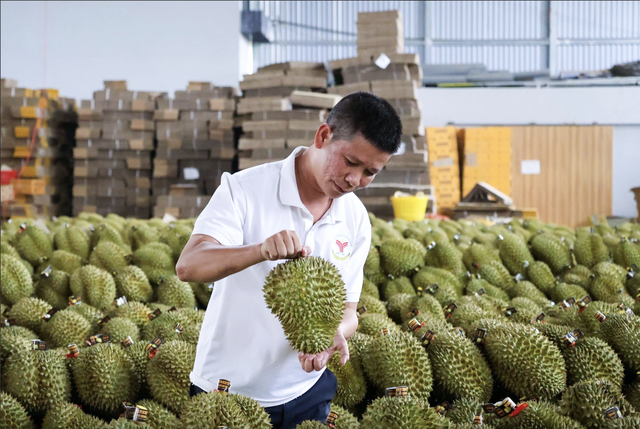
Durian exports were estimated at $2.27 billion in the first eight months of the year. Photo: Minh Phuong / Tuoi Tre
Cutting red tape
Concluding the meeting, Standing Deputy Prime Minister Pham Gia Tuc emphasized that developing the agriculture, forestry and fisheries sectors should not be aimed solely at increasing export turnover, but also at building a modern, ecological and high-value-added agricultural sector and promoting sustainable development.
The agriculture sector therefore needs to shift decisively from production-driven growth toward improving quality, deep processing, branding, science and technology, and innovation.
“More importantly, the model needs to shift from producing and supplying goods before looking for export markets to researching markets first and then organizing raw-material areas, controlling varieties and inputs, standardizing production, carrying out deep processing, building brands, organizing international distribution, and maintaining and expanding market share,” Tuc said.
The Standing Deputy Prime Minister also called for management reforms based on value-chain and industry-wide governance, with production and export efficiency, competitiveness and producers’ incomes serving as key measures of performance.
Management should gradually shift from administrative methods to data-driven digital management, with a national data system covering production, processing, logistics and markets to improve forecasting and policy management.
On this basis, the agriculture, forestry and fisheries sectors are targeting $100 billion in export turnover by 2030, with the possibility of reaching the goal earlier if implementation proceeds effectively.
Regarding proposals raised at the meeting, Tuc assigned the Government Office to compile them and forward them to relevant ministries and agencies for consideration and handling within their authority.
The government will also continue to streamline administrative procedures, improve the business environment and, in particular, reduce unofficial costs.









Max: 1500 characters
There are no comments yet. Be the first to comment.