



Nguyen Thi Thien Phuong, deputy head of the Vietnam Environment Agency, speaks at a press briefing on haze in southern Vietnam, September 16, 2026. Photo: C.Tue / Tuoi Tre
Speaking at a press briefing held in Hanoi on Wednesday, Mai Van Khiem, head of the National Center for Hydro-Meteorological Forecasting, explained that visibility in some areas across southern Vietnam had decreased to mild or moderate levels.
In addition, weak winds reduced the dispersion of pollutants, while a light temperature inversion in the atmosphere further trapped particles near the ground.
“In theory, these factors make the air appear hazy, though not reaching the threshold of fog,” Khiem said.
He added that fog typically occurs during seasonal transitions, especially in winter, and usually forms overnight or in the early morning.
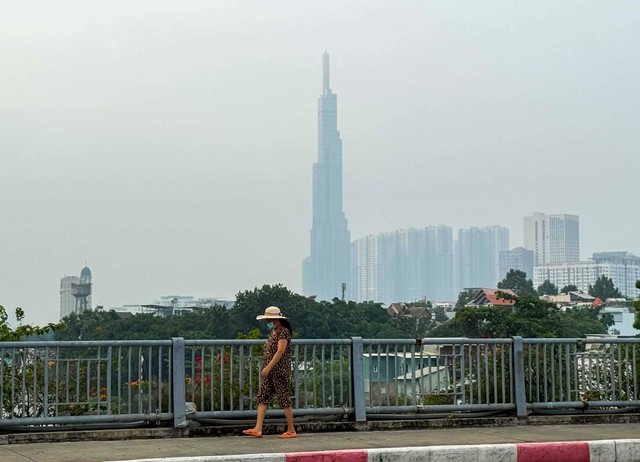
The sky in Ho Chi Minh City appears hazy at noon on September 16, 2026. Photo: Le Phan / Tuoi Tre
Nguyen Thi Thien Phuong, deputy head of the Vietnam Environment Agency, said that haze can result from multiple influences, including humidity, meteorological conditions, temperature inversion, and emissions.
Phuong emphasized that further analysis of environmental data, including fine dust levels (PM2.5 and PM10), is needed to determine the exact cause.
She said air quality indexes in southern provinces and cities have recently been rated ‘poor’ but not at dangerous levels.
The Vietnam Environment Agency will continue monitoring and evaluating air quality in the region.








Max: 1500 characters
There are no comments yet. Be the first to comment.