


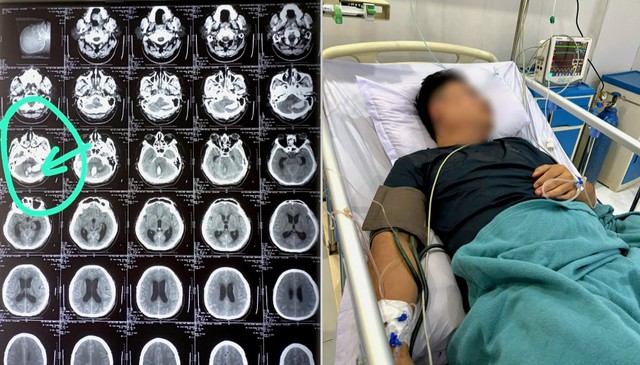
A hospital-supplied photo shows CT scans revealing a large cerebellar hemorrhage near the brainstem, alongside with photo of Nguyen Hoang Phuong during the critical days of his treatment in Vietnam.
Seeing Nguyen Hoang Phuong from northern Quang Ninh Province back in the classroom today, resuming his work and even driving his wife to the hospital for the birth of their third child, few would imagine that just six months ago he was fighting for his life after a devastating hemorrhagic stroke.
A sudden headache at midnight
Phuong, a 40-year-old Vietnamese language teacher and interpreter from Quang Ninh working in Laos, had previously been diagnosed with hypertension.
However, believing he was still young and in good health, he did not take his medication regularly.
Around midnight one day in December 2025, he suddenly developed an excruciating headache accompanied by repeated vomiting.
His wife, Van Anh, rushed him to the hospital. He was admitted to two private hospitals in Laos in succession.
CT scans revealed a large cerebellar hemorrhage that compressed the brainstem and blocked the flow of cerebrospinal fluid, causing acute hydrocephalus.
His condition worsened by the hour as he gradually lost consciousness.
Van Anh then requested that her husband be transferred to Lao Military Hospital 103.
Despite two days of conservative treatment, his condition continued to deteriorate and he fell into a deep coma. Doctors gave him a very guarded prognosis.
Van Anh then determined to make the biggest decision of her life, bringing her husband back to Vietnam, after listening to doctors' warnings that the mountainous journey from Laos could prove fatal because of the constant jolts and changes in altitude.
Emergency cross-border clearance procedures were completed overnight. An ambulance took Phuong to Nghe An General Hospital in the eponymous province for initial stabilization before the journey resumed to Hanoi.
Over more than 1,000 kilometers and through five hospitals, a deeply unconscious man lay in the ambulance while his young wife never once let go of his hand.
Upon arriving at the Stroke Center of Bach Mai Hospital in Hanoi, Phuong remained in a deep coma with a Glasgow Coma Scale score of just eight, indicating a severe brain injury.
Without emergency decompression, his chances of survival were almost non-existent.
Back from the brink
The medical team immediately initiated emergency neurocritical care.
Doctors performed an external ventricular drainage to relieve acute hydrocephalus, rapidly reducing intracranial pressure and relieving compression of the brainstem.
According to Dr. Nguyen Tien Dung, deputy director of the Stroke Center at Bach Mai Hospital, a large cerebellar hemorrhage accompanied by coma is among the most critical forms of stroke.
The line between life and death can sometimes be measured in minutes, he said.
What gave the patient a chance to survive was the venue’s comprehensive, closed-loop treatment model, Dung added.
"From diagnosis and external ventricular drainage to neurocritical care, every step was carried out within the Stroke Center, without losing valuable time to patient transfers,” he said.
“We never give up on any patient, even when the chance of survival is only one percent.”
Following the intervention, the brain injury stopped progressing.
Phuong responded well to intensive care, gradually regained consciousness, was taken off the ventilator, and steadily recovered his neurological functions, much to the relief of his family.

A supplied photo shows Nguyen Hoang Phuong with his family following his recovery from the life-threatening stroke.
Six months after surviving the life-threatening stroke, Phuong has returned to Laos, where he has resumed teaching Vietnamese and working as an interpreter while caring for his family.
More recently, he drove his wife to the hospital to give birth to their third child and personally cared for her and their newborn in the days following the delivery.
A family that had seemed on the verge of falling apart was kept together by a wife's refusal to give up and the relentless efforts of doctors and nurses to save her husband's life.
Expert recommendations to reduce risk of stroke
Do not stop taking blood pressure medication without medical advice
High blood pressure is the leading cause of ruptured blood vessels in the brain, resulting in brain hemorrhage or cerebellar hemorrhage. Blood pressure returns to normal because of medication, not because the condition has been cured. Stopping medication on your own is a common mistake, particularly among younger patients.
Stroke is affecting younger people
Stroke is no longer a disease that affects only older adults. People between the ages of 30 and 45 who experience chronic stress, lead a sedentary lifestyle, smoke, or drink heavily are also at risk. Regular blood pressure checks and screening for stroke risk factors are essential.
Recognize stroke symptoms using the BE FAST rule
Doctors also recommend using the BE FAST rule to recognize the warning signs of stroke: sudden loss of balance or coordination (Balance), blurred or double vision or sudden vision loss (Eyes), facial drooping (Face), weakness or numbness in a limb (Arms), slurred speech or difficulty speaking or understanding speech (Speech), and acting quickly by calling emergency medical services (115 in Vietnam) immediately while noting the time the symptoms first appeared (Time).
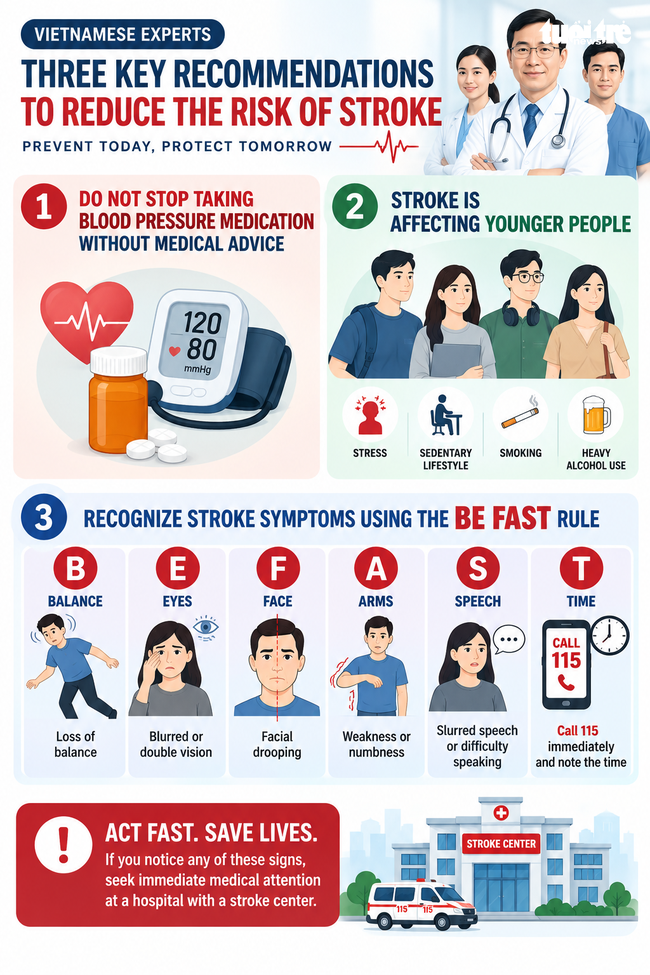
Illustration generated by AI








Max: 1500 characters
There are no comments yet. Be the first to comment.