


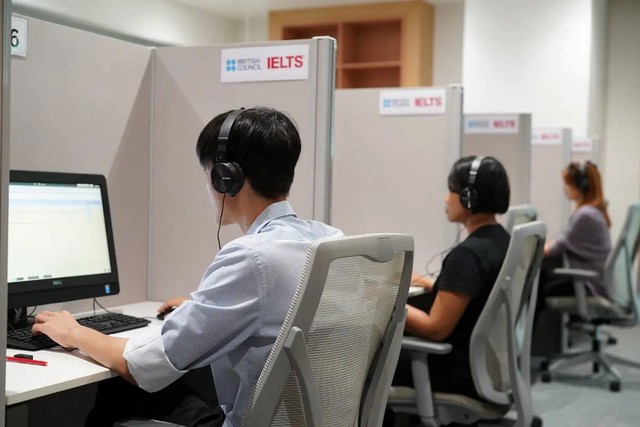
IELTS candidates. Photo: B.C. / Tuoi Tre
But an IELTS certificate should not be pursued simply to earn extra admission points.
The key question is how universities can recognize students' English proficiency without turning the certificate into an advantage unrelated to their chosen field.
The Ministry of Education and Training's proposal to remove university admission-specific bonus points for IELTS certificates from 2027 has received support from many people.
However, some parents and students worry that those who have spent years preparing for the test could be disadvantaged and that students' motivation to learn English could decline.
In my view, the ministry's proposed adjustment is necessary.
But the policy should clarify three issues: why the current bonus-point system is unfair, how IELTS scores will continue to be used, and how the interests of students who have already prepared under previous admission rules will be addressed.
The draft does not eliminate IELTS scoring from university admissions.
The certificate can still be converted into an English subject score, used as an entry requirement for English-taught programs, or recognized for course exemptions and graduation requirements.
What would be removed is the additional bonus score set independently by each university.
What is IELTS actually for?
The IELTS test is designed to assess English proficiency.
But when its score is added to a student's overall admission score, the certificate can become an advantage even for programs that do not use English as an admission subject.
For example, if a program admits students based on mathematics, physics and chemistry, a student with higher scores in those three subjects could still rank below another student with lower scores after the latter receives an IELTS bonus.
If English is already included in an admission combination and an IELTS certificate is also awarded bonus points, the same ability is effectively being recognized twice.
According to the Ministry of Education and Training, an IELTS score of 6.0 has been assigned 26 different bonus-point levels by universities.

This means the same level of English proficiency can have different admission values from one university to another, while even a fraction of a point can affect admission chances.
Students who achieve high IELTS scores have invested significant time and effort, and that achievement should be recognized.
However, international language tests also cost money.
Students in cities have greater access to language centers, teachers and opportunities to retake the test, while those in remote areas or from financially disadvantaged families may have to carefully consider the cost of each attempt.
When the IELTS test becomes a decisive source of bonus points, differences in financial circumstances can translate into differences in university admission opportunities.
That does not mean students with IELTS certificates are less deserving.
Fairness does not mean denying their efforts.
It means ensuring that applicants to the same program are assessed according to criteria relevant to that program.
Concerns that students could lose motivation to study English therefore have some basis, particularly as the government is implementing a scheme to make English a second language in schools.
How can IELTS be recognized?
Nearly every profession now requires foreign-language skills.
But if English is needed across fields, the answer is not necessarily to award bonus points to students with certificates.
Instead, universities should establish appropriate English-language standards and ensure students have access to quality English education.
Students should not be motivated to learn a foreign language solely by the prospect of gaining a few extra admission points.
If English is studied mainly to gain an advantage in university admissions, learning can remain focused on test preparation rather than actual language use.
To make English a second language, Vietnam needs good teachers, regular opportunities to use English and relatively equal access to quality language education across regions.
International experience also shows that English is often used as an admission requirement rather than a source of bonus points.
The University of Melbourne accepts multiple ways of demonstrating English proficiency, while the Hong Kong University of Science and Technology sets an English-language threshold because English is the language of instruction.
Applicants must meet academic requirements while also reaching the required language standard.
This approach could be considered in Vietnam.
The IELTS test would not be eliminated, and English proficiency would not be undervalued, but the certificate would not become an advantage unrelated to the field of study.
Universities could still recognize students' language proficiency by granting course exemptions, scholarships or opportunities for international study.
The Ministry of Education and Training should also avoid simply changing the name of the mechanism without changing its substance.
If IELTS conversion rules are overly generous, bonus points could simply be replaced by converted scores.
A reliable framework for converting English test scores and other recognized certificates is therefore needed.
Programs that genuinely require foreign-language skills could set higher standards, but these requirements should be announced early and clearly.
The final regulations should also take into account students applying to universities in 2027, many of whom may have started preparing for the IELTS test in Grade 10 or 11 based on admission information available at the time.
An inappropriate mechanism should not be maintained simply because students have built expectations around it.
At the same time, certificates students have already earned can still be used to convert English scores, meet language requirements, qualify for course exemptions or apply for scholarships.
The question is straightforward: should the IELTS test confirm that a student can use English, or should it give that student an advantage when applying to a program that does not require English?
Removing IELTS bonus points does not necessarily conflict with the goal of improving English proficiency.
It could instead return the certificate to its intended role while helping create a more transparent university admission system.
* This article is authored by Nguyen Tuan Quynh, who wrote it in Vietnamese. Tuoi Tre News provides the English translation.








Max: 1500 characters
There are no comments yet. Be the first to comment.