


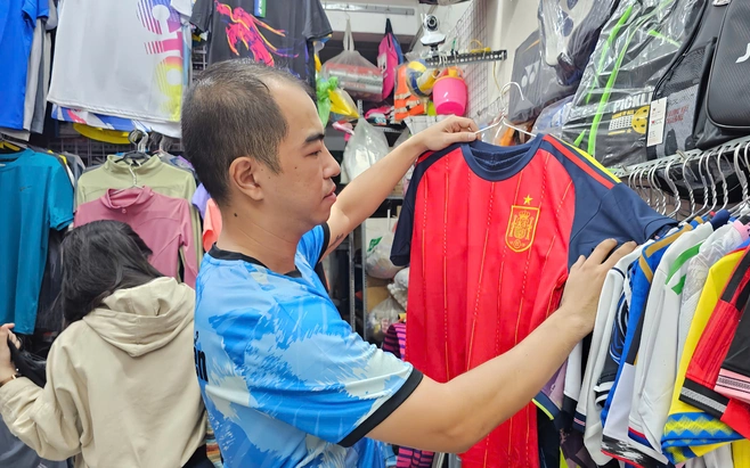
Many jerseys at P.H.Q.’s store in Ho Chi Minh City were stocked well before the 2026 World Cup began, but demand has remained slow. Photo: Truong Linh
Along several sportswear retail streets in Ho Chi Minh City, football jerseys are available in a wide range of designs and styles but consumer demand has been relatively slow.
Retailers wary of unsold stock
Nguyen Minh Kien, a 27-year-old office worker and avid football fan in Ho Chi Minh City, said he purchased a jersey this year for match-viewing gatherings with friends, but opted for a design versatile enough to wear well beyond the tournament.
“I used to buy national team jerseys on impulse, but after the tournament I almost never wore them again. This year I chose a simple design costing just over VND100,000 [US$3.8] so I can continue wearing it for football games or sports activities later,” he said.
Kien added that his group of friends agreed to wear the same jersey for major matches this year instead of each person choosing a different design as in previous tournaments.
According to sportswear retailers, sales usually rise significantly only shortly before the opening match and when the tournament reaches the knockout stages.
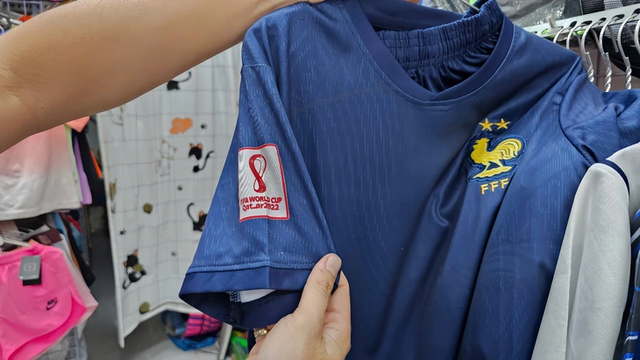
Many products remain unsold from the 2022 World Cup, making retailers hesitant to import large quantities. Photo: Truong Linh
After the competition ends, leftover inventory is often difficult to sell.
P.H.Q., owner of a sportswear store on Huyen Tran Cong Chua Street in Ben Thanh Ward, said his shop still has jerseys from the previous World Cup representing teams such as France and England.
Learning from experience, he no longer imports large quantities of merchandise. If stock remains unsold, he said, it may take another four years before demand returns during the next World Cup.
“I only dare to stock jerseys of teams with large fan bases such as France, Germany, and Brazil, priced at VND100,000-120,000 [$3.8-4.6]. I bring in around 20 sets at a time, but customer traffic has not increased much,” he said.
Another sportswear retailer on the same street, T.V.T., said he had abandoned the practice of making large speculative purchases.
“This year I only bring in small quantities and monitor market demand before ordering more," he said.
"In the past, whenever the World Cup atmosphere became lively, I would import hundreds of jerseys, but by the end of the tournament many shirts from teams eliminated early were still left unsold. World Cup jerseys are highly seasonal and become difficult to sell once the event ends."
According to T., the expansion of the 2026 World Cup to 48 teams and the scheduling of many matches at late-night hours have made the tournament atmosphere less vibrant than in previous editions.
“Customers are not buying too early. Most wait until teams have played a few matches or until the knockout rounds before deciding whether to make a purchase,” he added.
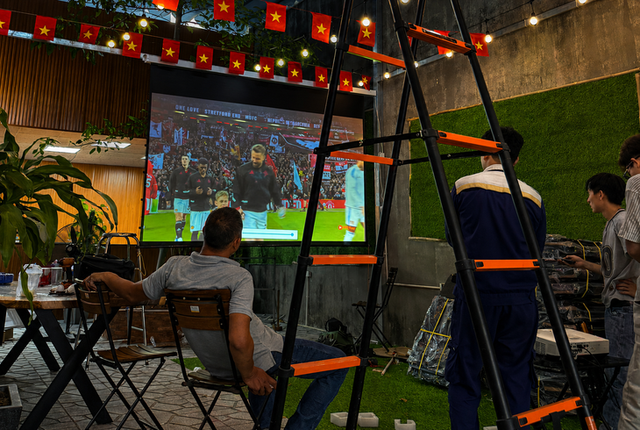
A large projector is installed at a café in Ho Chi Minh City. Photo: D.B.
At the premium end of the market, a survey at an Adidas store found that official jerseys continue to sell relatively well despite prices being much higher than mass-market products.
Fan versions are currently priced at around VND2.2 million ($83.6), while authentic match versions cost as much as VND3 million ($114.1).
According to store staff, most buyers are long-time supporters or collectors.
“Many customers are willing to pay because of the quality, the designs identical to those worn by players, and the fact that they can continue wearing them as sports fashion items rather than only for seasonal support,” a store employee said.
In addition to traditional retail channels, many merchants have expanded online sales to generate additional revenue during the World Cup season.
T., a sportswear retailer on Huyen Tran Cong Chua Street, said his online sales through social media currently average about 10 jerseys per day, outperforming in-store traffic.
Online shopping platforms also show strong demand for World Cup-related products.
Some online stores selling football jerseys have recorded more than 1,200 orders even though the 2026 World Cup has only recently begun.
In addition to sportswear retailers, garment workshops and custom-printing businesses have also joined the online marketplace to capitalize on tournament-related demand.
Cafés invest in projection systems to attract customers
Beyond the jersey market, many cafés in Ho Chi Minh City have been upgrading their facilities and installing large-scale projection systems to capitalize on football fans gathering to watch matches.
Nguyen An, owner of a café on Hoang Hoa Tham Street, said he invested more than VND10 million ($380.2) in a projector system with a screen measuring nearly 150 inches about a month before the tournament began.
Similarly, Pham Van Duc, owner of a café on Tran Hung Dao Street in Cau Ong Lanh Ward, said his business installed a projector system about a week before the World Cup started.
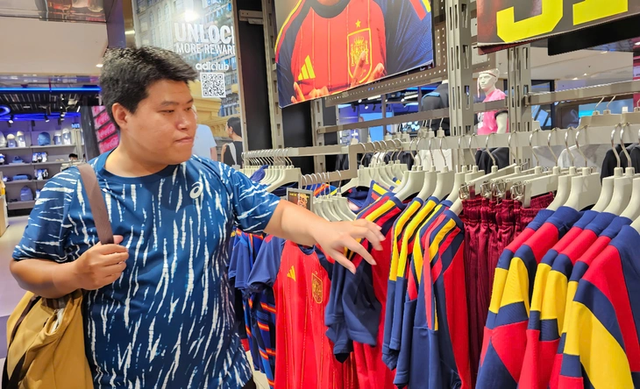
Customers shop for Spain national team jerseys at an Adidas store in Saigon Centre in Ho Chi Minh City. Photo: Truong Linh
In addition to football viewing areas, the café arranged parking facilities and staff to serve customers.
According to Duc, the investment is intended not only for the World Cup but also for other sporting events throughout the year.
“If customer numbers double, that would be great. Even an increase of around 50 percent compared to normal days would already be encouraging,” he said.
Online listings seeking to buy or sell projectors have also increased ahead of the tournament.
Do Bach, who has been selling projectors online in Ho Chi Minh City for more than six years, said inquiries have increased three to four times compared to normal levels, mainly from cafés and pubs.
According to Bach, most businesses prefer used projectors because of their lower cost.
Popular models suitable for screens of around 130 inches, with a brightness of 5,000 ANSI lumens and Full HD+ resolution, are currently priced at about VND13 million ($494.4), while new units with similar specifications can cost VND40-50 million ($1,521-1,901).
“The World Cup lasts just over a month. During the rest of the year many venues may not use projectors frequently, so owners often choose second-hand equipment to reduce investment costs and improve capital efficiency,” he said.








Max: 1500 characters
There are no comments yet. Be the first to comment.